Table Of Content
Related Posts
How to Prevent Sensitive Data Leaking to GenAI Tools
-
July 10, 2026
-
Quick summary :
Autonomous AI agents are quietly becoming one of the most significant data security blind spots in enterprise environments today. Unlike a human employee who clicks, pauses, and considers, an AI agent reads files, summarizes documents, calls APIs, and uploads outputs at machine speed – all within the same trusted session your security tools already approved. In 2026, the question is no longer whether your organization uses AI agents. The question is whether your security controls were actually built to handle them.
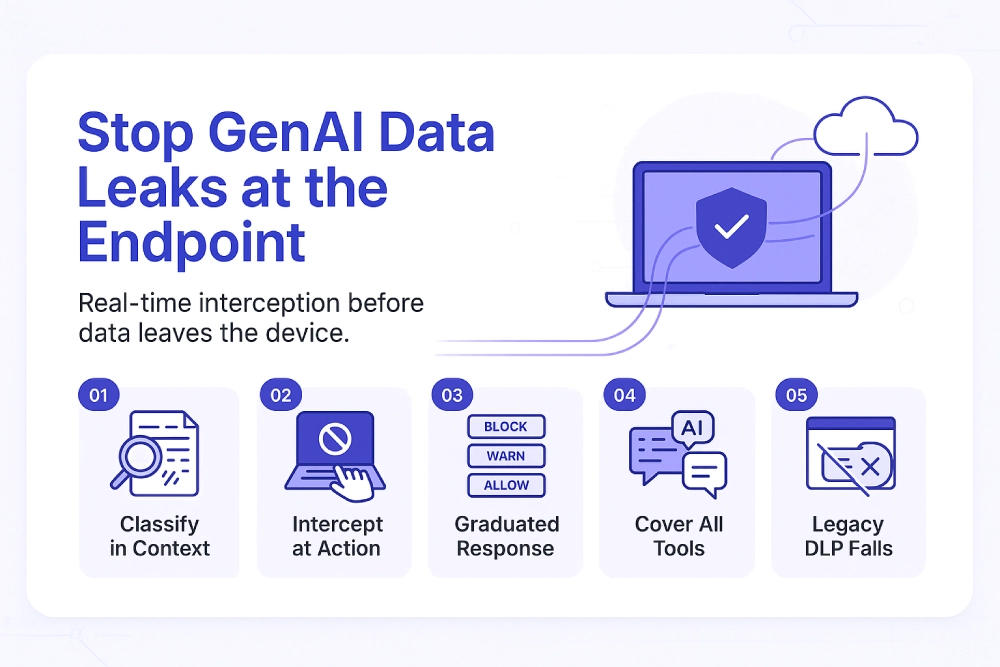
Preventing sensitive data from leaking to GenAI tools requires real-time enforcement at the endpoint, where employees actually paste prompts, upload files, and trigger AI workflows. Static policies, network inspection, and after-the-fact audits all react too slowly to catch a GenAI prompt mid-flight. The answer is an endpoint-native approach that classifies data in context, intercepts the action at the moment it happens, and enforces the right response, whether that is blocking, redacting, warning, or logging, before the data ever leaves the organization [obsidiansecurity.com].
TL;DR
- Employees routinely paste source code, customer records, and excel sheets and CSV files with sensitive data into ChatGPT and other GenAI tools, often without realizing the risk [usecure.io][unio.digital]. .
- Legacy data loss prevention tools were built for email and USB, not for AI prompts, browser-based SaaS uploads, or autonomous AI agents acting at machine speed.
- The endpoint is the only point where every data path, browser, clipboard, local file, and AI agent, converges and can be controlled in real time.
- Effective GenAI data protection combines context-aware classification, prompt inspection, and SaaS data loss prevention into a unified enforcement layer.
- The goal is to let teams adopt AI confidently without creating uncontrolled data exposure.
Why Is GenAI a New Kind of Data Leakage Risk?
GenAI tools are not just another SaaS application. They actively consume whatever text or files a user provides, and that input often includes sensitive data that employees would never have attached to a public email [usecure.io]. The problem is behavioral and structural at the same time.
What employees actually share with GenAI tools [unio.digital]:
- Source code and internal API logic
- Customer PII and support tickets
- Financial models and projections
- Internal credentials and configuration files
- Legal documents and contracts
The speed issue makes this qualitatively different from older data leakage vectors. A human copying files to a USB drive is visible and slow. An AI copilot or autonomous agent can read a directory, summarize it, and upload a response in seconds. Legacy endpoint tools detect malware. Network inspection tools scan traffic. Neither was designed to intercept a clipboard paste into a browser-based AI tool and evaluate whether the content is sensitive before it is transmitted [kiteworks.com].
What Are the Most Common GenAI Data Leakage Paths?
Building on the behavioral risk above, the harder question is which technical paths data actually travels before reaching an external AI service.
Primary leakage vectors:
|
Leakage Path |
Why It Is Risky |
|---|---|
|
Browser prompt input |
Clipboard pastes and typed content bypass most network controls |
|
File uploads to AI tools |
Documents, spreadsheets, and code archives sent directly |
|
Shadow GenAI apps |
Unsanctioned apps employees discover and use independently |
|
AI copilot integrations |
IDE plugins and Office copilots with broad file-read permissions |
|
Agentic workflows |
Autonomous agents that access data stores and act without human review per action |
Shadow GenAI is a particular challenge [usecure.io]. Employees do not intend to cause a breach; they find a useful tool and start using it. By the time IT discovers the app, data has already moved. SaaS data loss prevention that only covers a pre-approved app list will miss every unsanctioned tool by definition.
Why Do Legacy Data Loss Prevention Tools Fall Short Here?
A related but distinct question is why organizations that already have data loss prevention tools in place still experience GenAI-related leakage.
Most legacy DLP tools were architected around three assumptions that no longer hold:
- Sensitive data lives in files. Pattern matching on SSNs or credit card numbers in a document made sense when leakage meant email attachments. It does not catch a developer pasting a function from their IDE directly into a prompt box.
- The network perimeter is the control point. Routing traffic through a cloud inspection proxy adds latency and misses encrypted local activity entirely.
- Policies are static. A rule that blocks uploads to a domain cannot account for context: the same user, the same file, and the same destination might be acceptable in one workflow and a policy violation in another.
Modern GenAI data leakage prevention requires classification that understands document context, not just regex patterns [blog.qualys.com]. It also requires enforcement at the endpoint, not at the network edge, because that is where the action originates [underdefense.com].
What Does Effective GenAI Data Protection Actually Look Like?
Stepping back from the specific failure modes, a practical protection model needs to cover four capabilities working together.
1. Classify data in context, not just by pattern
Effective classification understands that a block of Python code is sensitive source code, not just text. It uses document context alongside pattern matching to assign a sensitivity level before any action is taken.
2. Intercept at the point of action
The endpoint is where a user pastes into a browser, where a copilot reads a local file, and where an agent executes a workflow. Enforcement placed at the network level, after the data has left the machine, is already too late for real-time prevention [mind.io].
3. Apply graduated responses
Not every action should be blocked. A well-designed system allows, blocks, warns, coaches, or logs depending on who is acting, what data is involved, what device is being used, and where the data is going. Coaching users in the moment, rather than blocking everything, supports adoption of AI without compromising security.
4. Cover sanctioned and unsanctioned tools
SaaS data loss prevention must extend beyond an approved app list. Any browser-based GenAI tool, whether on the corporate allowlist or not, is a potential leakage path. Controls should apply uniformly [obsidiansecurity.com].
Kitecyber’s endpoint-native platform follows a continuous See, Decide, Enforce model. Its single lightweight agent observes all data movement at the endpoint, including clipboard activity, browser uploads, GenAI prompts, and agentic workflows. It evaluates each action in context and enforces the right control before data leaves the device, replacing a fragmented stack of point solutions with one unified enforcement layer.
About Kitecyber
Kitecyber is a next-generation cybersecurity platform built around a simple premise: data protection belongs at the endpoint, where work actually happens. Its single lightweight agent delivers endpoint and network DLP, GenAI and AI agent security, Secure Web Gateway, SaaS app protection, ZTNA, and unified endpoint management from one console, without the complexity of stitching together multiple point solutions. Kitecyber was built specifically for the AI agent era, giving teams the real-time visibility and enforcement they need to adopt AI confidently. Organizations looking for a practical alternative to legacy SSE vendors like Netskope and Zscaler, or standalone DLP tools like Forcepoint, Nightfall, and Cyberhaven, can explore Kitecyber’s consolidated approach at https://kitecyber.com.
References
- Stop Sensitive Data from Leaking to GenAI Apps (obsidiansecurity.com)
- Data Leakage Prevention in AI | Complete Information Leakage Guide | Qualys (blog.qualys.com)
- Stop AI Data Leaks: A Guide for IT, Risk & Compliance Pros (kiteworks.com)
- How to Protect Sensitive Data While Using ChatGPT and … (underdefense.com)
- GenAI Data Loss Prevention: Protect Against AI Data Leaks | MIND (mind.io)
- GenAI Data Leakage: Employees Pasting Confidential Data into AI Tools (usecure.io)
- ChatGPT Sensitive Data Statistics: What Employees Share (2026) (unio.digital)
Frequently Asked Questions
It is the unintended or uncontrolled transfer of sensitive organizational data to an external AI service, typically through user prompts, file uploads, or autonomous AI agent activity [usecure.io].
Network inspection can block known AI tool domains, but it cannot inspect encrypted clipboard content, evaluate prompt context, or control AI copilots operating locally on the endpoint [kiteworks.com].
Source code, customer PII, credentials, financial data, and internal documents are the most commonly exposed categories [unio.digital].
Shadow GenAI refers to unsanctioned AI tools that employees adopt independently, without IT approval or visibility, creating data exposure outside any governed perimeter [usecure.io].
Endpoint DLP intercepts data at the moment of action, before it leaves the device. Network DLP inspects traffic after the data is already in transit, which is too late for prompt-level interception [underdefense.com].
SaaS data loss prevention governs data movement across cloud applications, both sanctioned and unsanctioned, including upload controls, access governance, and activity monitoring.
Blanket blocking is often counterproductive; employees find workarounds. A more effective approach combines visibility, contextual enforcement, and user coaching so teams can use AI tools productively within safe boundaries [blog.qualys.com].

Ajay Gulati
Ajay Gulati is a passionate entrepreneur focused on bringing innovative products to market that solve real-world problems with high impact. He is highly skilled in building and leading effective software development teams, driving success through strong leadership and technical expertise. With deep knowledge across multiple domains, including virtualization, networking, storage, cloud environments, and on-premises systems, he excels in product development and troubleshooting. His experience spans global development environments, working across multiple geographies. As the co-founder of Kitecyber, he is dedicated to advancing AI-driven security solutions.