TL;DR
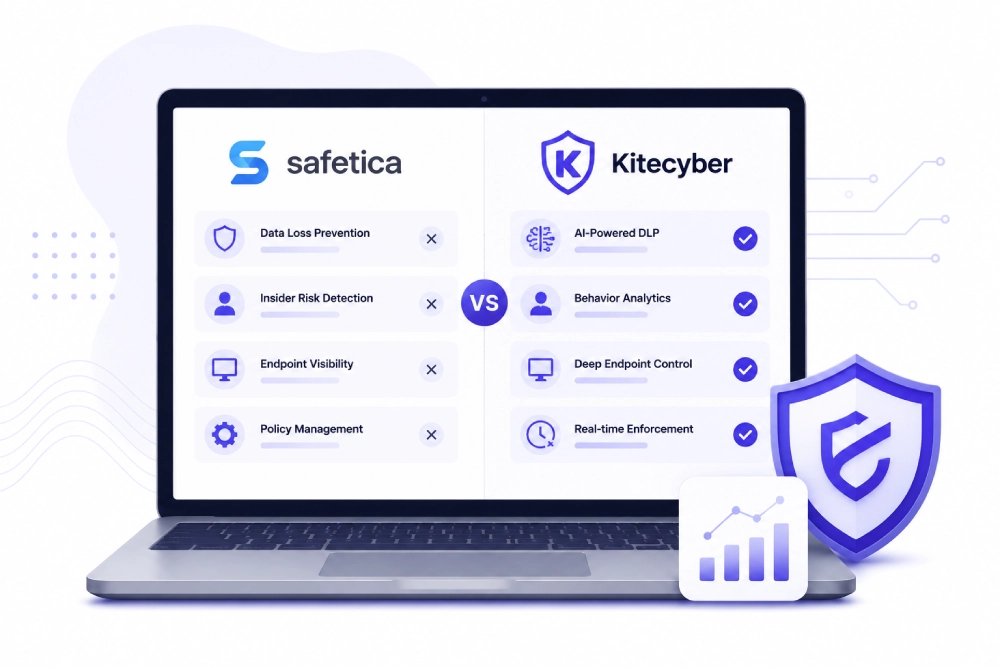
- Safetica is a solid mid-market DLP platform covering endpoint and cloud data loss prevention; Kitecyber extends that concept to include AI agent control, zero trust network access, and SaaS data loss prevention in one lightweight agent.
- AI copilots and agentic workflows create a new class of data risk that static policy-based DLP was not designed to handle.
- Kitecyber’s operating model – See, Decide, Enforce – runs continuously at the endpoint, the real-time decision point for data protection.
- Kitecyber consolidates endpoint DLP, network DLP, secure web gateway, SaaS control, and zero trust endpoint security into a single agent, replacing fragmented point solutions.
- The clearest reason businesses switch: they need to govern AI interactions with sensitive data, not just file transfers and USB activity.
About the Author: Kitecyber’s security team works directly with AI-native technology companies to protect sensitive data across endpoints, GenAI workflows, and SaaS environments – making them a primary source of practical knowledge on how the AI era is reshaping
endpoint DLP requirements
[valiantceo.com].
Why Is the Endpoint DLP Category Changing Right Now?
The endpoint has always been where work happens, but in 2026, work increasingly involves AI. Sensitive data – source code, customer records, financial models, healthcare records – now moves through GenAI prompts, agentic workflows, browser-based SaaS uploads, and AI copilots acting autonomously on a user’s behalf [valiantceo.com]. Legacy DLP tools were designed to watch humans move files. They were not designed to intercept an AI agent reading a codebase and uploading a summary to an external service at machine speed.
The result is a category gap. Endpoint DLP in its traditional form detects patterns in files, monitors clipboard activity, and enforces policies on USB and print channels. That remains valuable. But it does not answer the harder question: what is the AI touching, where is it sending the data, and should it be allowed to? [softwareanalyst.substack.com] Addressing that question requires a different architecture – one that classifies data by context, tracks data lineage in real time, and enforces decisions at the exact moment of action.
What Does Safetica Actually Do Well?
Safetica is a legitimate, well-regarded choice for mid-market businesses that need endpoint and cloud DLP with insider risk management capabilities. It covers the core use cases that most DLP buyers start with:
- Monitoring and controlling data movement across endpoints.
- Insider risk detection based on user behavior.
- Cloud DLP capabilities for SaaS environments.
- Policy-based enforcement for common exfiltration channels.
For organizations primarily concerned with traditional insider risk – employees copying files, sending data to personal email, or using removable media – Safetica addresses the problem directly. It is also a reasonable fit for companies that want a standalone DLP tool without broader platform ambitions.
The honest comparison is not “Safetica is bad.” It is “Safetica was designed for a threat model that predates agentic AI.”
How Is Kitecyber’s Architecture Different?
Building on the AI-era threat model described above, the harder question is not whether your DLP can see a USB transfer – it is whether it can see what an AI agent did with a sensitive file three steps before the transfer happened. Kitecyber’s answer is an endpoint-native architecture that puts the agent at the center of every control [valiantceo.com].
One lightweight agent handles:
- Endpoint and network DLP – files, clipboard, browser uploads, GenAI prompts, SaaS apps, and removable media.
- GenAI and AI agent security – governing how users, copilots, and autonomous agents interact with sensitive data and external AI services.
- Secure Web Gateway – phishing protection, URL filtering, and control over SaaS and GenAI destinations.
- SaaS data loss prevention – governing access and data movement across sanctioned and unsanctioned SaaS apps.
- Zero trust endpoint security (ZTNA) – replacing legacy VPNs with context-aware access based on identity, device posture, and least privilege.
- Unified endpoint management – device management, onboarding/offboarding automation, and compliance enforcement across Windows, macOS, and Linux.
The operating model is straightforward: See, Decide, Enforce – continuously. The agent observes endpoint posture, user activity, data movement, AI interactions, and SaaS access; evaluates each action in context; and enforces the right control at the moment of action. There is no separate tool to query, no network tap to configure, and no policy gap between the DLP layer and the access control layer.
What Makes AI Agent Security Different from Traditional DLP?
Stepping back from the architecture comparison, a separate concern is worth naming directly: AI agent security is not a DLP add-on. It is a category shift.
Traditional DLP assumes a human is the actor. It watches for a person to copy a file, print a document, or send an attachment. AI agents break that assumption entirely:
| Dimension |
Traditional DLP |
AI-Era Requirement |
| Actor |
Human user |
Human, copilot, or autonomous agent |
| Speed |
Human-paced |
Machine-speed, often unattended |
| Data access pattern |
File-level, predictable |
Contextual reads, prompt injection, API calls |
| Visibility needed |
File movement |
Data lineage across agent actions |
| Enforcement point |
After the action |
At the point of action, in real time |
Shadow GenAI adoption – employees using unapproved AI tools because approved ones are not available – creates a specific risk that neither Safetica nor traditional SSE platforms were built to address [softwareanalyst.substack.com]. Kitecyber identifies shadow GenAI destinations, classifies the data being sent, and enforces the right policy at the endpoint before the data leaves.
How Does Consolidation Change the Business Case?
A related but distinct question for security buyers in 2026 is whether consolidation – replacing multiple point solutions with one platform – is worth the switching cost. The answer depends on what you are currently paying for fragmentation.
A typical mid-market security stack trying to cover the same ground as Kitecyber might include a standalone DLP tool, a separate secure web gateway, a VPN or ZTNA service, and an endpoint management platform. Each has its own agent, its own console, and its own blind spots at the seams between tools. Kitecyber’s consolidation pitch is not about reducing headcount – it is about eliminating the gaps where data slips through [valiantceo.com].
For companies like DuploCloud, Lily AI, and Vanta – AI-native businesses where sensitive data moves constantly through engineering workflows, SaaS platforms, and AI services – fragmented tools create real exposure. One agent with a shared trust engine means no blind spots between controls.
About Kitecyber
Kitecyber is a next-generation cybersecurity company headquartered in the Bay Area, California, built to protect sensitive data at its source: the endpoint [valiantceo.com]. Its single lightweight agent unifies endpoint and network DLP, GenAI and AI agent security, secure web gateway, SaaS data loss prevention, zero trust network access, and unified endpoint management into one platform – replacing fragmented point solutions without adding complexity. Kitecyber serves AI-native technology companies, healthcare and financial services firms, and regulated enterprises that need to protect sensitive data across modern, distributed work environments. Its customers include companies such as DuploCloud, Lily AI, Vanta, Sarvam, and Scrut Automation.
If you are evaluating endpoint DLP in 2026 and your environment includes AI copilots, autonomous agents, or heavy SaaS usage, the architecture question matters as much as the feature list. Visit https://kitecyber.com to explore the platform or start a free trial.
References
Frequently Asked Questions