Enforcing data controls on devices your company doesn’t own requires shifting security enforcement from the network perimeter to the endpoint itself, using agents or agentless methods that classify sensitive data, monitor how it moves, and apply real-time policy at the moment a contractor or employee tries to copy, upload, or paste it, regardless of who owns the laptop. This is no longer optional: over 80 percent of enterprise organizations now have formal BYOD policies, and 95 percent allow personal devices into the business in some form. Contractors and freelancers make up roughly 46.6 percent of the global workforce, and 65 percent of companies plan to expand their use of contingent labor. The devices doing this work sit outside IT’s purchasing and imaging pipeline, but the data flowing across them is exactly as sensitive as anything on a corporate laptop.
TL;DR
About the Author: This article is written from Kitecyber’s vantage point as an endpoint-native data security company built for hybrid, contractor-heavy, and AI-adopting organizations, drawing on work with technology and compliance-driven customers such as DuploCloud, Vanta, and Scrut Automation who manage exactly this kind of mixed-ownership device fleet.
What Makes Contractor and BYOD Fleets Different From Managed Device Security?
A BYOD or contractor fleet is a set of endpoints accessing company systems and data that the company does not own, image, or fully control, which means the usual security assumption, that IT can push an agent, lock down USB ports, or wipe a device at will, often doesn’t hold. Contractors frequently work across multiple clients from the same machine. Employees using personal phones or laptops resist invasive mobile device management that reaches into personal photos or apps. Legal and HR constraints in many jurisdictions limit how much control a company can assert over a device it doesn’t own.
This creates a structural mismatch. Security teams are accountable for where sensitive data goes, but they don’t own the hardware carrying it. The practical implication: BYOD security best practices have to separate “control the device” from “control the data,” because full device control is frequently unavailable or inappropriate on a fleet you don’t own.
A few characteristics define these fleets:
Why Do Regulatory Frameworks Require Data Controls on Devices the Company Doesn't Own?
Regulatory frameworks do not exempt unmanaged endpoints from data protection obligations; they require the opposite. HIPAA, GDPR, SOC 2, and PCI-DSS all mandate technical and organizational measures, such as encryption, access controls, and remote wipe capability, to keep sensitive data like ePHI or personal information secure regardless of whether the device is company-issued. The obligation attaches to the data, not the asset tag.
This matters for how compliance teams should think about audits. An auditor reviewing HIPAA DLP controls or a SOC 2 report doesn’t ask whether a contractor’s laptop is enrolled in corporate MDM. They ask whether sensitive data on that device is encrypted, access is controlled, and the organization can demonstrate visibility into where that data went. Building a program that only covers owned devices leaves a documented, auditable gap. This is one reason organizations pursuing CMMC, ISO 27001, or FINRA obligations increasingly extend endpoint DLP and access controls to contractor and BYOD fleets rather than assuming those devices sit outside scope [konfirmity.com].
Why Can't Traditional DLP Handle Contractor and BYOD Data Movement?
Traditional DLP inspects data at fixed transfer points, like email attachments or file uploads, using pattern matching and regular expressions, and that approach was built for a world where data moved through predictable channels. It cannot see a browser session where a contractor pastes a customer record into a chat prompt, and it cannot follow an agentic workflow that never generates a conventional file transfer event at all.
This gap is now measurable. Recent 2026 reporting shows 52 percent of data leakage involves SaaS applications, organizations see an average of 223 GenAI data policy violations per month, and 77 percent of employees paste data into GenAI prompts during normal work. Documented exploits like CVE-2025-32711 have shown automatic data exfiltration triggered by a single crafted email inside AI agents such as Microsoft 365 Copilot, no user action required beyond receiving a message.
Traditional DLP tools check for sensitive data only at controlled gates like email, not at the point where contractors or employees actually work with it inside GenAI sessions or browser tabs. GenAI prompts and browser-based copy-paste happen at the endpoint, in real time, and static DLP positioned on the network cannot watch for those interactions because they never leave the device as a conventional file transfer.
How Fast Do Attacks Move on Unmanaged Endpoints, and Why Does That Change the Response Model?
Real-time enforcement at the endpoint is the only workable control point when attack speeds compress data exfiltration into minutes. Breakout times have shortened significantly, and endpoint-level protection decisions must happen at the moment an action occurs because manual investigation and containment take weeks to months. On a contractor or BYOD device, this response model is even more critical because there’s often less baseline visibility to begin with. If the primary control is a quarterly access review or a log audit after the fact, the exfiltration already happened weeks or months before anyone looked. This is the core argument for prevention over reaction: enforcement has to happen at the point of risk, on the endpoint, in real time, because a compressed exfiltration window leaves no time for a security team to intervene manually.
What Does Endpoint-Native Data Security Look Like for Devices You Don't Own?
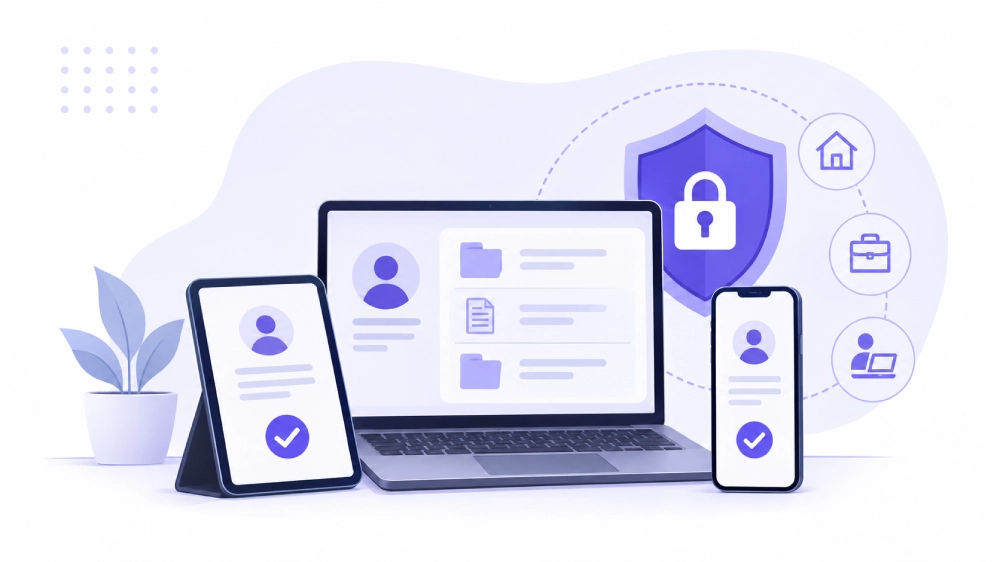
Endpoint-native data security means the enforcement point is the device itself, not the network path traffic happens to take, and this is exactly what makes it workable on BYOD and contractor fleets. Instead of demanding a company image or full MDM enrollment, an endpoint-native approach installs one lightweight agent that observes data movement, classifies sensitive content using document context in addition to pattern matching, and enforces the right action, allow, block, warn, coach, log, or isolate, at the moment someone tries to move data, whether that’s a clipboard paste, a browser upload, a GenAI prompt, or removable media.
Kitecyber built its model around this idea directly: See, Decide, Enforce, continuously. The agent sees endpoint posture, browser behavior, data movement, SaaS access, and AI interactions; decides based on who is acting, what device, what data, and where it’s headed; and enforces the appropriate control at that exact moment, not after a log review surfaces it. Because this runs at the endpoint rather than relying on network inspection, it works the same way whether the laptop is corporate-issued or a contractor’s personal machine, which sidesteps the ownership problem that blocks full MDM deployment.
This also addresses insider risk management directly. Most insider risk isn’t malicious; it’s a contractor pasting a spec sheet into a GenAI tool to save time, or an employee uploading a customer list to a personal cloud drive during offboarding. Real-time enforcement at the point of action catches both the careless and the deliberate case, because it doesn’t depend on guessing intent, it depends on observing the action and the data involved.
How Should a Security Team Protect Sensitive Data in Contractor and BYOD Environments?
Protecting contractor and
BYOD data works best when it’s built around least privilege and short-lived access rather than broad network trust, because contractors are, by definition, temporary and often working across multiple organizations. A few practical steps:
What Does This Mean for Data Loss Prevention Pricing and Consolidation Decisions?
Data loss prevention pricing decisions increasingly hinge on how many separate tools an organization needs to stitch together to cover managed devices,
BYOD, contractors, SaaS, and GenAI, and that stitching cost is often larger than the line-item price of any single product. A point-solution DLP tool priced per seat can look inexpensive until it’s paired with a separate SWG, a separate
ZTNA/
VPN replacement, and a separate SaaS governance tool, each with its own agent, console, and support contract.
|
Approach
|
Coverage of BYOD/contractor devices
|
Coverage of GenAI/agentic data movement
|
Operational overhead
|
|
Legacy network DLP + VPN
|
Limited, requires network path through corporate infrastructure
|
Minimal to none
|
Multiple consoles, multiple agents
|
|
Point-solution GenAI/SaaS DLP
|
Varies, often app-specific
|
Partial, tool-dependent
|
Additional agent, additional policy set
|
|
Endpoint-native consolidated platform
|
Native, works regardless of device ownership
|
Direct, observes prompts and browser sessions at the source
|
One agent, one policy engine
|
The consolidation argument isn’t just about cost, though fewer contracts and fewer agents does reduce total spend and administrative burden. It’s about coverage gaps. Every additional point solution is another integration point where a contractor’s device, a SaaS upload, or a GenAI prompt might slip past because no single tool was watching that specific channel. Organizations consolidating multiple point solutions toward a single endpoint-native agent typically cite reduced blind spots between tools as the primary driver, not price alone.
References
Frequently Asked Questions