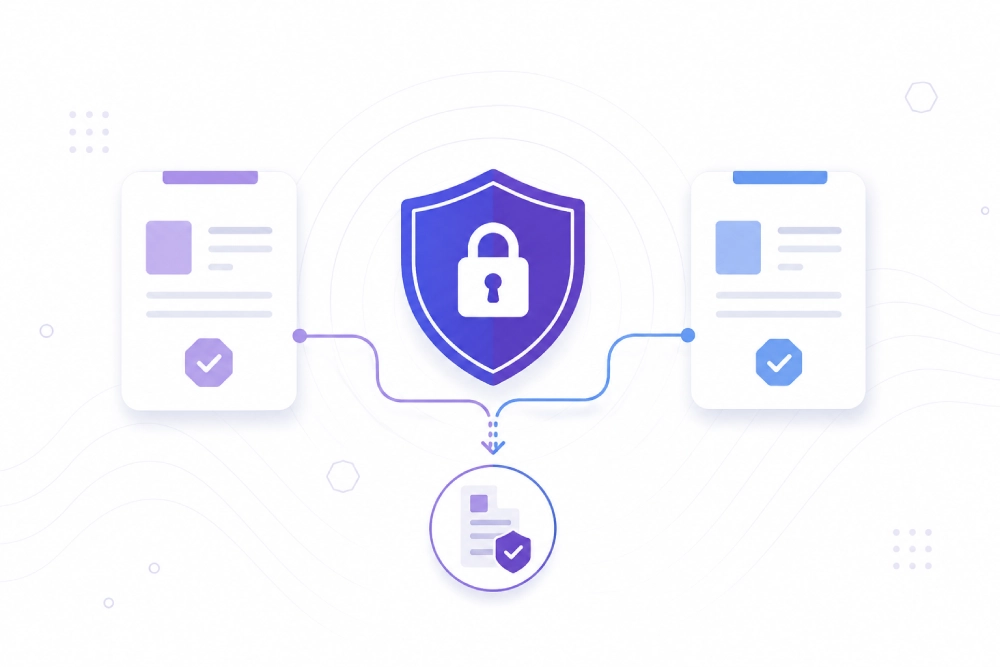
When two companies merge as equals, each side arrives with its own definition of what counts as “confidential,” its own labeling scheme, and its own DLP rules built around that scheme. Reconciling these into one policy set means mapping both classification taxonomies to a shared standard, re-tagging data under unified labels, and deploying endpoint data loss prevention that enforces the merged policy consistently, regardless of which legacy system the data originated from. Skipping this step is one of the most common ways sensitive data slips through the cracks during post merger IT integration, not because anyone was careless, but because two valid systems simply do not speak the same language.
TL;DR
About the Author: This article is informed by Kitecyber’s work securing data across distributed, multi-entity organizations, including AI-native and fast-growing technology companies navigating infrastructure consolidation. Kitecyber’s endpoint-native platform is built specifically to unify data protection where classification schemes, device fleets, and SaaS environments collide.
Why Is Data Classification Reconciliation So Hard in a Merger of Equals?
A merger of equals is structurally different from an acquisition, and that difference is exactly what makes data classification reconciliation hard. In an acquisition, the acquirer’s policy typically wins by default; the acquired company adopts it, sometimes painfully, but the direction of change is clear. In a merger of equals, neither side has that authority, and both classification systems were built independently around different regulatory exposure, different customer contracts, and different internal culture around what “sensitive” means.
Company A might use a three-tier system: Public, Internal, Confidential. Company B might use four tiers with a separate “Regulated” category for anything touching health or financial data. Neither is wrong. But a DLP rule written against “Confidential” at Company A will not automatically catch what Company B calls “Regulated,” even though a compliance officer looking at both would recognize significant overlap.
This is a data governance problem before it is a technology problem [atlan.com]. The technology only becomes relevant once you have a target taxonomy to enforce.
What Should the Reconciliation Process Actually Look Like?
Reconciliation is the structured process of comparing two
data classification systems, identifying where their categories align, and producing one taxonomy that both organizations enforce going forward. It generally follows five stages, similar to how any two-system reconciliation works when merging financial or operational records
[montecarlo.ai]:
The mechanism worth understanding here is why step 2 is the hardest part. Matching classification labels is not a simple lookup; it is closer to translating between two languages that both borrow from a common root but diverged over time. “Confidential” in one company’s usage might include contractual terms and pricing, while in another it is reserved strictly for source code and credentials. A literal name match (“Confidential” equals “Confidential”) will produce a policy that is either too loose or too strict for at least one side’s original intent.
Where Should GDPR and Other Compliance Frameworks Fit Into the New Taxonomy?
Regulatory frameworks give merging companies a neutral reference point instead of forcing one side’s internal scheme onto the other. GDPR requires identifying and categorizing personal data under Articles 5, 25, and 30. HIPAA mandates identifying and safeguarding electronic protected health information. SOC 2 requires classification that satisfies confidentiality and trust services criteria under CC6.1 and CC6.6. ISO 27001, under Annex A.8.2, requires information to be classified based on sensitivity and business value. Companies reference these frameworks directly in their DLP policies to keep sensitive data appropriately categorized and protected across every tier.
Building on the reconciliation process above, the practical value of anchoring to these frameworks is that they are external and defensible. Neither merging company “owns” GDPR data classification requirements, so using them as the backbone of the unified taxonomy sidesteps the political question of whose internal scheme wins. It also future-proofs the policy: a taxonomy built to satisfy documented regulatory criteria is easier to defend in an audit than one built around internal habit.
A related but distinct question is timing. Classification reconciliation should ideally happen before systems integration, not after, per most M&A data governance guidance [atlan.com][congruity360.com]. Running two classification systems against merged infrastructure, even temporarily, creates exactly the kind of gap where sensitive data goes unprotected simply because no rule was written to catch it under its new combined identity.
How Do You Discover What Data You Actually Have Before Reconciling Policy?
You cannot classify what you have not found, which is why sensitive data discovery tools have to run before, not after, taxonomy reconciliation begins. Discovery means scanning file shares, SaaS repositories, endpoints, and databases across both companies to build an inventory of where sensitive data actually lives, independent of how it was previously labeled.
This step matters more in mergers of equals than in acquisitions because both companies bring their own shadow inventory: files copied to personal cloud storage, spreadsheets shared over email that were never formally classified, and data sitting in SaaS applications that IT was only partially aware of. Deduplication work compounds this, since overlapping customer records or duplicate files across two merging environments need to be identified and reconciled before you can apply one classification consistently [dataladder.com].
Modern discovery tools that classify by document context, not just keyword or pattern matching, tend to produce fewer false positives during this phase. A pattern match might flag any file containing a nine-digit number as a potential SSN; context-aware classification distinguishes between an actual customer record and a product SKU list that happens to use similar formatting.
Why Does Endpoint DLP Matter More Than Network DLP During This Transition?
Endpoint data loss prevention enforces classification policy at the point where a person or an AI agent actually interacts with a file, rather than inspecting traffic after the fact at the network layer. During a merger integration window, this distinction has real consequences.
Two companies merging rarely finish infrastructure consolidation on day one. Employees from both sides are working across overlapping SaaS tools, sometimes still on separate VPNs, sometimes with AI copilots summarizing documents that carry the old classification labels. Network-based inspection was designed for a world where the primary risk was traffic crossing a perimeter. It has a harder time distinguishing whether the file being uploaded is tagged “Confidential” under the old Company A scheme or “Regulated” under Company B’s, because it is inspecting the wire, not the document’s classification lineage.
This is where zero trust data protection at the endpoint closes the gap. An endpoint-native agent that understands document context, tracks data lineage, and enforces policy the moment a user (or an AI agent acting for that user) tries to copy, upload, or paste sensitive content gives you one consistent enforcement point regardless of which legacy classification system tagged the file originally. Kitecyber’s approach follows a continuous loop, “See, Decide, Enforce,” observing data movement across files, clipboard, browser, GenAI prompts, and SaaS uploads, evaluating the action against the reconciled policy in real time, and applying the right response, whether that is allow, warn, block, or log, at the exact point of risk.
A cloud DLP solution complements this by extending the same reconciled policy across SaaS environments that both merging companies bring into the combined organization, so a file classified under the new taxonomy is protected consistently whether it lives on a laptop, in a shared drive, or inside a GenAI prompt.
What Role Does a Single Agent Play in Post Merger IT Integration?
Consolidation reduces the number of places a reconciled policy can fail to apply. Every additional point solution, one company’s legacy DLP, the other’s endpoint tool, a third-party network gateway, is another place where the new unified taxonomy has to be manually re-implemented, and another place where a mismatch between the two original classification systems can hide.
Deploying one lightweight agent across the combined device fleet means the reconciled classification policy is enforced identically for every employee, on both sides of the merger, from the moment device onboarding completes. This matters practically during post merger IT integration because device onboarding, SaaS access, and policy enforcement all need to happen in the same timeframe, and doing that with four or five disconnected tools multiplies the chance that someone’s laptop is still running the old policy weeks after the merger closes.
About Kitecyber
Kitecyber is a next-generation cybersecurity company built to protect sensitive data at the endpoint, where work actually happens. Its platform unifies endpoint and network DLP, GenAI and AI agent security, secure web gateway, SaaS protection, and zero trust network access into one lightweight agent, replacing the fragmented point solutions that often struggle to enforce a single policy across two merging environments. Kitecyber serves technology and AI-native companies, including DuploCloud, Lily AI, Vanta, Sarvam, and Scrut Automation, with compliance support spanning HIPAA, GDPR, CMMC, ISO 27001, SOC 2, and PCI DSS. Its core model, “See, Decide, Enforce, continuously,” gives merging organizations one consistent enforcement layer for data classification, regardless of which legacy system originally tagged the file.
If your organization is working through a merger of equals and needs one policy set enforced consistently across both companies’ endpoints, visit Kitecyber to learn more.
References
Frequently Asked Questions