Table Of Content
Related Posts


The AI Agent Audit Trail: What Compliance Teams Must Log When Machines Make Autonomous Data Decisions
-
August 30, 2026
-
Quick Answer:
AI Security Posture Management (AISPM), also called AI Posture Management, is the continuous process of discovering, monitoring, and controlling how AI tools, models, and agents interact with your company's data and systems. It covers everything from spotting an unapproved AI app on someone's laptop to blocking a customer record from being pasted into a public chatbot. Most teams that manage AI posture well pair a discovery layer with policy enforcement at the point where employees actually use AI, which is the endpoint.
An AI agent audit trail is a timestamped, tamper-evident record of every data-affecting decision an autonomous AI agent makes: what it accessed, why it acted, what it did with the data, and who authorized it. Compliance teams need this record because AI agents now make data-access decisions at a speed and volume no human review process can keep pace with, and regulators have started writing that expectation directly into law. As organizations increasingly deploy autonomous AI agents, audit trail gaps have become a critical compliance vulnerability. Separately, organizations report watching AI agents act outside their intended scope, including sharing sensitive data they should not have touched. The audit trail is how a compliance team proves, after the fact, exactly what happened and why.
TL;DR
- An AI agent audit trail must capture agent identity, the data accessed, the action taken, the reasoning behind it, and the outcome, not just system-level logs of errors and latency.
- ISO/IEC 42001 and the NIST AI Risk Management Framework both now expect logging that ties a specific AI decision to a specific data event.
- Most audit failures happen because logs answer "what happened" but not "why" or "who authorized it," which is exactly what auditors and incident responders need.
- Endpoint-native monitoring closes the gap that server-side agent logs leave open: it sees the data before the agent touches it and after, at the point where the decision is actually enforced.
- Consolidating audit logging with data-loss prevention and access control, rather than bolting on a separate agent-monitoring tool, reduces blind spots and audit fatigue.
About the Author: This article is published by Kitecyber, a data security company that builds endpoint-native controls specifically for the era of AI copilots and autonomous agents. Kitecyber’s platform generates real-time data lineage and incident records for GenAI prompts, SaaS uploads, and agentic workflows, giving compliance and security teams the audit foundation this article describes, natively, at the endpoint.
What Counts as an AI Agent Audit Trail?
An AI agent audit trail is not the same thing as an application log. A log records technical events like errors and latency; an audit trail records the who, what, and why of an agent’s decision-making process [loginradius.com]. That distinction matters more than it sounds. A server log can tell you an API call failed. It cannot tell you which employee’s session triggered an autonomous agent to summarize a customer database and paste the output into an external GenAI tool, or whether that action was ever supposed to be permitted in the first place.
Compliance frameworks have converged on four questions every AI audit trail should be able to answer for any given decision: what data went in, what came out, what the model or agent decided, and why [collibra.com]. If a log cannot answer all four, it is a diagnostic tool, not a compliance artifact. That gap is the reason audit trail requirements have moved from a “nice to have” for AI governance into a hard requirement under emerging regulation.
Why Do Regulators Now Require Logging Autonomous AI Decisions?
Regulators require this because autonomous agents remove the human decision point that most existing accountability frameworks were built around. Frameworks like SOC 2 and GDPR require granular, timestamped, tamper-evident audit trails detailing every action an AI agent takes, who authorized it, and what data it accessed.
This is not an isolated requirement. It shows up across the frameworks compliance teams already work with:
| Framework | What it requires for AI agent logging |
|---|---|
| ISO/IEC 42001 | AI management system controls that map logging to organizational risk governance |
| NIST AI Risk Management Framework | Documented traceability of AI decisions as part of a broader AI governance framework |
| Cloud Security Alliance AICM | Maps AI-specific logging requirements to SOC 2 and ISO 27001 controls |
| SOC 2 | Granular, timestamped, tamper-evident audit trails for all system actions and data access |
The Cloud Security Alliance’s AI Control Matrix explicitly maps AI-specific logging requirements back onto SOC 2 and ISO 27001, which tells you something important: this isn’t a parallel compliance track. It is an extension of the audit obligations most enterprises already carry, now applied to a class of actor (the autonomous agent) that didn’t exist when those obligations were written.
What Should Compliance Teams Actually Log?
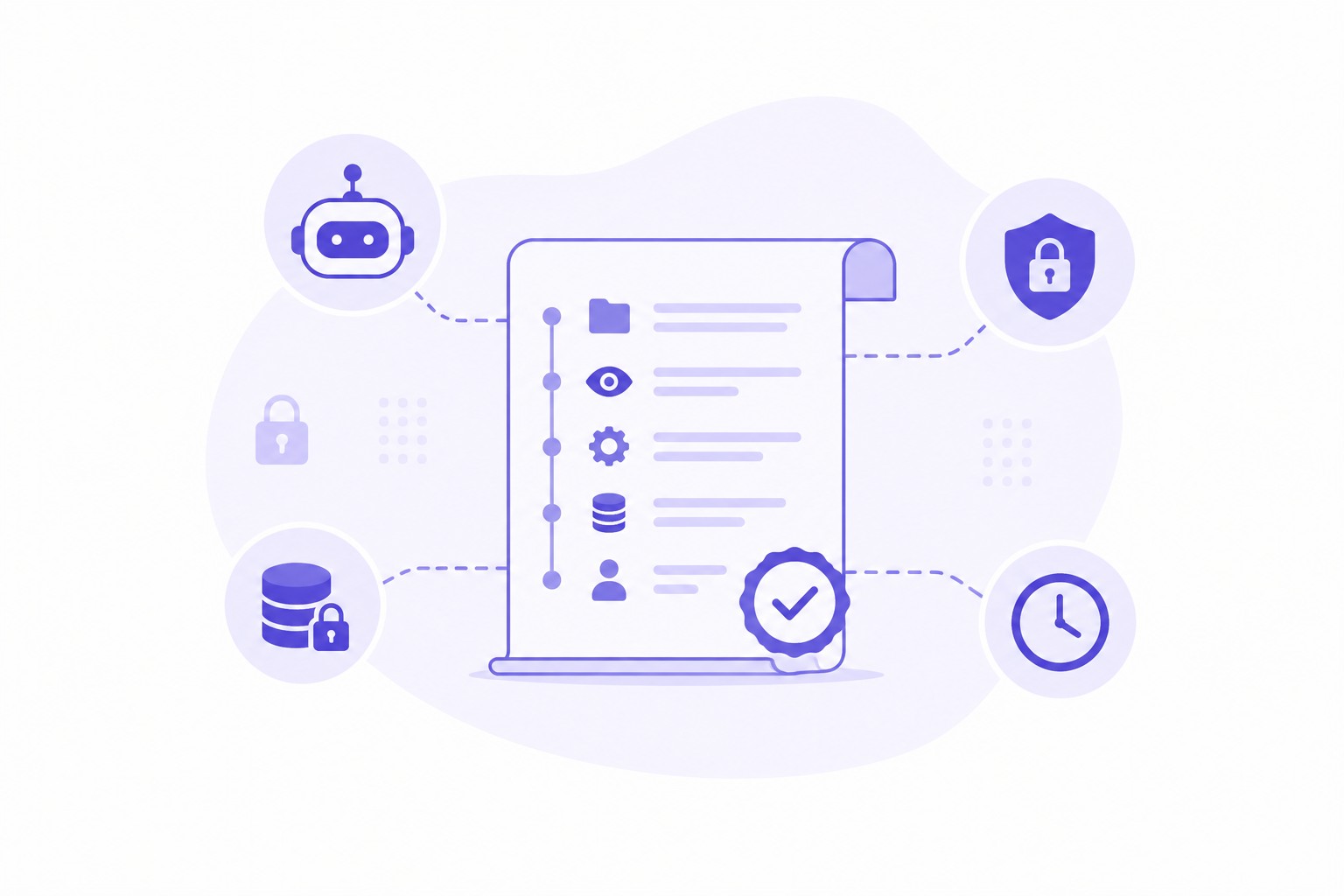
The minimum viable audit trail for an AI agent covers five categories, not just one. Teams that log only prompts, or only outputs, or only errors, consistently discover the gap during an incident review rather than before one [armosec.io]. A complete record should include:
- Agent identity: which agent, which version, which credential or service account initiated the action
- Data lineage: what sensitive data was accessed, its classification, and its origin
- Action classification: read, summarize, copy, upload, transmit, or delete, structured in a way that supports automated review
- Reasoning or authorization context: what triggered the action and under what policy it was permitted
- Outcome: whether the action succeeded, was blocked, or was modified by a control
Emerging technical specifications back this structure directly. Structured audit records should capture agent identity, action classification, and outcome tracking, with tamper-evident mechanisms such as hash chaining using SHA-256 and optional cryptographic signatures for non-repudiation, plus export to formats like Syslog and JSONL. That level of structure is what turns a log into evidence.
A useful mental model here: think of the audit trail like a flight data recorder, not a security camera. A security camera shows you that something happened. A flight recorder captures the inputs, the system state, and the sequence of decisions leading up to an event, which is what lets investigators reconstruct causality rather than just confirm occurrence. Compliance teams that build agent monitoring like a camera end up with footage. The ones that build it like a flight recorder end up with answers.
Where Does Shadow AI Fit Into the Audit Trail Problem?
Shadow AI risk is the audit trail problem’s less-discussed cousin: you cannot log what you cannot see. Building on the logging structure above, the harder question is what happens when an employee routes sensitive data through an AI agent, plugin, or GenAI tool that was never sanctioned or provisioned by IT. There is no service account to trace, no API log to pull, no agent identity registered anywhere in the stack. This is the scenario where server-side and application-side logging, however well-structured, simply has no visibility.
That is a structural argument for capturing data movement at the endpoint rather than relying solely on logs from the AI platforms themselves. If the monitoring point sits at the device, where the browser session, the clipboard action, and the GenAI prompt actually occur, shadow tools become visible the moment sensitive data touches them, regardless of whether the tool was sanctioned. This is the design principle behind Kitecyber’s endpoint DLP and AI-agent security controls: one lightweight agent observes data movement, GenAI prompts, and agentic workflows directly at the endpoint, building data lineage in real time instead of reconstructing it after an incident.
How Should Compliance Teams Operationalize Audit Trail Logging?
Operationalizing this means moving from “we have logs somewhere” to a continuous, enforced discipline. A related but distinct question from what to log is how to make sure logging happens consistently, is reviewed by the right people, and actually informs enforcement rather than sitting in storage. Practical steps compliance teams should take:
- Restrict audit trail access to authorized roles: security teams, compliance officers, auditors, platform administrators, and incident responders [miniorange.com].
- Require tamper-evident storage (hash chaining or equivalent) so logs hold up as evidence, not just internal records
- Build review cadences tied to risk tier, not a single annual audit, especially for agents with access to regulated data
- Treat the 72-hour window after an incident as the real test of your audit trail; teams that only build audit trails after an agent has already done something wrong [armosec.io] are working in reactive mode
- Fold agent-specific requirements (HIPAA AI compliance, GDPR, FINRA, PCI DSS) into the same review process as your existing SOC 2 or ISO 27001 controls, rather than standing up a parallel track
This is where ai compliance automation earns its keep: reducing the manual burden of triaging thousands of log entries so the compliance team’s time goes to reviewing genuine risk signals, not scrolling through routine activity.
Kitecyber’s own operating model reflects this same logic: See, Decide, Enforce, continuously. The endpoint agent observes data movement and AI interactions in real time, evaluates each action against policy and context, and enforces the right response (allow, block, warn, coach, log, or isolate) at the point of risk, generating the audit record as a byproduct of enforcement rather than a separate afterthought.
About Kitecyber
Kitecyber is a data security company built to protect sensitive information at the endpoint, where work with data actually happens. Its single lightweight agent unifies endpoint and network DLP, GenAI and AI-agent security, secure web gateway, SaaS control, ZTNA, and unified endpoint management, replacing fragmented point solutions with one real-time enforcement layer. Kitecyber supports compliance programs spanning HIPAA, GDPR, CMMC, ISO 27001, SOC 2, DPDP, FINRA, and PCI DSS. Its See, Decide, Enforce model gives security and compliance teams the real-time data lineage and audit foundation that AI-era governance now requires.
Compliance teams that want to see how endpoint-native audit trails and data lineage work in practice can learn more at Kitecyber.
References
- AI Agent Audit Trails Explained: The Missing Layer of Enterprise AI Governance (miniorange.com)
- What to Log for AI Agent Activity: The Minimum Viable Audit Trail (armosec.io)
- Auditing and Logging AI Agent Activity: A Guide for Engineers (loginradius.com)
- AI audit trails: What to log for models and agents, and how a Command Center captures it |Collibra (collibra.com)
Frequently Asked Questions
A log captures technical events like errors, latency, or API calls. An audit trail captures the who, what, and why behind a decision, structured so it can answer accountability questions during a compliance review or incident investigation [loginradius.com].
GDPR requires granular, timestamped, tamper-evident audit trails detailing every action an AI agent takes, who authorized it, and what data it accessed, which applies directly to autonomous agents processing personal data.
Emerging frameworks including ISO/IEC 42001 and the NIST AI Risk Management Framework establish that high-risk autonomous AI systems must automatically record events with appropriate provenance, ensuring that logs can support accountability and audit requirements.
Shadow AI tools operate outside sanctioned platforms, so there is often no service account or API log to trace. Endpoint-level monitoring is one of the few ways to capture this activity as it happens, regardless of whether IT provisioned the tool.
Structured audit records should capture agent identity, action classification, and outcome fields, secured with SHA-256 hash chaining and optional cryptographic signatures, exportable to Syslog or JSONL for integration with compliance systems.
HIPAA AI compliance requires that any AI agent accessing protected health information have its access, actions, and disclosures logged in a way that supports the same accountability standards applied to human staff, tied to data lineage and access authorization.
Largely yes. The Cloud Security Alliance's AI Control Matrix maps AI-specific logging requirements to SOC 2 and ISO 27001 controls, meaning teams can extend existing programs rather than building a separate compliance track from scratch.

Ajay Gulati
Ajay Gulati is a passionate entrepreneur focused on bringing innovative products to market that solve real-world problems with high impact. He is highly skilled in building and leading effective software development teams, driving success through strong leadership and technical expertise. With deep knowledge across multiple domains, including virtualization, networking, storage, cloud environments, and on-premises systems, he excels in product development and troubleshooting. His experience spans global development environments, working across multiple geographies. As the co-founder of Kitecyber, he is dedicated to advancing AI-driven security solutions.