- Secure Gen AI & AI Agents
Endpoint-Native DLP for GenAI: Stop Data Leaks to ChatGPT, Copilot & AI Agents
Kitecyber is an endpoint-native data loss prevention (DLP) platform that stops employees and AI agents from leaking sensitive data into ChatGPT, Copilot, Claude Code, Cursor, and other GenAI tools. One lightweight agent classifies the data in a paste or upload the moment it enters a GenAI tool and enforces policy, block, warn, coach, or log, in real time, so fintech, healthcare, and AI-native companies can adopt GenAI with confidence.
- Discover agents
- Detect sensitive data
- Block exfiltration








Trusted by Renowned Customers & Partners












































Secure the AI and the agents running on your endpoints
Kitecyber is endpoint-native DLP built for the GenAI era. GenAI is the fastest-growing data-leak channel in your organization, and AI agents take it further: tools like Claude Code, Copilot, and Codex run directly on your devices with the user’s full privileges, reaching the terminal, filesystem, and CLI. Kitecyber classifies sensitive data the moment it is pasted or uploaded into a GenAI tool and enforces policy, allow, block, warn, coach, log, or isolate, at that exact point, following a simple model: See, Decide, Enforce, continuously.
- The Reality
GenAI is expanding your attack surface right now
Employees use ChatGPT, Gemini, Copilot, and dozens of other AI tools every day — some sanctioned, many not. In nearly every session, sensitive data moves in ways your security team cannot see. Now AI agents add a new dimension: they don’t just receive prompts, they act on the endpoint.
- AI Agents on the Endpoint
Agents run with your users’ full privileges
An AI agent on a laptop inherits the signed-in user’s access. It can read and write files, run shell commands, call CLIs and APIs, and reach internal systems — faster than any human, and usually invisibly to network-centric tools.
- Terminal & shell
- Filesystem read / write
- CLI & automation
- Credentials & tokens
- SaaS & APIs
Sensitive data in prompts & uploads
Customer records, source code, and secrets get pasted or uploaded into GenAI tools, or read by an agent, and leave the device before anyone realizes they should have been blocked. Kitecyber does not read, store, or log the text of a user's prompt; it classifies the sensitive data in the paste or upload payload at the moment it enters the AI tool.
No visibility into agent activity
Without endpoint-level insight, teams don’t know which agents run where, what they touch, or where their output goes.
Prompt injection turns agents hostile
A poisoned web page or document can hijack an agent into exfiltrating data or running unintended actions on connected systems.
- Product Features
How Kitecyber secures GenAI & AI agents
Endpoint-first visibility and real-time control over how data moves across
endpoints, SaaS, and GenAI tools — with the product screens to match.
endpoints, SaaS, and GenAI tools — with the product screens to match.
- Discover
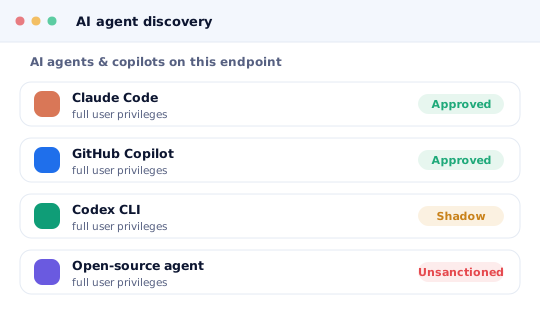
Endpoint-first AI & agent discovery
Kitecyber’s endpoint agent surfaces every AI application and agent accessed from a managed device — browser tools, desktop apps, CLIs, and embedded AI features — so shadow and unsanctioned usage no longer hides.
- ACCESS VISIBILITY
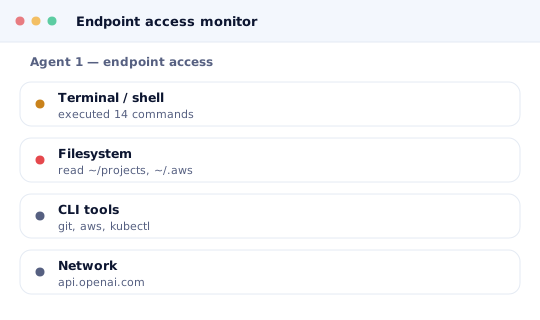
See what each agent can reach
Because Kitecyber lives on the endpoint, it sees the same terminal, filesystem, CLI, and network access your agents do — giving you a clear picture of exactly what an agent can touch.
- DATA LINEAGE
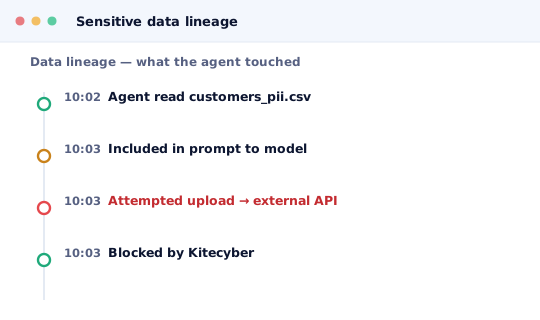
Track data across prompts & files
Follow how data moves from its origin through to GenAI interactions, with a clear record of what was shared, when, by whom, and through which agent or tool.
- REAL-TIME CONTROL
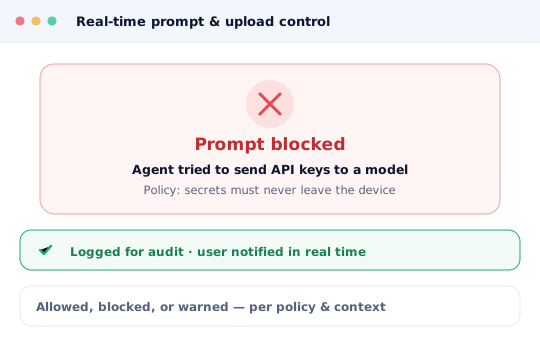
Block uploads & risky prompts in real time
When a user or agent tries to upload a classified document or paste sensitive data into ChatGPT, Copilot, Gemini, or any other GenAI tool, Kitecyber intercepts the action at the endpoint and applies policy, allow, block, warn, coach, log, or isolate, before the data leaves the device. This stops exfiltration without blocking GenAI tools outright, so employees keep using AI while sensitive data stays protected.
- GOVERNANCE
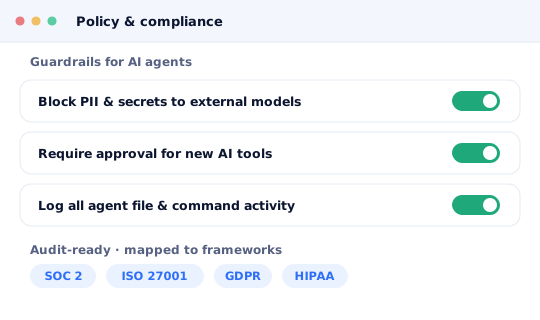
Context-aware policy & compliance
Because the same lightweight agent also provides secure web gateway, SaaS app protection, zero trust network access, and unified endpoint management, Kitecyber helps address more SOC 2, ISO 27001, HIPAA, FINRA, PCI DSS, GDPR, CMMC, and DPDP controls than a pure DLP point product, with nothing extra to deploy. Kitecyber’s tooling supports these controls; certification itself still depends on how an organization configures, operates, and documents its program.”
Apply guardrails that adapt to the user, device, data classification, and AI tool in use, and keep an audit-ready record mapped to SOC 2, ISO 27001, GDPR, and HIPAA.
- UNIFIED DLP
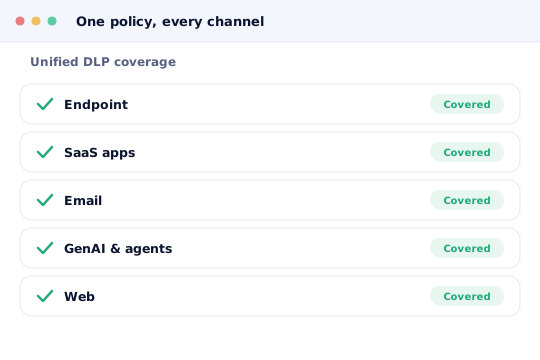
One policy across endpoint, SaaS & GenAI
Instead of separate tools for endpoint DLP, cloud security, and AI monitoring, manage one policy with consistent enforcement across every data channel.
- Why Traditional Tools Fall Short
Legacy stacks weren’t built for GenAI or agents
Network tools only inspect traffic they can see, legacy DLP suites enforce static regex patterns, and API-based DLP covers individual SaaS apps but not the device where data actually moves. Kitecyber closes that gap with endpoint-native, real-time enforcement at the point of risk.
No prompt-level visibility
No input-level visibility into GenAI activity / Traditional DLP inspects files and email. It was never built to classify the data users paste or upload into AI tools, or watch an agent act on the endpoint in real time.
Fragmented endpoint & cloud tools
When endpoint security, CASBs, and web filters run as separate consoles, agent-driven leaks fall through the gaps between them.
Detection comes too late
Log analysis and periodic review find leaks after the data has already reached an external model. Real-time prevention needs a different architecture.
- Benefits
Use AI productively, without losing control
Real-time protection
Catch exposure at the moment of interaction, not hours later.
Less data-leak risk
Consistent policy across every AI tool cuts incidents and investigations.
Simpler operations
One platform instead of three or four reduces alert fatigue and training.
Better compliance
Audit-ready logging and documentation for your AI governance posture.
1
Discover
The endpoint agent inventories every AI agent and the skills it loads.
2
Analyze
Connections, SaaS reach, and skill files are analyzed for risk and data exposure.
3
Detect
Sensitive-data access and movement by each agent is flagged in real time.
4
Enforce
Policies block risky exfiltration and capture an audit trail for compliance.
- Get Started
Take control of GenAI & agent data risk
The goal isn’t to block AI — it’s to use it safely. See exactly which agents run on your endpoints, what data they touch, and stop unapproved transfers before they leave the device.
Securing AI coding assistants like Cursor, Copilot, and Claude Code / AI coding assistants run on the endpoint with the signed-in developer’s full privileges, reading and writing source code, calling CLIs, and reaching internal repositories. Kitecyber discovers every coding assistant and agent running on a managed device, tracks the data lineage from source code to the assistant, and blocks uploads or paste actions that would exfiltrate proprietary code or credentials, all without disabling the assistant.
FAQ's
Frequently Asked Questions About GenAI DLP
Secure GenAI refers to the controls, policies, and technologies that prevent unauthorized data exposure when employees and systems interact with generative AI tools. It includes endpoint-native DLP, context-aware classification of data pasted or uploaded into AI tools, and usage monitoring across both sanctioned and unsanctioned (shadow) AI applications.
The primary risks are data leakage through prompts and file uploads, shadow AI usage by employees, prompt injection attacks, and AI agents with excessive system access. Each of these can result in sensitive data being exposed to third-party systems without authorization.
Data leakage occurs when employees paste sensitive information into AI tools or upload confidential files to AI platforms such as ChatGPT, Gemini, or Copilot. Many GenAI tools retain this data or store it in ways that fall outside an organization's data governance controls, which is why Kitecyber enforces policy at the endpoint before the data leaves the device.
Prompt injection is an attack technique where malicious instructions are embedded in content that an AI model processes. These instructions can manipulate the model into revealing data, bypassing controls, or taking unintended actions on connected systems.
According to Harmonic's 2025 research, approximately 4.37% of all Gen AI prompts contain sensitive data, and nearly 22% of uploaded files contain confidential information. Check Point's 2025 research found that 1 in 35 prompts carries a high data leakage risk.
Shadow AI refers to the use of AI tools by employees without formal approval or security review. It is a risk because security teams have no visibility into what data is being shared, which tools are in use, or whether those tools meet your organization's data handling requirements. Proofpoint found that 44% of organizations currently lack this visibility.
The core practices are restricting sensitive data sharing, implementing automated data classification, monitoring and logging AI interactions, controlling access to AI tools based on role, and providing employees with regular training on AI-related risks.
Kitecyber may provide endpoint-first visibility into AI tool usage, real-time prompt inspection, data lineage tracking, and unified DLP policy enforcement across endpoints, SaaS platforms, and Gen AI tools. This could give security teams a single platform to manage AI data risk without deploying multiple separate products.
Kitecyber is designed to support compliance with data protection frameworks including GDPR, HIPAA, and CCPA by providing audit-ready logging of AI interactions, policy documentation, and demonstrable controls over how sensitive data is handled in AI environments.
Traditional DLP tools were designed to inspect files, emails, and structured data transfers. They were not built to analyze conversational inputs, monitor real-time AI interactions, or enforce policy at the prompt level. This creates coverage gaps specifically in the Gen AI layer where much of today's data leakage is occurring.
Kitecyber's endpoint agent discovers every GenAI tool and agent used on a managed device, including shadow AI, then classifies the sensitive data in any paste or upload at the moment it enters the tool and enforces policy (allow, block, warn, coach, log, or isolate) in real time. This lets employees keep using ChatGPT, Gemini, and Copilot productively while sensitive data stays protected.
Kitecyber intercepts data at the endpoint the moment a user or agent pastes or uploads it into a GenAI tool, classifying the data by context and applying policy before it leaves the device. It does not read, store, or log the text of a user's prompt, only the sensitive data within the paste or upload payload.
Kitecyber is endpoint-native DLP purpose-built for the GenAI era: one lightweight agent covers endpoints (Windows, macOS, native Linux), SaaS, email, browser, clipboard, and removable media, plus data pasted or uploaded into GenAI tools. It classifies sensitive data by context, tracks data lineage, and enforces policy at the exact point of risk rather than relying on static regex patterns or SaaS-only API scanning.
Yes. Kitecyber enforces policy at the point of upload or paste, applying block, warn, coach, or log actions to specific risky transfers rather than disabling the AI tool itself, so employees can keep using GenAI while sensitive data stays protected.
Because AI coding assistants run on the endpoint with the developer's full privileges, Kitecyber discovers each assistant and agent on a managed device, tracks source code lineage, and blocks uploads or paste actions that would exfiltrate code or credentials, without disabling the assistant.
Companies rolling out GenAI need endpoint-native DLP that covers data pasted or uploaded into AI tools in addition to files, email, SaaS, and removable media, since network and API-only tools cannot see what happens on the device. Kitecyber's one lightweight agent provides this coverage plus secure web gateway, SaaS protection, ZTNA, and unified endpoint management, helping address more SOC 2, ISO 27001, HIPAA, FINRA, PCI DSS, GDPR, CMMC, and DPDP controls than a pure DLP point product.
A GenAI startup should classify and track customer data from its source through to any AI interaction, enforcing real-time policy at the endpoint where developers and employees handle that data, rather than relying only on after-the-fact log review. Kitecyber's See, Decide, Enforce model gives continuous, real-time control over this data movement.