TL;DR
- Shadow AI agents operate inside enterprise environments without IT approval, moving sensitive data faster than legacy tools can detect [cloudfuze.com][cloudsecurityalliance.org].
- Endpoint data loss prevention is the correct enforcement layer because the endpoint is where AI agents actually execute and where data actually moves.
- Static DLP, network inspection, and perimeter-trusting VPNs were not designed for agentic workflows that bypass these layers entirely.
- Zero trust endpoint security must extend to non-human identities: agents need the same contextual access controls as human users.
- Consolidating controls into one endpoint-native agent is the practical path forward; fragmented point solutions create the gaps agents exploit.
About the Author: Kitecyber is a Bay Area cybersecurity company purpose-built to protect sensitive data at the endpoint, with a customer base of AI-native technology companies including DuploCloud, Lily AI, Vanta, and Sarvam. Kitecyber’s platform was designed from the ground up for the AI agent era, giving it direct operational insight into how agentic workflows interact with enterprise data.
What Exactly Is a Shadow AI Agent?
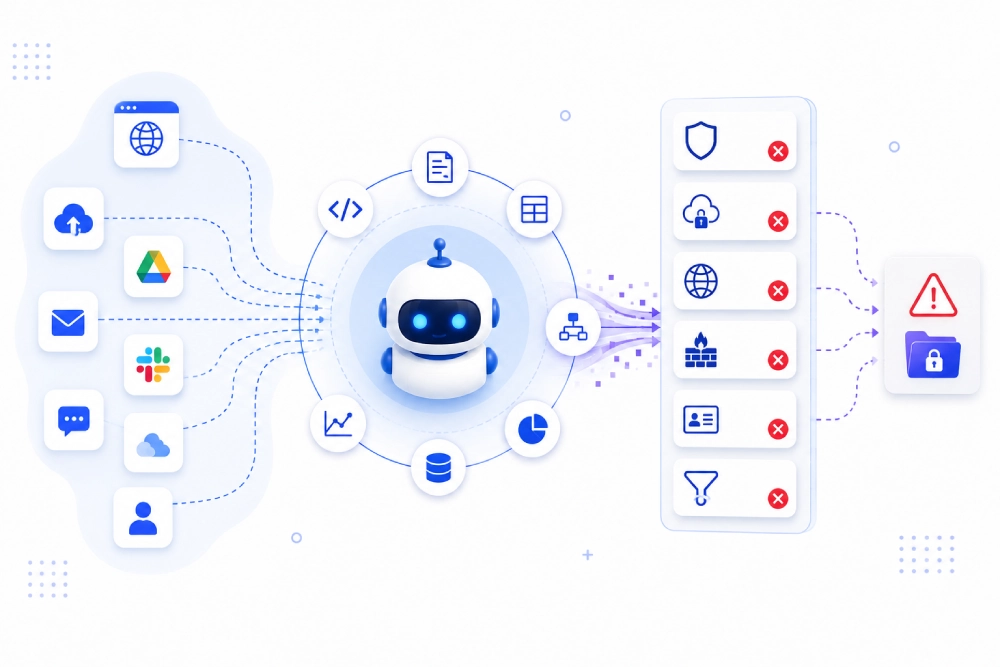
A shadow AI agent is any autonomous tool that employees deploy inside a company’s environment without formal IT or security approval [cloudfuze.com]. The “shadow” in the name mirrors the older concept of shadow IT, but the risk profile is meaningfully different. A shadow SaaS app sits and waits for a user to interact with it. A shadow AI agent acts on its own: it reads your files, queries your APIs, drafts and sends communications, and moves outputs to destinations your security team has never reviewed [cloudsecurityalliance.org].
Shadow AI agents are not always malicious in origin. An engineer connects a productivity agent to their code repository to automate pull request summaries. A sales rep authorizes a CRM agent to sync contact data with an outreach platform. The intent is efficiency. The outcome is a non-human identity operating with broad data access, outside any approved security boundary [livingsecurity.com].
Why Do Existing Security Controls Miss Them?
The core problem is that legacy tools were built around a human-centric threat model, and AI agents do not behave like humans.
Consider the layers most organizations rely on today:
- Malware-focused endpoint tools look for malicious code execution. An AI agent running inside a sanctioned browser extension or an approved SaaS integration triggers none of those signals.
- Network DLP and traffic inspection catch data leaving through known egress paths. Agents increasingly operate entirely within SaaS-to-SaaS pipelines, where data never touches the corporate network perimeter.
- Static DLP policies match patterns against known data types. They cannot evaluate whether a legitimate agent is acting within its authorized scope or has drifted outside it.
- VPNs trust the network, not the action. An agent operating on an authenticated device through a VPN tunnel looks identical to a legitimate user session [obsidiansecurity.com].
The result is a coverage gap specifically shaped around how agents work. They move fast, they operate in approved sessions, and they touch data through interfaces that legacy tools treat as trusted [wiz.io].
What Data Are Shadow Agents Actually Putting at Risk?
Building on the coverage gap above, the harder question is which data categories are most exposed. In practice, the sensitive data that shadow agents most commonly encounter falls into predictable categories:
| Data Type |
How Agents Commonly Access It |
Risk |
| Source code and IP |
Repository integrations, IDE plugins |
Exfiltration to external AI services |
| Customer records |
CRM and support platform agents |
Regulatory exposure (GDPR, HIPAA, CCPA) |
| Credentials and secrets |
Environment variable access, config file reads |
Lateral movement and privilege escalation |
| Financial data |
Spreadsheet and ERP integrations |
Insider risk, compliance violations |
| Internal communications |
Email and Slack agents |
Confidential context leak |
The pattern across all of these is the same: the agent has been granted access that feels narrowly scoped but is structurally broad, and there is no real-time enforcement reviewing what it actually does with that access [valencesecurity.com][agatsoftware.com].
How Should Endpoint Data Loss Prevention Be Adapted for Agents?
Endpoint data loss prevention has always been the right control layer because enforcement at the source is more reliable than enforcement at the perimeter. The AI agent era reinforces that logic. The endpoint is where the agent runs, where the files are read, where the clipboard is populated, and where the data leaves through a browser upload, a GenAI prompt, or an API call.
Effective endpoint DLP in 2026 needs to extend beyond user-initiated actions to cover non-human processes. That means:
- Process-level visibility: identifying which process is moving data, not just which user is logged in.
- Data lineage tracking: following sensitive content from its origin file through every transformation and destination, even across multiple agent steps.
- Context-aware classification: evaluating document context, not just pattern matching, so that a financial summary generated by an agent is recognized as sensitive even if it does not contain a literal account number.
- Real-time enforcement at the point of risk: blocking, warning, or logging the action at the moment it occurs, not after a batch review cycle.
This is also where SaaS data loss prevention connects. When an agent moves data from a local file into a SaaS platform and then on to an external AI service, the enforcement chain must span the endpoint and the SaaS layer simultaneously, with no gap between them.
Where Does Zero Trust Endpoint Security Fit?
A related but distinct question is how zero trust principles apply when the actor is not a human. Zero trust endpoint security was originally designed to stop over-trusting the network, requiring continuous verification of identity and device posture before granting access. That model must now extend to non-human identities [obsidiansecurity.com][livingsecurity.com].
For AI agents, zero trust means:
- Least-privilege access scoped to the task: an agent summarizing a document should not hold standing read access to every file in a repository.
- Continuous session evaluation: access granted at session start should be re-evaluated as the agent’s actions accumulate and context shifts.
- Device posture as a gate: agents operating on unmanaged or non-compliant devices should face tighter restrictions, not the same access as a fully managed endpoint.
- Behavioral baselines: deviations from expected agent behavior (new data destinations, unusual data volumes, off-hours activity) should trigger real-time review [wiz.io].
This approach is particularly effective against the clipboard, screenshot, and file-drag risks that AI copilots create, because the enforcement happens at the OS layer, before data reaches any external service. Compliance support for frameworks including HIPAA, GDPR, SOC 2, CMMC, and PCI DSS is built in, so organizations protecting regulated data get both the technical control and the audit evidence they need.
About Kitecyber
Kitecyber is a next-generation data security company that puts the endpoint at the center of protection. Built for the AI agent era, Kitecyber’s platform deploys one lightweight agent that unifies endpoint and network DLP, GenAI and AI agent security, Secure Web Gateway, SaaS app protection, ZTNA, and unified endpoint management into a single control plane. Its See, Decide, Enforce model evaluates every action continuously – covering user activity, AI agent behavior, data movement, and SaaS access – and enforces the right response at the exact point of risk. Kitecyber enables organizations to adopt AI confidently, replacing fragmented legacy stacks with a consolidated platform purpose-built for how work actually happens today.
Ready to see how Kitecyber handles shadow AI agents and agentic workflows in your environment? Learn more at kitecyber.com.
References
Frequently Asked Questions