TL;DR
- Clipboard, screenshot, and file-drag actions are now primary vectors for unintentional data leakage in AI-assisted workplaces.
- AI copilots process and potentially retain sensitive inputs at a speed and scale no human reviewer can match.
- Employee AI prompts can contain sensitive or confidential information at meaningful rates [sosafe-awareness.com].
- Legacy DLP tools and network inspection were not built to intercept these endpoint-level micro-actions in real time.
- Effective data leakage prevention software must operate at the endpoint, the actual point of risk, not the network perimeter.
About the Author: Kitecyber is a Bay Area cybersecurity company specializing in endpoint-native data security for organizations operating in AI-driven work environments. Its platform protects sensitive data across clipboard activity, browser uploads, GenAI interactions, and agentic workflows, covering the exact threat surfaces this article addresses.
Why Are Clipboard and Screenshot Actions Suddenly a Security Problem?
These actions were never risk-free, but the risk was bounded by human behavior. A person copying sensitive data and pasting it somewhere harmful was a deliberate act that took time and left observable traces. AI copilots have broken both of those constraints.
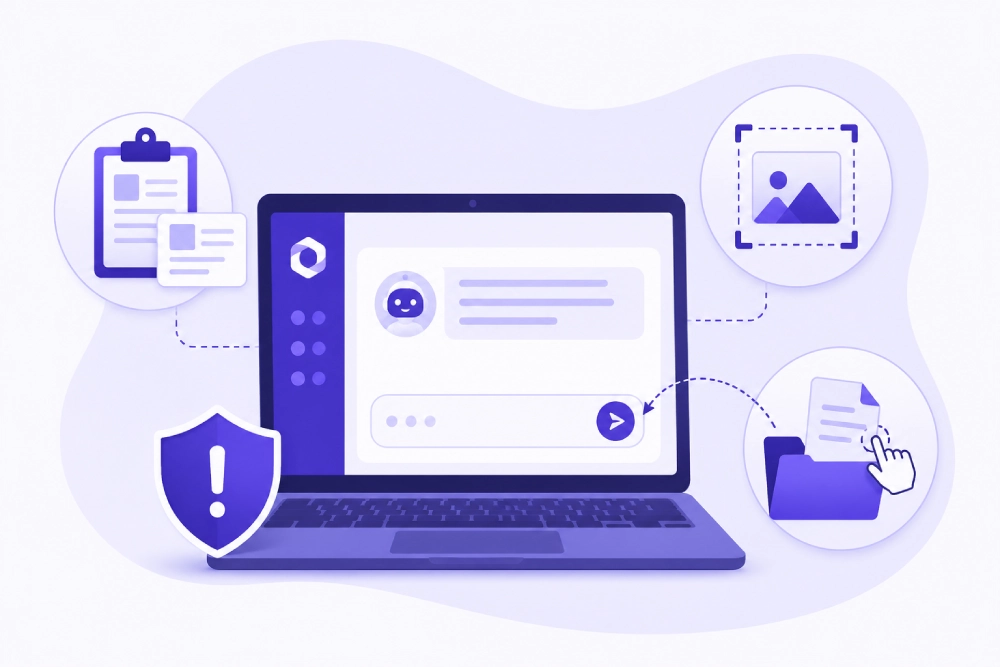
When an employee highlights a block of text, whether a patient record, a contract clause, or an API key, and pastes it into an AI chat interface, the data is transmitted to an external model, potentially logged, and potentially used for model training. The employee did not “send a file.” They performed a two-keystroke action that any knowledge worker executes dozens of times per day. The same logic applies to screenshots: a single key press can capture an entire screen of sensitive data and attach it to a multimodal AI prompt. File drag-and-drop into browser-based AI tools bypasses most upload controls because the action originates at the desktop level, not inside a managed application.
The underlying problem is that these micro-actions sit below the threshold of traditional monitoring. They happen at the endpoint, inside the operating system’s input layer, before any network inspection tool can see the content.
How Do AI Copilots Change the Threat Model for Endpoints?
The traditional endpoint threat model was built around malware: malicious software trying to exfiltrate data covertly. The new threat model includes trusted, user-invited software doing exactly what it was designed to do, which is read, summarize, and act on data that the user provides.
AI copilots and autonomous agents can read, copy, and process sensitive information at machine speed [securitymagazine.com]. An autonomous AI agent with access to a user’s file system, browser history, and clipboard can aggregate data from multiple sources and send a consolidated package to an external service in seconds, far faster than any human could. This is not a hypothetical: agentic workflows are already in production inside enterprise environments, connecting tools like Cursor, GitHub Copilot, and Microsoft 365 Copilot to internal data stores.
Legacy tools face a specific and structural problem here. Malware-focused endpoint tools look for suspicious processes and signatures. Network inspection tools examine traffic after it leaves the device. Static DLP rules check for pattern matches like credit card numbers or Social Security Numbers in outbound traffic. None of these approaches can evaluate the full context of a clipboard paste into a browser-based AI tool in real time, at the moment it happens, with enough intelligence to distinguish a safe action from a risky one.
What Makes Shadow GenAI Especially Dangerous for Data Leakage?
Shadow GenAI is the use of AI tools that the organization has not sanctioned, monitored, or risk-assessed. It is the AI equivalent of shadow IT, and it is growing rapidly [securitymagazine.com]. The problem is not that employees are being careless. It is that the tools are genuinely useful, and the friction of using an approved alternative is often higher than simply opening a browser tab.
Employee AI prompts can contain sensitive or confidential information [sosafe-awareness.com]. When those prompts are sent to an unsanctioned tool, the organization has no visibility into what was shared, no ability to enforce a retention policy, and no mechanism for incident response. The data has effectively left the building through the front door.
Clipboard and screenshot actions are the primary delivery mechanism for shadow GenAI data leakage. A user does not need to install anything or bypass any DLP agent. They open a browser, paste content, and the data is gone.
What Does Effective Endpoint Data Loss Prevention Look Like in 2026?
Effective endpoint data loss prevention in 2026 must operate at the source of the action, not downstream of it. That means the protection must reside on the device, observe what is happening at the OS level, classify the data in context rather than relying solely on pattern matching, and enforce a decision at the exact moment of the risky action.
The right approach covers these vectors simultaneously:
- Clipboard monitoring: Detecting when sensitive data is copied and intercepting the paste action before it reaches an AI tool or unsanctioned application.
- Screenshot and screen capture controls: Identifying sensitive content on screen and restricting or alerting on capture actions in high-risk contexts.
- File drag-and-drop inspection: Classifying files at the point of drag initiation, not just at the upload destination.
- Browser-based AI upload controls: Governing what can be submitted to which AI services, by whom, and under what conditions.
- Data lineage tracking: Understanding where a piece of data originated, how it has moved, and what happened to it, so that a security team can reconstruct an incident without guessing.
This is precisely why the conversation about data leakage prevention software has shifted from network-centric tools to endpoint-native platforms. Vendors like Netskope and Zscaler inspect traffic at the network layer, which provides value for some threat scenarios but introduces a fundamental blind spot: they cannot see clipboard content, screen state, or OS-level drag events before data enters a browser. Forcepoint and Safetica offer endpoint agents but were designed before agentic AI workflows became a real deployment scenario. Cyberhaven and Nightfall focus on data tracking in specific SaaS environments. None of them unify the full endpoint context, device posture, user identity, application behavior, and data movement, into a single real-time enforcement layer.
How Does Kitecyber Address These Risks?
Kitecyber was built specifically for the AI-agent era, treating the endpoint as the real-time decision point for data protection. Its single lightweight agent follows a continuous operating model: See, Decide, Enforce.
- See: The agent observes clipboard activity, screen state, browser behavior, file movement, GenAI prompt content, and agentic workflow actions across Windows, macOS, and Linux.
- Decide: It evaluates each action in context, considering who is acting, what device they are on, what data is involved, and where it is going, using document-context classification rather than pattern matching alone.
- Enforce: It applies the right control at the moment of action, whether that is allow, block, warn, coach, log, or isolate, without routing traffic through a remote inspection point.
This approach is particularly effective against the clipboard, screenshot, and file-drag risks that AI copilots create, because the enforcement happens at the OS layer, before data reaches any external service. Compliance support for frameworks including HIPAA, GDPR, SOC 2, CMMC, and PCI DSS is built in, so organizations protecting regulated data get both the technical control and the audit evidence they need.
About Kitecyber
Kitecyber is a next-generation cybersecurity platform that puts data security at the center of everything, protecting sensitive information at the endpoint where work actually happens. Its single lightweight agent unifies endpoint and network DLP, GenAI and AI agent security, Secure Web Gateway, SaaS app protection, ZTNA, and unified endpoint management, replacing fragmented point solutions with one integrated platform. Kitecyber is built for the AI-agent era, giving technology companies and regulated businesses the real-time visibility and enforcement they need to adopt AI confidently, without compromising compliance or security posture. Organizations including DuploCloud, Lily AI, Vanta, and Sarvam have chosen Kitecyber to secure their data in AI-driven environments.
Ready to see how Kitecyber protects against clipboard, screenshot, and file-drag data leakage in real time? Visit kitecyber.com to start a free trial or speak with the team.
References
Frequently Asked Questions