Table Of Content
Related Posts
How to Secure Employee Use of GenAI: The Complete Guide (2026)
-
July 10, 2026
-
Quick summary :
Autonomous AI agents are quietly becoming one of the most significant data security blind spots in enterprise environments today. Unlike a human employee who clicks, pauses, and considers, an AI agent reads files, summarizes documents, calls APIs, and uploads outputs at machine speed – all within the same trusted session your security tools already approved. In 2026, the question is no longer whether your organization uses AI agents. The question is whether your security controls were actually built to handle them.
Securing employee use of GenAI means controlling what sensitive data enters AI tools, which tools employees can access, and how autonomous AI agents act on behalf of users – all in real time, at the endpoint where the risk actually occurs. Generic awareness training and static policies are no longer sufficient. By 2026, the threat model has fundamentally shifted: AI copilots and agents can read, copy, and transmit sensitive data at machine speed, faster than any human reviewer or network inspection tool can respond [iternal.ai]. The right answer is enforcement at the point of risk, not detection after the fact.
About the Author: Kitecyber is an endpoint-native data security company specializing in AI agent security and data loss prevention for technology and regulated-industry businesses. Its platform is purpose-built for the era of autonomous AI, and its customer base includes AI-native companies such as DuploCloud, Lily AI, Vanta, and Sarvam.
TL;DR
- AI copilots and agents have made the endpoint the primary data exfiltration risk, not the network perimeter.
- Shadow GenAI use is widespread; employees routinely paste source code, customer records, and financial data into unauthorized AI tools [concentric.ai].
- A written AI usage policy is necessary but not sufficient – real-time technical enforcement is what actually prevents leakage [brside.com].
- AI data loss prevention requires context-aware classification and enforcement at the moment of action, not after-the-fact log review.
- Consolidating controls into one agent beats assembling a stack of point solutions that leave gaps between tools.
Why Has GenAI Made Employee Data Risk Worse?
The endpoint is now the primary data security battleground, and AI is the reason. Before AI copilots, a motivated insider still needed time to copy, compress, and move large volumes of sensitive data. An AI agent can do the same in seconds – summarizing a confidential contract, pasting it into an external prompt, or uploading an entire codebase to a shadow GenAI app without triggering a single network alert [concentric.ai].
Three specific shifts make this harder than the pre-AI problem:
- Speed: Agentic workflows operate at machine speed. A human security reviewer cannot interpose between action and completion.
- Invisibility: Employees use dozens of GenAI tools, many unsanctioned. Shadow GenAI is the new shadow IT, and most legacy tools cannot distinguish a sanctioned AI app from an unauthorized one.
- Ambiguity: Not every AI interaction is malicious. An employee pasting a customer name into a chatbot may be careless, not criminal. Controls need to coach and warn, not just block.
Legacy tools were not designed for this. Endpoint security tools focus on malware. Network DLP inspects traffic but cannot see encrypted browser sessions or clipboard activity. Static DLP policies written for file servers do not account for prompts and agentic workflows. VPNs trust the network, not the action.
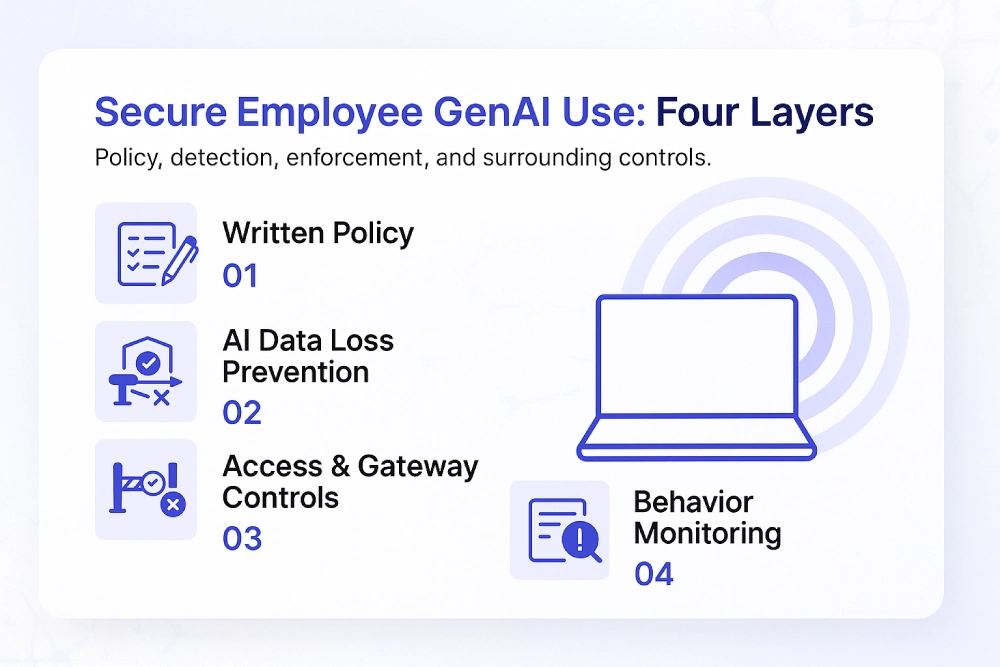
What Should an AI Usage Policy Actually Include?
A written policy is the governance foundation, but most organizations write policies that are too vague to enforce [brside.com]. An effective AI usage policy in 2026 should specify:
- Sanctioned vs. unsanctioned tools: Name the approved GenAI platforms explicitly. Employees need a clear list, not a general prohibition on “unapproved AI” [criadv.com].
- Data classification rules: Define which data categories – personal data, source code, financial records, health information – are prohibited from entering any external AI tool, sanctioned or not [concentric.ai].
- Acceptable use boundaries: Describe specific permitted use cases (drafting, summarization, code assistance) and prohibited ones (uploading customer PII, sharing credentials, pasting internal financial data) [brside.com].
- Incident reporting: Give employees a simple path to report accidental data exposure to an AI tool.
- Enforcement mechanism: State how violations are detected and what consequences follow. A policy without enforcement is a suggestion [it.nc.gov].
|
Policy Element |
Common Mistake |
Better Approach |
|---|---|---|
|
Tool allowlist |
“Use approved AI tools” |
Name each approved tool explicitly |
|
Data rules |
“Do not share sensitive data” |
List prohibited data categories by type |
|
Enforcement |
No mention of controls |
Reference real-time monitoring and DLP |
|
Employee onboarding |
Policy buried in handbook |
Required acknowledgment plus live training [kairntech.com] |
|
Review cadence |
Annual review |
Quarterly, given how fast AI tools change |
How Does AI Data Loss Prevention Actually Work?
AI data loss prevention (AI DLP) is the technical enforcement layer that makes a policy real. It intercepts, classifies, and controls data movement at the moment it happens – not in a log review the following morning. This is where the distinction between legacy DLP and modern, endpoint-native DLP matters most.
Legacy DLP approaches have three structural weaknesses against GenAI threats:
- Pattern matching alone is insufficient. A policy that blocks Social Security number patterns will miss a prompt that says “here is the contract for Acme Corp, their revenue is $40M.” Context matters as much as format. Also pattern matching leads to lot of false positives. It is not easy to distinguish a date from date of birth.
- Network inspection misses a lot of activity in/out of a browser. Most GenAI use happens in a browser, over HTTPS. Network-layer tools that decrypt and inspect traffic add latency and miss clipboard activity entirely. They also can’t inspect apps that are end to end encrypted and don’t allow for decryption.
- Static policies cannot keep pace. New AI tools appear weekly. A policy written against a fixed list of domains is obsolete before it is deployed.
Effective AI DLP in 2026 requires:
- Endpoint-native visibility: Observe what is happening on the device – clipboard, file access, browser activity, prompt content, and AI agent actions – not just what crosses the network.
- Context-aware classification: Classify data by document type, content, and usage context, not only by regex pattern matching.
- Real-time enforcement: Allow, block, warn, or coach at the moment of the action, not after it completes.
- Data lineage tracking: Know where a piece of sensitive data originated, how it moved, and where it ended up – across files, browser sessions, SaaS uploads, and AI prompts.
Kitecyber’s approach follows a straightforward model: See, Decide, Enforce – continuously. The single lightweight agent observes endpoint activity across all these channels, evaluates each action in context, and enforces the right control at the exact point of risk. This replaces the fragmented combination of a legacy DLP tool, a separate secure web gateway, and a standalone AI monitoring product that most organizations are currently trying to stitch together.
What Controls Should Wrap Around the Policy and DLP?
Building on the data-security core, a complete employee GenAI security program needs a small number of surrounding controls that work together rather than independently:
- Secure Web Gateway:
Block access to unsanctioned GenAI destinations and high-risk sites before a prompt is entered, not after. - SaaS app governance:
Control data movement into sanctioned apps and detect shadow GenAI apps being accessed through the browser. - Zero Trust Network Access:
Replace VPN with context-aware access based on identity, device posture, and least privilege – so a compromised or unmanaged device cannot reach sensitive internal systems that an AI agent might then read. - Unified endpoint management:
Automate onboarding so new employees start with the right policies applied, and offboarding so departing employees lose access before they walk out [kairntech.com]. - Insider risk monitoring:
Detect behavioral patterns that signal risk – mass file access before resignation, repeated attempts to paste data into blocked AI tools, or unusual access to sensitive directories.None of these controls work well in isolation. The reason organizations end up with blind spots is that each tool only sees part of the picture.
About Kitecyber
Kitecyber is a next-generation data security company headquartered in the Bay Area, California, built specifically for the AI agent era. Its platform delivers endpoint-native data protection through a single lightweight agent that unifies endpoint and network DLP, GenAI and AI agent security, Secure Web Gateway, SaaS app governance, ZTNA, and unified endpoint management. The See, Decide, Enforce model gives security teams real-time visibility and control over sensitive data movement across files, browsers, GenAI prompts, SaaS apps, and autonomous agentic workflows, without the fragmentation of assembling multiple point solutions. Kitecyber supports compliance with HIPAA, GDPR, SOC 2, CMMC, PCI DSS, and other frameworks, and is trusted by AI-native and technology companies seeking to adopt AI confidently.
Ready to see how Kitecyber secures employee GenAI use in practice? Visit kitecyber.com to start a free trial or speak with the team.
References
- Employee Onboarding AI: The Complete Guide for 2026 (kairntech.com)
- How to Create an Effective AI Usage Policy (2026 Guide) | Brightside AI Blog (brside.com)
- Enterprise AI Training: The Complete Guide to Workforce AI Fluency (2026) (iternal.ai)
- GenAI Data Security: A 2026 Guide (concentric.ai)
- Employee Use of AI: Why You Need a Policy and What to Include | Carr, Riggs & Ingram (criadv.com)
- New State Policy Sets Clear, Secure Standards for Employee Use of Generative AI | NCDIT (it.nc.gov)
Frequently Asked Questions
Shadow GenAI refers to AI tools that employees use without IT or security team approval. It is the AI equivalent of shadow IT. Employees paste sensitive data into public AI chatbots, browser extensions, and productivity apps that the organization has not vetted or authorized [concentric.ai].
Requirements vary by jurisdiction and industry, but regulators in healthcare, finance, and government sectors increasingly expect documented AI governance as part of broader data protection obligations [it.nc.gov]. A policy also provides a defensible record in the event of a breach investigation.
Most legacy DLP tools were built for file servers, email, and USB drives. They lack visibility into browser-based AI interactions, clipboard activity, and agentic workflows. Organizations evaluating tools like Forcepoint, Safetica, Netwrix, Nightfall, or Cyberhaven should specifically test whether the tool can inspect GenAI prompt content in real time on the endpoint.
Source code, customer records, personally identifiable information, financial data, and internal credentials are the categories most frequently exposed through GenAI tools [concentric.ai]. These are also the categories that attract the largest regulatory penalties.
The goal is not to prohibit AI use - it is to make it safe. Warn-and-coach controls let employees know when an action is risky without stopping them entirely. Over time, this shifts behavior without creating friction that drives shadow GenAI adoption.
Endpoint DLP operates on the device itself, giving it visibility into clipboard, file access, and browser activity before data leaves. Network DLP inspects traffic at a network layer but cannot see encrypted sessions in detail or on-device actions. For AI prompt security specifically, endpoint-native visibility is essential because the data often never traverses a corporate network gateway.
Autonomous AI agents require the same data-aware controls as human users, but applied at machine speed. Any agent that can read files, access internal systems, or make API calls is a potential data exfiltration path. Controls need to evaluate what data the agent is touching, where it is sending it, and whether that action matches an authorized workflow - all in real time.

Ajay Gulati
Ajay Gulati is a passionate entrepreneur focused on bringing innovative products to market that solve real-world problems with high impact. He is highly skilled in building and leading effective software development teams, driving success through strong leadership and technical expertise. With deep knowledge across multiple domains, including virtualization, networking, storage, cloud environments, and on-premises systems, he excels in product development and troubleshooting. His experience spans global development environments, working across multiple geographies. As the co-founder of Kitecyber, he is dedicated to advancing AI-driven security solutions.