Table Of Content
Related Posts



JumpCloud and Jamf Alternatives: What UEM Buyers Should Expect From an Endpoint-Native Security Platform
-
August 6, 2026
-
Quick Answer:
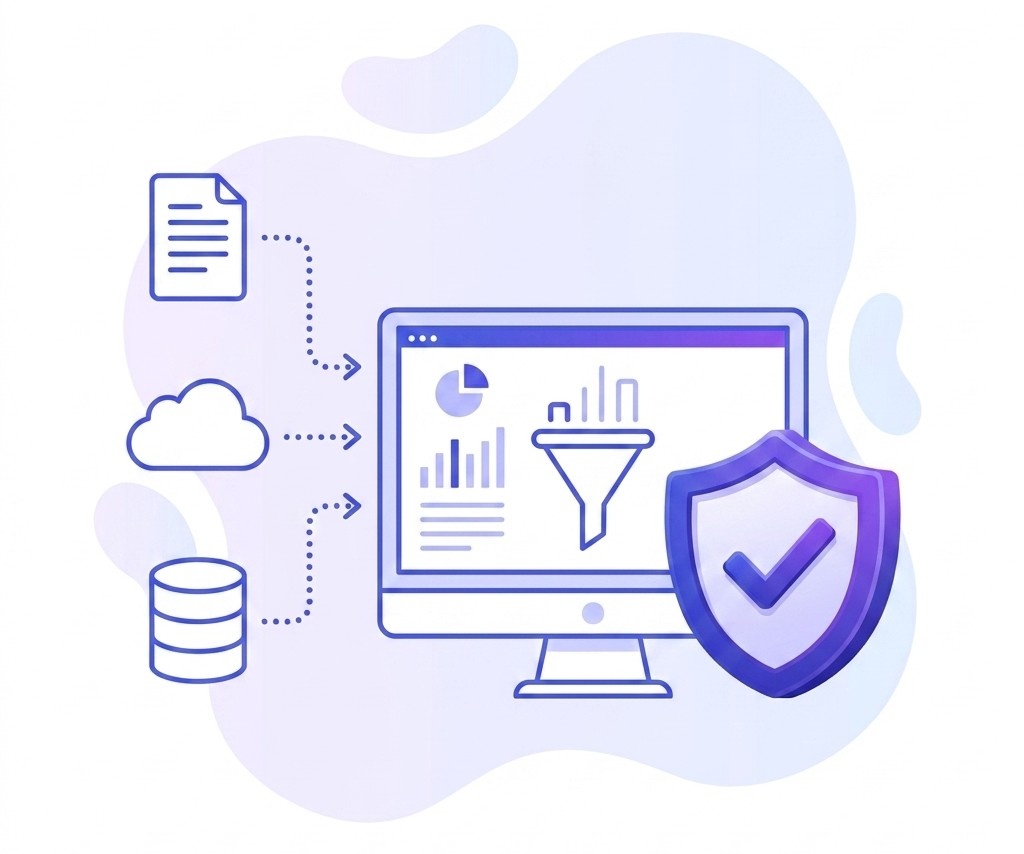
AI Security Posture Management (AISPM), also called AI Posture Management, is the continuous process of discovering, monitoring, and controlling how AI tools, models, and agents interact with your company's data and systems. It covers everything from spotting an unapproved AI app on someone's laptop to blocking a customer record from being pasted into a public chatbot. Most teams that manage AI posture well pair a discovery layer with policy enforcement at the point where employees actually use AI, which is the endpoint.
Buyers evaluating JumpCloud or Jamf alternatives in 2026 should expect a platform that does more than manage devices: it should classify and protect the sensitive data resident on those devices, in real time, without adding a second or third agent. Unified endpoint management (UEM) tools like JumpCloud and Jamf were built to configure, patch, and enforce policy on laptops and phones. They were not built to see what happens when a GenAI copilot reads a customer database, or when an autonomous agent copies source code into an unsanctioned SaaS tool. That gap is why endpoint-native security platforms, which fold data loss prevention (DLP), secure web gateway, and zero trust access into the same lightweight agent that manages the device, are becoming the standard buyers should hold vendors to.
TL;DR
- JumpCloud and Jamf are strong at device configuration, identity, and OS-level policy, but neither natively classifies sensitive data or tracks where it moves once a user or AI agent touches it [viewpointanalysis.com][getprimo.com].
- The UEM market reflects how central endpoint control has become to enterprise security budgets, with significant growth expected over the coming decade.
- The real buying question in 2026 is not "UEM vs MDM," it's whether device management and data security run as one agent or as a stitched-together stack of point tools.
- AI copilots and agentic workflows have changed what "risk" looks like at the endpoint: it's no longer just malware, it's data leaving through prompts, clipboard, and browser uploads at machine speed.
- Kitecyber approaches this by unifying endpoint DLP, GenAI/agent security, SWG, ZTNA, and UEM into one lightweight agent built around a single operating model: See, Decide, Enforce, continuously.
About the Author: This article is published by Kitecyber, a data security company headquartered in the Bay Area that builds endpoint-native protection for organizations navigating AI adoption, remote work, and compliance requirements such as HIPAA, SOC 2, and CMMC. Kitecyber’s platform is used by technology companies including DuploCloud, Lily AI, Sarvam, and Vanta to unify device management with real-time data protection.
What Is the Difference Between UEM and MDM?
Mobile device management (MDM) configures and restricts a device: it pushes profiles, enforces passcodes, wipes lost hardware, and manages app installs. Unified endpoint management (UEM) is the broader category that MDM sits inside, covering desktops, laptops, mobile devices, and increasingly Linux and IoT endpoints, all through a single console with policy, patching, and compliance reporting layered on top [zecurit.com][syncrosecure.com].
The distinction matters for buyers comparing JumpCloud and Jamf because both vendors market themselves as UEM platforms, but their strengths sit in different places:
- Jamf focuses heavily on Apple ecosystem management, with granular macOS and iOS controls and rapid compatibility with new Apple OS releases [jamf.com].
- JumpCloud combines directory services and identity with device management, appealing to organizations that want a single system for both authentication and endpoint policy [zenadmin.ai][peerspot.com].
Both platforms provide foundational OS-level DLP controls, such as restricting USB devices, application access, and data flow through MDM profiles. Neither, however, includes native advanced sensitive data classification or data lineage tracking. Both rely on third-party integrations, such as Cyberhaven, Microsoft Purview, or Cloudflare, to perform deep content analysis. That reliance on third-party tooling is the starting point for understanding why buyers look at endpoint-native alternatives.
Why Are Buyers Looking for Jamf Alternatives and JumpCloud Alternatives?
Buyers evaluate alternatives when the tool that manages their devices can’t answer a harder question: what happened to the data on those devices? Jamf pricing and JumpCloud pricing structures are built around per-device or per-user device management, not around data protection depth, so organizations that need both often end up licensing a second or third product to close the gap.
This has become more urgent as AI tools spread through the workforce. Neither JumpCloud nor Jamf natively supports GenAI prompt inspection, clipboard-level data visibility, or deep SaaS monitoring. Instead, they act as the deployment mechanism, pushing out a third-party AI-native agent, such as Kitecyber, that hooks into OS APIs to intercept clipboard activity and monitor AI prompts. In practice, this means a buyer choosing “just” a UEM platform is implicitly signing up for a second procurement cycle later, once shadow GenAI usage or insider risk becomes a board-level concern.
Compare this to the analyst definition of where the category is heading: endpoint-native security is the convergence of UEM, DLP, secure web gateway, and zero trust access into a single agent enforcing policy directly on the device. That convergence is viewed as necessary to address machine-speed data exfiltration by AI agents and shadow SaaS usage at the point of risk, rather than after the fact.
How Has AI Changed What an Endpoint Security Platform Needs to Do?
AI has turned the endpoint into a live decision point, not just a managed asset. A traditional endpoint agent asks “is this device compliant?” An endpoint-native security platform has to ask a faster, harder question: “is this specific action, happening right now, safe to allow?”
Documented incidents show why this matters. AI agents have exfiltrated data through over-permissioned identities, compromised SaaS integrations, and malicious agent plugins. Specific vectors include behavioral control traps and systemic vulnerabilities in AI supply chains, such as issues identified in the Anthropic MCP ecosystem, along with machine-speed exfiltration through chained tool calls. A human copying a sensitive file to an unsanctioned app takes seconds and can be caught by a slow-moving alert. An autonomous agent doing the same thing across a hundred files happens before a static rule engine even finishes evaluating the first one.
Think of it like the difference between a security guard checking badges at a door versus a guard who has to evaluate, in real time, whether the person walking through is actually who their badge says, whether they’re carrying something they shouldn’t, and whether the room they’re walking into is even one they should have access to. Static rules check the badge. Continuous evaluation checks the whole situation, every time, at the moment it happens.
What Should an Endpoint-Native Security Platform Actually Do?
An endpoint-native security platform should observe, evaluate, and act on data movement at the device level, continuously, not on a schedule. This is where Kitecyber’s operating model, See, Decide, Enforce, describes the mechanism directly: the agent observes endpoint posture, browser behavior, data movement, SaaS access, AI prompts, and private app sessions; evaluates each action in context (who is acting, what device, what data, where it’s headed); and enforces the appropriate control (allow, block, warn, coach, log, or isolate) at the exact point of risk.
Buyers should expect the following from a genuinely endpoint-native platform, not treat them as optional add-ons:
|
Capability |
What it means in practice |
|---|---|
|
Endpoint DLP software |
Classifies sensitive data by content and context, not just keyword matching, across files, clipboard, and uploads |
|
GenAI/agent security |
Inspects prompts and agent actions before data leaves the device |
|
Data lineage tracking |
Shows where a piece of sensitive data has traveled, not just where it currently sits |
|
Secure web gateway |
Filters risky destinations and unsafe downloads directly at the endpoint |
|
ZTNA |
Replaces VPN trust models with identity- and posture-based access to private apps and cloud infrastructure |
|
UEM and compliance automation |
Manages Windows, macOS, and Linux devices, automates onboarding and offboarding, and supports frameworks like HIPAA, GDPR, and PCI DSS |
Both JumpCloud and Jamf claim support for major regulatory frameworks including HIPAA, GDPR, and PCI DSS, and both hold SOC 2 Type 2 and ISO 27001 certifications, with Jamf additionally holding ISO 27701. That compliance posture covers device management. It does not, on its own, cover the data-in-motion requirements that HIPAA DLP, FINRA, or CMMC assessments increasingly scrutinize, which is why data-layer visibility has to be part of the same platform, not a bolt-on.
How Do Jamf and JumpCloud Compare to Endpoint-Native Platforms Like Kitecyber?
The comparison isn’t Jamf versus JumpCloud versus Kitecyber as competing UEM tools; it’s device management versus device management plus data security, running as one agent. Jamf’s strength in Apple-specific management and JumpCloud’s combination of identity and device policy remain genuinely useful for IT teams that need fast, reliable device configuration [jamf.com][zenadmin.ai][peerspot.com]. Neither, on current documentation, extends into content-aware DLP, data lineage, or GenAI prompt inspection without a third-party integration.
Kitecyber approaches the same buyer problem from the data-security side first, then unifies device management around it. Instead of stitching a UEM tool to a separate DLP vendor to a separate SWG to a separate ZTNA client, one lightweight agent covers all of it: endpoint and network DLP, GenAI and AI-agent security, secure web gateway, SaaS app protection, ZTNA, and UEM with compliance automation for HIPAA, GDPR, CMMC, ISO 27001, SOC 2, DPDP, FINRA, and PCI DSS. For IT and security teams evaluating JumpCloud or Jamf alternatives, that consolidation is the practical answer to fragmentation: fewer agents on the endpoint, fewer blind spots between tools, and one place to see data lineage and enforce policy at the moment of risk.
About Kitecyber
Kitecyber is a data security company built around the idea that the endpoint, not the network perimeter, is where sensitive data actually needs protection. Its platform unifies endpoint and network DLP, GenAI and AI-agent security, secure web gateway, SaaS app protection, ZTNA, and unified endpoint management into one lightweight agent, replacing the fragmented stacks that many organizations assemble from separate UEM, DLP, and SSE vendors. Kitecyber is used by technology and AI-native companies including DuploCloud, Lily AI, Sarvam, Scrut Automation, and Vanta, and supports compliance requirements spanning HIPAA, GDPR, CMMC, ISO 27001, SOC 2, DPDP, FINRA, and PCI DSS. The company positions its approach as prevention over reaction: seeing data movement, deciding in context, and enforcing at the point of risk, continuously.
References
- Endpoint Management Software Options 2026 (viewpointanalysis.com)
- Best Jamf Alternatives in 2026 (Top Tools for Mac SMBs) (getprimo.com)
- Top 10 Unified Endpoint Management Tools in 2026 | Reviewed (zecurit.com)
- 10 Unified Endpoint Management Tools Compared for 2026 (syncrosecure.com)
- Jamf named a Unified Endpoint Management leader…again! (jamf.com)
- JumpCloud Alternatives for Global Identity and Device Management in 2026 | ZenAdmin (zenadmin.ai)
- Jamf Pro vs JumpCloud (2026) (peerspot.com)
Frequently Asked Questions
Kitecyber includes native UEM and compliance automation for Windows, macOS, and Linux, so it can operate as a consolidated replacement. Organizations already invested in Jamf for Apple-specific management can also run Kitecyber alongside it for the data-security layer JumpCloud and Jamf don't natively provide.
MDM configures and restricts individual devices. UEM is the broader console covering desktops, mobile, and often Linux, with policy and compliance reporting layered on top [zecurit.com][syncrosecure.com]. Neither term, by itself, implies data-loss prevention or content classification.
Both provide OS-level controls like USB restriction and app-access policy through MDM profiles. Neither includes native advanced content classification or data lineage tracking; both typically integrate with third-party DLP tools for that depth.
Because AI copilots and agents can read, summarize, and move sensitive data at machine speed, often through prompts or clipboard actions that legacy MDM profiles were never designed to inspect.
The global UEM market is growing significantly, with projections to expand substantially over the coming decade. Jamf and JumpCloud are among the recognized vendors in this category.
Buyers in regulated industries should look for support of HIPAA, GDPR, PCI DSS, SOC 2, ISO 27001, CMMC, DPDP, and FINRA, depending on sector. Both JumpCloud and Jamf maintain SOC 2 Type 2 and ISO 27001; Jamf additionally holds ISO 27701.
It means UEM, DLP, secure web gateway, and zero trust access converge into a single agent enforcing policy directly on the device, rather than a network appliance or a stack of separate point tools inspecting traffic after the fact.

Ajay Gulati
Ajay Gulati is a passionate entrepreneur focused on bringing innovative products to market that solve real-world problems with high impact. He is highly skilled in building and leading effective software development teams, driving success through strong leadership and technical expertise. With deep knowledge across multiple domains, including virtualization, networking, storage, cloud environments, and on-premises systems, he excels in product development and troubleshooting. His experience spans global development environments, working across multiple geographies. As the co-founder of Kitecyber, he is dedicated to advancing AI-driven security solutions.