Table Of Content
- What Does Microsoft Purview Actually Include at Each License Tier?
- Where Does Purview's Coverage Stop for a Non-Microsoft-Only Environment?
- Which Alternatives Should Mid-Market Teams Actually Evaluate?
- How Should a Mid-Market Team Decide Between Purview and an Alternative?
- Why Does Endpoint-Native DLP Matter More as AI Adoption Grows?
Related Posts


Table Of Content
- What Does Microsoft Purview Actually Include at Each License Tier?
- Where Does Purview's Coverage Stop for a Non-Microsoft-Only Environment?
- Which Alternatives Should Mid-Market Teams Actually Evaluate?
- How Should a Mid-Market Team Decide Between Purview and an Alternative?
- Why Does Endpoint-Native DLP Matter More as AI Adoption Grows?
Best Endpoint-Native DLP Alternatives to Microsoft Purview for Mid-Market Companies Outside the E5 License
-
September 17, 2026
-
Quick Answer:
AI Security Posture Management (AISPM), also called AI Posture Management, is the continuous process of discovering, monitoring, and controlling how AI tools, models, and agents interact with your company's data and systems. It covers everything from spotting an unapproved AI app on someone's laptop to blocking a customer record from being pasted into a public chatbot. Most teams that manage AI posture well pair a discovery layer with policy enforcement at the point where employees actually use AI, which is the endpoint.
Mid-market companies that run Microsoft 365 E3 or Business Premium often discover that the Purview capability they actually need, like advanced endpoint DLP or insider risk analytics, sits behind an E5 license or a separate Purview add-on. When the upgrade cost cannot be justified for a security team of two or three people, the right move is not to wait for budget approval. It is to evaluate endpoint-native and cloud-native DLP platforms built to run independently of Microsoft’s licensing tiers, several of which cover more ground outside the Microsoft ecosystem, including Linux endpoints, non-Microsoft SaaS apps, and data pasted or uploaded into GenAI tools like ChatGPT and Claude, than Purview’s native DLP does today.
This is not a case against Purview. For a company operating entirely within Microsoft 365 and Azure, Purview’s data mapping, sensitivity labeling, and compliance tooling are genuinely capable. The issue is fit: what a company gets at E3, what requires E5 or a Purview add-on, and what stays out of reach regardless of tier because it falls outside Microsoft’s own ecosystem.
TL;DR
- Microsoft Purview's core DLP exists at multiple tiers, but advanced endpoint DLP, insider risk management, and adaptive protection are commonly gated behind E5 or a Purview/compliance add-on layered onto E3 or Business Premium.
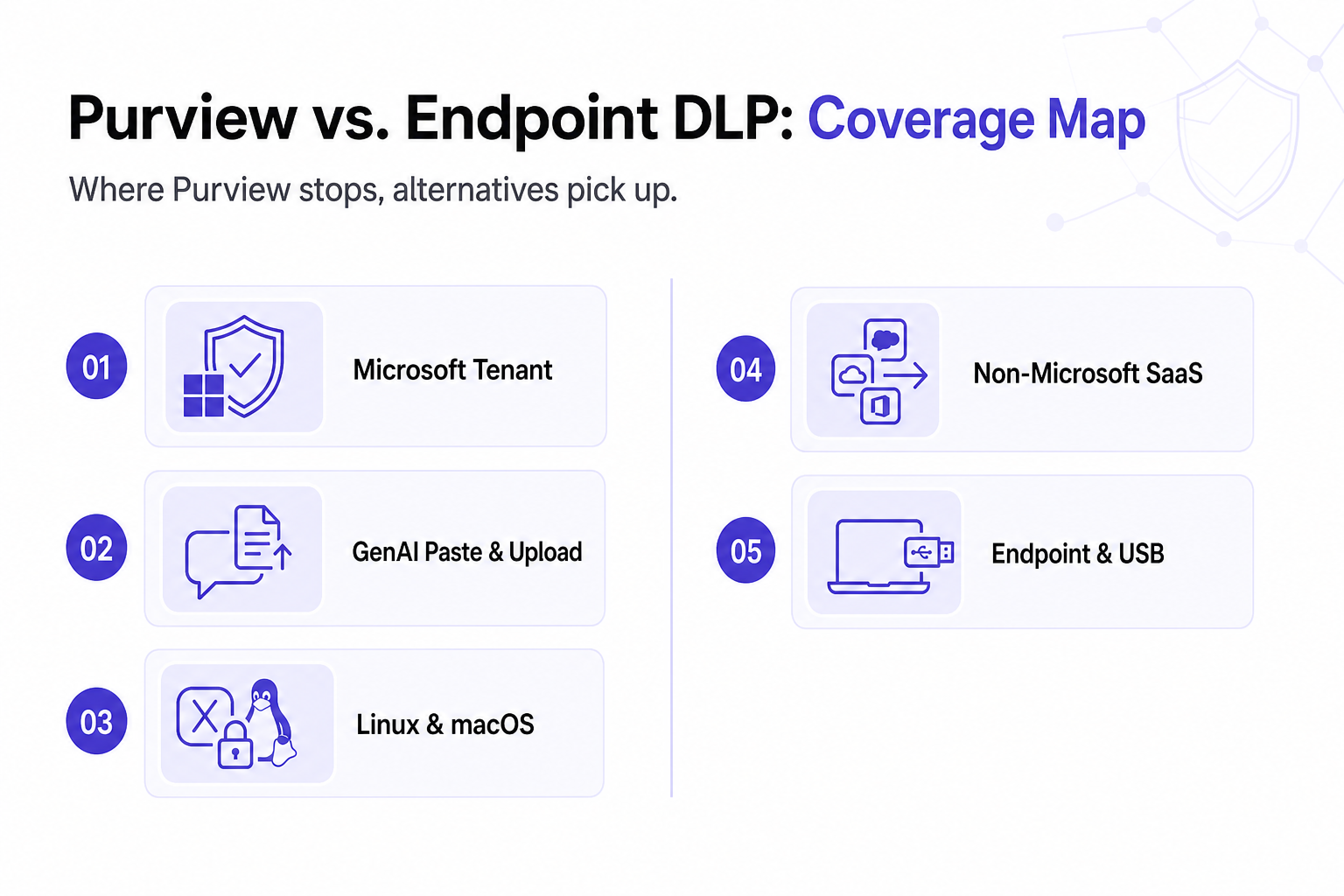
- Purview's DLP is tenant-centric: it is strongest inside Microsoft 365 and struggles with non-Microsoft SaaS apps, arbitrary browser uploads, GenAI tools outside Copilot, and Linux or macOS endpoints without added configuration.
- Alternatives worth evaluating include Kitecyber, Nightfall, Strac, Cyberhaven, and Safetica, each with a different architecture and a different honest fit.
- The decision should be based on where your sensitive data actually moves (endpoint, browser, SaaS, GenAI paste and upload activity) rather than which vendor has the longest feature list.
- Endpoint-native DLP with GenAI security built in closes the specific gaps mid-market teams hit most: shadow AI usage, personal browser profiles, and cross-platform endpoint coverage.
About the Author: This article is written by the Kitecyber team, which builds endpoint-native DLP for mid-market and regulated companies, including fintech, healthcare, and GenAI-native businesses, that need real-time data protection without deploying a full enterprise security suite or hiring a dedicated DLP analyst.
What Does Microsoft Purview Actually Include at Each License Tier?
Microsoft Purview is not one product with one price point; it is a set of modules that activate differently depending on your Microsoft 365 license. Purview includes capabilities spanning data loss prevention, information protection, data lifecycle management, eDiscovery, and insider risk management. Mid-market companies running E3 or Business Premium can access more advanced DLP functionality, but typically by purchasing a Purview add-on or a higher compliance tier layered onto their existing license.
That licensing structure matters because most mid-market Microsoft 365 estates are not on E5. In practice, the majority run on E3 or Business Premium, which means most mid-market IT teams researching Purview DLP are evaluating a capability they would need to add to, not one they already fully own.
The practical takeaway: before assuming you need E5, map the specific Purview module you want (endpoint DLP, insider risk management, adaptive protection, data lifecycle management) against your current tier and ask whether a modular add-on covers it. Do not assume every advanced feature is E5-exclusive; several are available as add-ons on top of E3. Because Microsoft renames and repackages these modules periodically, confirm the current add-on structure and module names against Microsoft’s own licensing documentation before you budget.
Where Does Purview's Coverage Stop for a Non-Microsoft-Only Environment?
Purview’s DLP is built around the Microsoft 365 tenant, and that is both its strength and its boundary. Its native DLP is heavily tenant-centric and struggles to monitor data exfiltration through non-Microsoft GenAI paste and upload activity, personal browser profiles, and third-party SaaS applications without premium endpoint DLP configurations. It also lacks deep contextual parsing to reliably classify sensitive data at the point of paste or upload in complex AI workflows outside the Microsoft ecosystem, often requiring third-party integrations to close these gaps.
Think of Purview as a building’s badge access system. It is excellent at controlling who enters through the Microsoft-branded doors: SharePoint, Exchange, Teams, OneDrive. But if an employee copies a customer list into a personal Gmail tab, pastes source code into a GenAI chatbot outside Copilot, or works from a Linux workstation, that traffic never passes through a badge reader Purview controls. The data left the building through a different exit.
This is exactly the gap that shows up for mid-market companies with:
- Mixed SaaS stacks that include tools outside Microsoft 365, where DLP coverage depends on API integrations rather than native tenant policy.
- BYOD and contractor devices, including Linux and macOS machines, where endpoint DLP configuration is more limited without premium add-ons.
- Shadow GenAI usage, where employees use ChatGPT, Claude, or other AI tools directly in a browser rather than through Copilot.
- Browser-based uploads to arbitrary destinations that never touch a monitored Microsoft 365 workflow.
None of this makes Purview a weak product for what it is built to do. It means a Microsoft-centric DLP policy has a Microsoft-centric blind spot, and that blind spot is precisely where modern data loss happens most often.
Which Alternatives Should Mid-Market Teams Actually Evaluate?
The honest answer depends on where your data risk concentrates, not on which vendor markets itself loudest as a “Purview alternative.” Because the underlying need is DLP that follows data outside the Microsoft tenant, it’s worth looking at how each alternative handles cross-platform endpoint coverage, deep API-based SaaS monitoring outside Microsoft, or GenAI security that classifies sensitive data at the point it’s pasted or uploaded into tools like ChatGPT and Claude.
| Platform | Architecture | Best Fit | Honest Limitation |
|---|---|---|---|
| Kitecyber | Endpoint-native DLP agent across Windows, macOS, native Linux, plus SaaS, email, browser, and GenAI paste/upload coverage | Mid-market teams needing DLP that follows data across endpoints, browsers, SaaS, and AI tools | Best suited to teams ready to standardize on one lightweight agent rather than stitch together point tools |
| Nightfall | Cloud-native, API-first with an endpoint agent | Teams whose main exposure is SaaS apps and cloud storage | Relies on cloud connectivity for its core detection engine |
| Strac | Endpoint DLP agent for macOS, Windows, and Linux, combined with API-first DSPM/DLP for SaaS and email | Teams wanting both device-level exfiltration controls (USB, clipboard, print) and fast SaaS and email coverage | Combines agent-based and API-based approaches, which means deployment and management span both models |
| Cyberhaven | Cloud console with endpoint agents and browser extensions | Teams prioritizing data lineage tracking to see exactly how a file moved before it left | Requires agent or extension deployment on every device to capture full lineage |
| Safetica | On-prem or cloud-native endpoint agents | Mid-market teams wanting DLP and insider risk in one product with flexible deployment | Validate classification depth on scanned or image-based documents during evaluation |
Nightfall is genuinely strong for teams whose primary exposure sits in SaaS applications and cloud storage rather than on managed devices; its API-first model fits companies that want fast coverage across cloud platforms without deploying agents everywhere, though its core detection depends on cloud connectivity rather than on-device enforcement. Strac fits teams that want both device-level control and SaaS and email coverage, since it pairs a full endpoint DLP agent for macOS, Windows, and Linux, governing channels like USB, clipboard, and print, with an API-first approach for SaaS and email; the tradeoff is that managing both an agent and API-based integrations adds more moving parts than a single-architecture solution. Cyberhaven is a good fit for teams whose priority is understanding data lineage, tracing exactly how a file moved and where it came from before it left the organization, though realizing that visibility fully requires deploying its agent or browser extension on every device in scope. Safetica suits mid-market teams that want DLP and insider risk monitoring in a single product with either on-prem or cloud deployment flexibility, so teams that rely heavily on scanned or image-based documents should validate its classification depth on those during evaluation.
A related but distinct question worth asking during evaluation is not “which vendor has more features” but “which vendor sees the moment data actually moves.” A tool that inspects cloud API traffic will not see a file dragged from desktop to USB drive. A tool that only watches the endpoint will not see a SaaS-to-SaaS data transfer with no local footprint. This is why Kitecyber’s approach is built around a single lightweight agent that covers the endpoint, browser, clipboard, removable media, email, and SaaS from one place, operating on a continuous loop: See, Decide, Enforce.
How Should a Mid-Market Team Decide Between Purview and an Alternative?
The decision is not binary, and for most Microsoft-heavy shops, it should not be framed as replacing Purview entirely. Building on the coverage gaps above, the harder question is whether your organization’s actual risk surface is inside the Microsoft tenant or outside it.
A practical framework:
- Map your sensitive data types. Financial records, PHI, source code, customer PII, and credentials each move through different channels. Fintech and healthcare teams handling FINRA, PCI DSS, or HIPAA-regulated data need to know exactly where that data lives, not just inside SharePoint but on endpoints, in email, and increasingly in what gets pasted or uploaded into GenAI tools.
- Trace where data actually exits.. If most exfiltration risk runs through Microsoft 365 apps you already govern, Purview's native tooling may be sufficient. If it runs through personal browser tabs, Linux dev machines, or non-Microsoft SaaS, that is a native gap regardless of license tier.
- Check your compliance mapping. Mid-market companies in regulated verticals typically must address requirements under SOC 2, ISO 27001, HIPAA, GDPR, and PCI DSS. Alternative DLP solutions help support these requirements through pre-built policy templates, automated evidence collection, and audit-ready logging, though certification ultimately depends on how the organization configures, operates, and documents its own program.
- Evaluate endpoint-native DLP. Because Kitecyber's agent operates across endpoints, browsers, SaaS, and GenAI paste and upload activity, it helps address more compliance controls across SOC 2, ISO 27001, HIPAA, FINRA, PCI DSS, and GDPR than a pure DLP point product, while reducing operational overhead through policy templates and automated classification.
Why Does Endpoint-Native DLP Matter More as AI Adoption Grows?
Stepping back from the vendor comparison, the deeper shift driving this whole search is that AI has changed the endpoint threat model. Copilots and autonomous agents can read, summarize, and move sensitive data at machine speed, often without a clear security boundary between “approved AI tool” and “unmanaged AI tool.” Securing GenAI applications requires on-device interception, classification of sensitive data at the point it’s pasted or uploaded across AI providers, deep attachment decomposition, and context-aware classification that can act on sensitive data in real time.
Kitecyber applies this same real-time model at the endpoint: it discovers shadow GenAI usage across the organization, prevents sensitive data from leaking into ChatGPT and similar apps, and secures AI agents running on company devices, all through one agent rather than a separate tool bolted onto the DLP stack. Context-aware classification (reading document context, not just regex patterns) combined with real-time data lineage tracking means the system does not just flag that a file matched a keyword; it understands what the file is, where it came from, and where it is trying to go, then enforces the right action, allow, block, warn, coach, log, or isolate, at that exact point of risk.
References
Frequently Asked Questions
No. Some advanced DLP capabilities are available as modular add-ons or a higher compliance tier layered onto E3 or Business Premium, rather than requiring a full E5 upgrade. Which specific module you need determines whether an add-on suffices, and the exact packaging is worth confirming against Microsoft's current licensing documentation.
Purview's native monitoring is strongest for Copilot and other Microsoft-integrated AI tools. Covering GenAI usage outside the Microsoft ecosystem, including data pasted or uploaded into third-party chatbots, typically requires a third-party integration or a separate DLP layer.
Purview's endpoint DLP configuration is more built out for Windows within the Microsoft ecosystem. Organizations with meaningful Linux or macOS populations often need to confirm coverage carefully or supplement with a platform built for cross-platform endpoint enforcement.
No. Many mid-market teams keep Purview for Microsoft 365 governance and layer an endpoint-native DLP platform on top to cover browsers, non-Microsoft SaaS, removable media, and GenAI paste and upload activity, the areas where tenant-centric tools have less native reach.
Prioritize a platform that reduces manual tuning and triage. Context-aware classification and automated policy templates matter more for a lean team than a long feature list that requires ongoing rule-writing.
It shows exactly how a file moved before it left the organization, which reduces the manual investigation work a lean team would otherwise need to do by hand.
See verified customer reviews of Kitecyber on G2 and SourceForge.

Ajay Gulati
Ajay Gulati is a passionate entrepreneur focused on bringing innovative products to market that solve real-world problems with high impact. He is highly skilled in building and leading effective software development teams, driving success through strong leadership and technical expertise. With deep knowledge across multiple domains, including virtualization, networking, storage, cloud environments, and on-premises systems, he excels in product development and troubleshooting. His experience spans global development environments, working across multiple geographies. As the co-founder of Kitecyber, he is dedicated to advancing AI-driven security solutions.