Table Of Content
Related Posts
DLP for Mid-Market Security Teams Migrating from Symantec
-
September 17, 2026
-
Quick Answer:
AI Security Posture Management (AISPM), also called AI Posture Management, is the continuous process of discovering, monitoring, and controlling how AI tools, models, and agents interact with your company's data and systems. It covers everything from spotting an unapproved AI app on someone's laptop to blocking a customer record from being pasted into a public chatbot. Most teams that manage AI posture well pair a discovery layer with policy enforcement at the point where employees actually use AI, which is the endpoint.
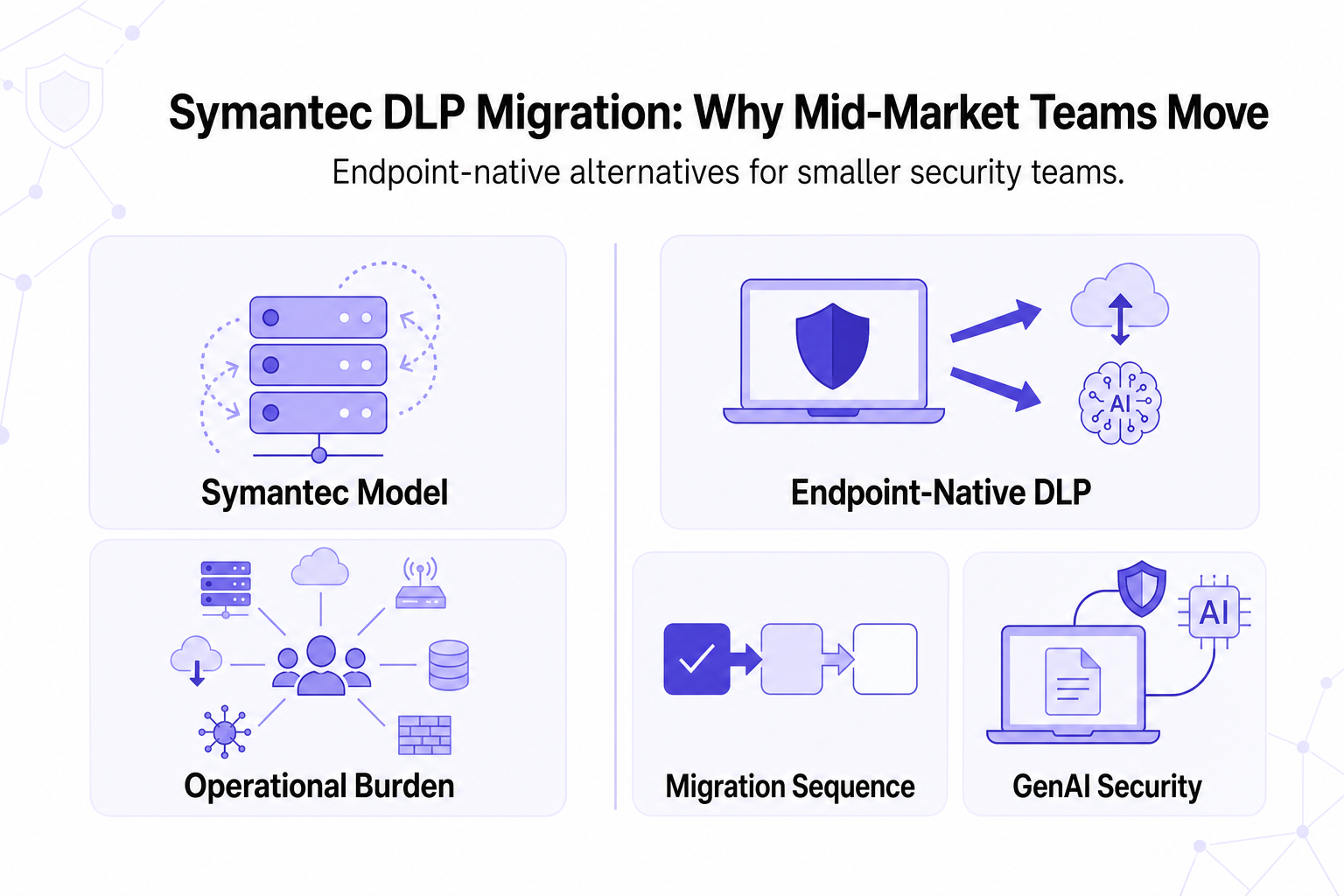
For a mid-market security team evaluating data loss prevention platforms after Symantec DLP, the key is finding a tool that matches your operating model, built around endpoint-native DLP with real-time enforcement at the point of risk, extending into GenAI security and reduced operational complexity. Symantec DLP by Broadcom remains a capable enterprise suite, built around a central Enforce Server, endpoint agents, and dedicated network appliances for web and email inspection, with strong Exact Data Matching and centralized policy management. That same architecture, deploying and managing multiple distinct server components, is what makes it a heavier fit for a team without a dedicated DLP engineer. Kitecyber is an endpoint-native data loss prevention platform built for mid-market fintech, healthcare, insurance, and companies handling sensitive AI workflows. This article walks through how to evaluate your migration path and sequence the move.
TL;DR
- Symantec DLP covers endpoint, network, and cloud channels well, but its architecture requires a central Enforce Server plus separate appliances for web and email, which adds operational overhead for smaller teams.
- Broadcom completed the Symantec Enterprise Security acquisition in 2019 and later shifted to a portfolio license agreement model.
- Mid-market DLP alternatives span cloud-native API platforms (Nightfall, Strac), endpoint and insider-risk focused vendors (Safetica, Teramind), data lineage specialists (Cyberhaven), and endpoint-native DLP with built-in GenAI security (Kitecyber).
- Evaluations of DLP vendors commonly weigh data classification accuracy and strategy, not just channel count.
- Migrations succeed when teams sequence by data risk first, moving the highest-exposure channel (usually endpoint and removable media) before tackling network and email rules.
About the Author: This article is written by the Kitecyber team. Kitecyber is an endpoint-native data loss prevention platform purpose-built for mid-market fintech, healthcare, and companies protecting sensitive data in AI workflows; we work directly with teams evaluating vendor transitions
What Does Symantec DLP Cover Well, and What Does Its Deployment Model Assume?
Symantec DLP by Broadcom is built as a distributed enterprise suite: a central Enforce Server for policy management, endpoint agents for device-level enforcement, and dedicated network or virtual appliances for web and email monitoring. This gives it genuinely strong capabilities where they matter for large regulated enterprises, including Exact Data Matching for structured data like account numbers and centralized policy management across channels. That architecture is also the reason it fits certain organizations better than others. Running Enforce Server, agent fleets, and appliance clusters as separate components means a team needs the staffing to maintain each piece independently. For an enterprise with a dedicated DLP function, that is a reasonable tradeoff for depth of coverage. For a mid-market team of a handful of security engineers who also own endpoint management, cloud security, and compliance reporting, it is a meaningfully larger footprint to operate than a single agent.
Why Are Mid-Market Teams Actually Looking Elsewhere?
The honest driver is rarely one dramatic failure; it is usually a combination of deployment complexity and how coverage is packaged. Three things repeatedly come up in migration conversations:
- Component count. Because Symantec DLP's architecture separates the Enforce Server from network and email appliances, standing up full coverage means provisioning and patching several distinct systems rather than one.
- Module-based coverage. Enterprise data loss prevention software of this generation is typically organized so that endpoint, network, and cloud protection are addressed through separate modules, which means the scope a team gets depends on which modules they have deployed and configured, not a single unified policy surface.
- Post-acquisition changes. Broadcom completed its acquisition of Symantec's Enterprise Security business in 2019 and subsequently moved to a portfolio license agreement (PLA) model aimed at Global 2000 customers. A PLA model built around large enterprise customers is a different commercial motion than what most mid-market teams are used to negotiating, which is often enough on its own to trigger a look at alternatives.
None of this makes Symantec DLP a poor product. It means the operating model assumes an enterprise-scale team, and mid-market buyers evaluating data loss prevention platforms in 2026 are weighing that assumption against tools built for smaller operations from the start.
How Endpoint-Native DLP Handles Mid-Market Requirements
The right DLP platform depends on what a team is actually trying to fix: fewer servers to run, better SaaS and GenAI visibility, or insider-risk monitoring alongside data protection. Here is how the main options compare.
| Vendor | Architecture | Best fit when… |
|---|---|---|
| Kitecyber | Single lightweight endpoint agent covering endpoints, SaaS, browser, clipboard, email, and removable media; native Linux support alongside Windows and macOS. | You need endpoint-native DLP and GenAI security from one lightweight agent, with compliance controls built in rather than layered on top. |
| Safetica | Cloud-native or on-prem deployment using endpoint agents, with no dedicated network appliance. | You want DLP and insider-risk monitoring without appliance infrastructure; validate classification depth on scanned or image-based documents during evaluation. |
| Nightfall | Cloud-native, API-driven, with an endpoint agent. | Your priority is SaaS and cloud app coverage and you are comfortable relying on cloud connectivity for detection. |
| Cyberhaven | Cloud console with endpoint agents, browser extensions, and network appliances that feed into its analytics platform. | Data lineage and tracing exactly how a file moved before exfiltration is the primary requirement. |
| Strac | API-first with both a browser extension and a dedicated endpoint agent for macOS, Windows, and Linux. | SaaS, email, and GenAI app coverage matters more than network-level inspection. |
| Teramind | Hybrid: lightweight endpoint agents plus cloud analytics, or on-prem/private cloud. | Insider-risk monitoring and user activity logging are as important as data-loss controls. |
Nightfall and Strac are strong picks if your data mostly lives and moves inside SaaS and GenAI apps rather than on managed laptops, since both are architected around API and browser-extension coverage alongside endpoint agents rather than relying solely on network packet inspection. Nightfall fits teams whose primary exposure runs through SaaS platforms and cloud storage, though relying on cloud connectivity for detection means it is a weaker fit for organizations that need enforcement to work the same way on a disconnected endpoint. Strac is a good match for teams that want DLP and GenAI coverage across SaaS, email, and the endpoint, since it pairs its API-first approach with a dedicated agent for macOS, Windows, and Linux to govern data exit channels on the device. Teramind is the more natural fit if the underlying concern is “what is this specific user doing,” since its model is built around full endpoint event logging, though it depends on agents to capture offline activity and needs API connectors for cloud visibility, and teams that want data classification as the primary lens rather than user monitoring may find it a secondary fit. Cyberhaven is worth a serious look if the compliance conversation keeps coming back to “show me exactly where this file went,” since lineage tracing is its core mechanism, supported by endpoint agents, browser extensions, and network appliances that feed into its analytics platform, though that broader footprint is a heavier lift than a pure API-based tool. Safetica fits teams that want endpoint DLP and insider-risk monitoring without standing up network appliances, so teams that rely heavily on scanned documents or screenshots should validate its classification depth on those during evaluation. Kitecyber fits teams that want one lightweight agent handling endpoint DLP, SaaS governance, and GenAI security together, though as with any single-agent model, organizations with a large existing investment in point solutions for each channel will have some consolidation work to do during migration.
Kitecyber’s approach is built around endpoint-native DLP with real-time enforcement at the point of risk. Kitecyber operates on See, Decide, Enforce, continuously: it discovers and classifies sensitive data using document context rather than regex alone, tracks data lineage as files move across channels, and enforces the right action (allow, block, warn, coach, log, or isolate) at the exact point of risk, whether that is a clipboard paste, a browser upload, or data entering a GenAI tool.
How Modern DLP Handles GenAI and Shadow AI Risk
A related question most mid-market teams are actually asking in 2026 is what happens when an employee pastes a customer record into an AI copilot. Modern data loss prevention now includes native GenAI security: leading platforms offer real-time monitoring and blocking of sensitive data pasted or uploaded into tools like ChatGPT and Claude, using machine learning models that understand context and intent rather than matching static patterns. This matters because a regex rule that flags “16 digits in a row” cannot tell the difference between a credit card number and a tracking ID, but a model that understands document context can.
This is critical at the endpoint. An AI agent or copilot running on a laptop can read, summarize, and upload a file in seconds, well before a network-based control ever sees the traffic. Kitecyber treats this as a core scenario rather than an add-on: the same agent that classifies and tracks files also discovers shadow GenAI use across the organization, secures AI agents running on company devices, and stops agentic workflows from moving data out to an unapproved destination. Because it is the same lightweight agent handling endpoint DLP and SaaS governance, GenAI monitoring adds no separate deployment.
How to Sequence Your DLP Migration
A related but distinct question from “which vendor” is “in what order.” Migrating data loss prevention is rarely a weekend cutover, and treating it as one increases the odds of policy gaps. A workable sequence:
- Endpoint and removable media first. This is usually where the highest-value, highest-volume exfiltration risk sits, and it is the channel most DLP alternatives can stand up quickly with a single agent.
- SaaS and cloud app coverage next. Once endpoint policies are stable, extend classification and enforcement to the SaaS apps holding the same sensitive data categories.
- Email and browser uploads. These channels benefit from having endpoint context already established, so policies can reference the same classification engine rather than starting fresh.
- Network and legacy appliance rules last. Retire Symantec's network and email appliance policies only after the new platform has run in parallel long enough to confirm parity on your highest-risk data types.
Run both systems in parallel during the migration rather than cutting over in one step, and validate the new platform’s classification accuracy against a known set of sensitive documents before retiring the old policy set.
Compliance Coverage: What Modern DLP Platforms Actually Support
A related concern for any regulated mid-market team is whether the replacement actually helps address the frameworks the renewal conversation started with. Modern data loss prevention platforms including Kitecyber support GDPR, HIPAA, SOC 2,ISO 27001, and PCI-DSS requirements, though material differences exist: some platforms offer broader compliance automation, including DSAR handling and DPIAs, while others cover only partial requirements or lack native data discovery. Vendor evaluations commonly weigh data classification accuracy and strategy, which is a useful proxy for how much manual tuning a compliance program will need after go-live. Tooling like this supports the underlying controls, but certification still depends on how the organization configures, operates, and documents its own program.
Kitecyber helps address a broad set of SOC 2, ISO 27001, HIPAA, FINRA, and PCI DSS controls because the same endpoint-native DLP agent also handles SaaS governance and endpoint context, without requiring separate point products for each control domain.
References
Frequently Asked Questions
Symantec DLP's architecture requires a central Enforce Server plus separate network and email appliances. Modern alternatives like Nightfall, Strac, Cyberhaven, and Kitecyber are built around agent-based or API-based deployment without requiring the same central server architecture.
Broadcom's commercial model since the acquisition has centered on portfolio license agreements aimed at Global 2000 customers. Specific pricing structures vary and should be confirmed directly with Broadcom; this article does not assert a figure.
Teramind is primarily an insider-risk and user-activity monitoring platform with data loss prevention features layered on top. Teams evaluating alternatives to Teramind that also need full data classification and endpoint DLP coverage should weigh platforms like Kitecyber or Safetica that were built DLP-first.
Endpoint-native DLP closes most of the gap, but not entirely on its own. An endpoint agent that also covers browser uploads, SaaS apps, and clipboard activity handles the majority of exfiltration risk, since most cloud data exposure originates from an endpoint action.
Duration depends on data volume, number of DLP policies, and how many channels are in scope; there is no fixed timeline. Sequencing by risk (endpoint first, network last) tends to reduce the total migration window compared to a full cutover.
Yes. Kitecyber, Safetica, and some modern endpoint-native DLP platforms offer native Linux support alongside Windows and macOS coverage.
See verified customer reviews of Kitecyber on G2 and SourceForge.

Ajay Gulati
Ajay Gulati is a passionate entrepreneur focused on bringing innovative products to market that solve real-world problems with high impact. He is highly skilled in building and leading effective software development teams, driving success through strong leadership and technical expertise. With deep knowledge across multiple domains, including virtualization, networking, storage, cloud environments, and on-premises systems, he excels in product development and troubleshooting. His experience spans global development environments, working across multiple geographies. As the co-founder of Kitecyber, he is dedicated to advancing AI-driven security solutions.