Table Of Content
Related Posts
DLP for Manufacturing: Protecting CAD Files, Design IP, and Supplier Data on the Factory Floor and Beyond
-
September 15, 2026
-
Quick Answer:
AI Security Posture Management (AISPM), also called AI Posture Management, is the continuous process of discovering, monitoring, and controlling how AI tools, models, and agents interact with your company's data and systems. It covers everything from spotting an unapproved AI app on someone's laptop to blocking a customer record from being pasted into a public chatbot. Most teams that manage AI posture well pair a discovery layer with policy enforcement at the point where employees actually use AI, which is the endpoint.
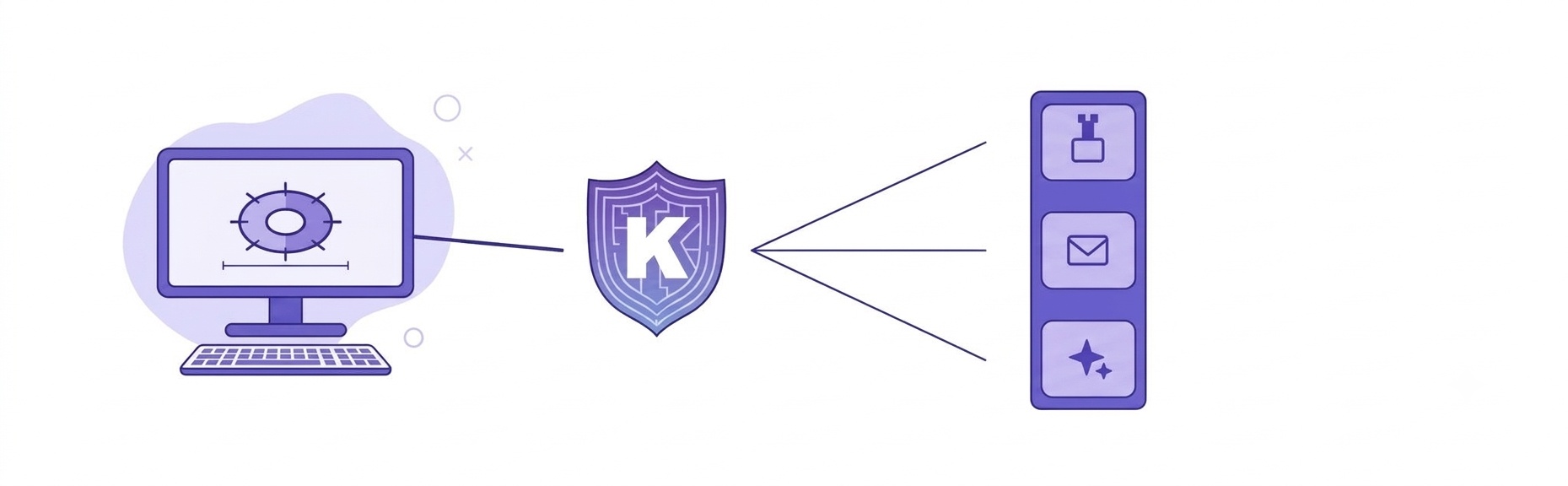
Data loss prevention for manufacturing means applying real-time, context-aware controls to CAD files, product design data, and supplier information at the endpoint, the moment an engineer opens, exports, or shares a file, not after it has already left the building. Manufacturing IP does not live neatly in a database the way a customer record does. It lives inside CAD files, PLM exports, machine configs, and supplier emails, moving constantly between engineers, contractors, and partners. That movement is exactly where most DLP tools designed for regex-matching credit card numbers fall short, and it is exactly where an endpoint-native approach earns its keep.
Kitecyber built its platform around this reality: sensitive data protection has to happen where the work happens, not just where the data eventually gets stored. For manufacturers, that means the CAD workstation, the engineer’s laptop, the email client used to send a drawing to a supplier, and increasingly, the AI copilot summarizing a spec sheet.
TL;DR
- Manufacturing breaches are among the costliest of any sector — averaging roughly $5.5 million (IBM's Cost of a Data Breach research) — with unplanned downtime running as high as $125,000 an hour by industry estimates when IP theft or ransomware disrupts production.
- Standard DLP, built to catch text patterns like SSNs and card numbers, misses most of what makes a CAD file or supplier contract sensitive, because that sensitivity is structural and contextual, not pattern-based.
- A large share of breaches — commonly cited as roughly a third to nearly half — trace back to third-party vendors or supply-chain weaknesses, making supplier access controls a core part of any DLP strategy, not an afterthought.
- ITAR and EAR compliance require export control classification, marking, and audit trails for design files, which most legacy DLP tools were never built to track.
- Endpoint-native DLP that understands document context, not just keywords, is the practical path to data exfiltration prevention for CAD and design IP.
About the Author: Kitecyber builds endpoint-native DLP for regulated industries including fintech, healthcare, and manufacturing, and works with security teams protecting design IP, source code, and supplier data from insider risk and shadow GenAI exposure. This piece draws on that work with manufacturing and engineering-heavy customers evaluating DLP after legacy tools failed to catch CAD-specific risk.
Why Doesn't Standard DLP Catch CAD File Leaks?
Standard DLP was built to find text patterns, not engineering structures. Most commercial DLP products were designed for a specific compliance job: stopping social security numbers, credit card digits, or health record identifiers from leaking in plain text. That works reasonably well for finance and healthcare data, which tends to follow predictable formats.
CAD files do not follow that logic. A SolidWorks assembly or an AutoCAD drawing does not contain a string that a regex pattern can flag as “sensitive.” Its sensitivity comes from what it represents: a tolerance spec, a proprietary alloy composition, a supplier part number tied to an unreleased product. A DLP engine scanning for 16-digit numbers has nothing to match against.
This gets worse with file format. Neutral formats like STEP and IGES are the de facto standard for exchanging 3D models across supply chains, but proprietary native formats carry far more complex, application-specific data structures, and that complexity creates its own risk. Parser vulnerabilities such as CVE-2026-0875 — an out-of-bounds write in a shared Autodesk component that affects AutoCAD and other 2026 products, per Autodesk’s own security advisory — show how a maliciously crafted file can trigger conditions that attackers exploit for arbitrary code execution. A file format built for engineering precision, not security, becomes an attack surface in itself.
The practical takeaway: DLP for manufacturing has to classify by document context, not just content pattern. It needs to recognize that a file living in a PLM export folder, opened by a mechanical engineer, tagged to an active product line, is categorically different from a random PDF, even if neither contains a single string that matches a compliance regex.
How Much Does IP Theft Actually Cost Manufacturers?
The financial exposure is large enough that IP protection has become a board-level issue, not just an IT ticket. Manufacturing breaches are among the most expensive of any sector — IBM’s Cost of a Data Breach research puts the average around $5.5 million — and manufacturing remains one of the most heavily targeted industries for IP theft and ransomware, where unplanned production downtime can reach roughly $125,000 an hour by industry estimates.
Those numbers explain why manufacturing IP theft is different from a typical data breach. A stolen customer list is a compliance and reputation problem. A stolen CAD file for a next-generation product can hand a competitor years of R&D for free, with no notification requirement and often no immediate sign anything happened at all.
Recent cases make the mechanism concrete. In August 2025, Taiwan prosecutors arrested three current and former TSMC employees for allegedly stealing trade secrets tied to the company’s advanced 2-nanometer process — an insider theft that TSMC says it caught through internal monitoring of unusual access to confidential files, not through any external network alarm. The exposure does not always come from inside, either: in 2026, a breach at Tata Electronics, an Apple contract manufacturer in India, pushed more than 200,000 engineering files — design blueprints, prototype images, and supplier lists for the unreleased iPhone 18 Pro — onto the dark web through a supplier’s systems rather than Apple’s own. Together the two cases show the pattern that matters for manufacturing: design IP most often leaves through people and partners who already have legitimate access to it, at the endpoint or inside the supply chain, not through a break-in at the corporate firewall.
Why Is Supplier Data the Weakest Link in Manufacturing Security?
Supplier data is frequently the entry point for manufacturing breaches because trust extended to a vendor rarely comes with equivalent security controls. Third-party vendors and supply-chain weaknesses are involved in a large share of breaches — commonly cited in the range of roughly a third to nearly half — making this a primary attack vector rather than an edge case.
Two documented cases show how third-party exposure plays out at scale:
| Incident | Vector | Exposure |
|---|---|---|
| Nissan | Third-party software testing vendor | Roughly 18,000 records exposed |
| Volkswagen Group of America | Vendor’s unsecured cloud storage | Over 3 million customer records exposed |
Neither breach originated inside the manufacturer’s own perimeter; both came from a vendor with legitimate access that failed to secure it to the same standard. Those two exposed customer records — but as the Tata Electronics leak above shows, the same supplier-trust gap now reaches core design IP, not just customer data. This is precisely why supplier risk management software has become a distinct budget line for manufacturing security teams: the question is not just “did we get breached,” but “did our supplier get breached on our behalf.”
The practical fix looks less like a vendor questionnaire and more like enforcement: real-time visibility into what data leaves the building toward a supplier, from which endpoint, in what format, and whether that transfer matches an approved workflow. A quarterly security review of a vendor tells you nothing about the CAD file an engineer emailed them on a Tuesday afternoon.
What Do ITAR and EAR Require for CAD Files and Design IP?
ITAR and EAR compliance turns CAD file handling into a formal export-control process, not just a security best practice. Regulatory frameworks like ITAR and EAR require strict export control classifications, appropriate markings, and handling instructions for CAD files and design IP. Compliance with these regulations, alongside standards like ISO 27001, mandates comprehensive access logging and audit trails to track who views or modifies sensitive manufacturing designs.
This is a meaningfully higher bar than typical data protection. A defense contractor’s CAD file for a controlled component is not just “confidential,” it is legally restricted from being viewed by non-US persons, transmitted outside approved channels, or stored on non-compliant infrastructure. Getting this wrong is not a breach notification problem, it is a federal compliance violation.
For manufacturers under ITAR or EAR, DLP has to do more than block obvious exfiltration. It needs to:
- Maintain an audit trail of every access, edit, and export event tied to a controlled file
- Enforce access boundaries based on user citizenship or clearance status, not just role
- Log and flag any attempt to move a controlled design file to an unauthorized endpoint, cloud app, or GenAI tool
- Support export control classification workflows without requiring engineers to manually tag every file
This is where the endpoint becomes decisive. A tool that only monitors network traffic cannot see what happens when a controlled CAD file is opened locally and copied to a USB drive, or pasted into a chatbot for a “quick summary.” An engineer running an AI copilot for design review is now a live compliance risk if that copilot has any path to send file content outside the organization’s boundary.
How Should Manufacturers Think About Shadow AI Risk on the Factory Floor?
Shadow GenAI use turns every AI-enabled endpoint into a potential exfiltration point for design data, often without anyone approving it or knowing it happened. Engineers under deadline pressure paste spec sheets into ChatGPT for a faster summary, or use an AI-powered CAD plugin that quietly uploads geometry data to a third-party server for processing. Neither action typically shows up on a security dashboard built around network traffic inspection, because the request often looks like ordinary encrypted web traffic.
This is the same shift Kitecyber describes across every regulated vertical it serves, but manufacturing has a specific version of it: engineering tools are increasingly shipping with AI features baked in, and those features do not always come with a clear boundary around where data goes. The fix is not banning AI tools, since that pushes usage further underground. It is visibility and enforcement at the point where the request happens, following a continuous loop: see what data is moving and where, decide whether that movement matches policy, and enforce the right action, whether that is a block, a warning, or a logged allow.
Where Does Endpoint-Native DLP Fit Into a Manufacturing Security Stack?
Endpoint-native DLP sits at the one point in the workflow where every risk described above becomes visible: the device where the engineer is actually working. Network-based tools only see traffic that crosses a monitored boundary, which misses local copies, USB transfers, and encrypted app traffic. API-based DLP covers individual SaaS apps but has no visibility into what happens on the laptop itself, where a CAD file gets opened, screenshotted, or pasted into a chat window.
Kitecyber’s approach runs a single lightweight agent across Windows, macOS, and native Linux endpoints, providing context-aware classification that recognizes a PLM export or engineering drawing by its context, not just its file extension. It tracks data lineage in real time, so a security team can trace exactly where a controlled design file traveled, and enforces policy directly at the endpoint, whether that means blocking an upload to an unapproved cloud drive, warning a user pasting CAD data into a GenAI tool, or logging a routine, approved transfer to a supplier portal.
Because that same agent also provides secure web gateway, ZTNA, and SaaS app controls, manufacturers get audit-trail depth that supports the access-logging requirements ITAR, EAR, and ISO 27001 impose, without deploying a separate compliance tool on top of DLP. That consolidation matters more in manufacturing than most verticals, because engineering teams are already juggling PLM systems, CAD licenses, and supplier portals, and few have appetite for another heavyweight agent competing for laptop resources.
About Kitecyber
Kitecyber is an endpoint-native DLP platform built for the GenAI era, giving security teams real-time visibility and control over where sensitive data goes, whether that is a CAD file, a supplier contract, or data pasted or uploaded into an AI chatbot. One lightweight agent covers Windows, macOS, and native Linux endpoints, using context-aware classification and real-time data lineage to enforce the right action — allow, block, warn, coach, log, or isolate — at the exact point of risk.
See verified customer reviews of Kitecyber on G2 and SourceForge.
Frequently Asked Questions
It is the application of data loss prevention controls, specifically tuned to recognize CAD files, PLM exports, and engineering data by context rather than text pattern, enforced at the endpoint where design work happens.
Most DLP was built to catch text patterns like credit card numbers, but CAD file sensitivity is structural, tied to what the file represents rather than any string it contains.
Third-party vendor and supply-chain weaknesses are tied to a large share of breaches — commonly cited as roughly a third to nearly half — including documented cases at Nissan and Volkswagen Group of America.
Export control classification, proper markings and handling instructions, and comprehensive access logging and audit trails for anyone who views or modifies the design.
Yes. An engineer pasting spec data into an AI tool for summarization can move controlled information outside approved boundaries without any conventional network alert triggering.
Both carry risk, but proprietary native formats have more complex data structures and have shown parser-level vulnerabilities, such as CVE-2026-0875 affecting AutoCAD and other Autodesk 2026 products, that neutral formats like STEP and IGES are less prone to.
No. DLP enforces what happens to data at the endpoint and in transit; supplier risk management software assesses vendor security posture. They address different parts of the same third-party risk problem and work best together.

Ajay Gulati
Ajay Gulati is a passionate entrepreneur focused on bringing innovative products to market that solve real-world problems with high impact. He is highly skilled in building and leading effective software development teams, driving success through strong leadership and technical expertise. With deep knowledge across multiple domains, including virtualization, networking, storage, cloud environments, and on-premises systems, he excels in product development and troubleshooting. His experience spans global development environments, working across multiple geographies. As the co-founder of Kitecyber, he is dedicated to advancing AI-driven security solutions.