Table Of Content
Related Posts
DLP for Financial Advisors: Meeting FINRA and SEC Recordkeeping Rules Without Slowing Down Client Communication
-
September 15, 2026
-
Quick Answer:
AI Security Posture Management (AISPM), also called AI Posture Management, is the continuous process of discovering, monitoring, and controlling how AI tools, models, and agents interact with your company's data and systems. It covers everything from spotting an unapproved AI app on someone's laptop to blocking a customer record from being pasted into a public chatbot. Most teams that manage AI posture well pair a discovery layer with policy enforcement at the point where employees actually use AI, which is the endpoint.
Financial advisors face a genuine conflict every day: FINRA and the SEC require every client-related message to be captured, retained, and supervisable, while advisors need to respond to clients fast, on whatever channel the client prefers. The recordkeeping problem is usually not that a firm lacks an archive — it’s that regulated conversations keep happening on channels the archive never sees. Data loss prevention built into the endpoint closes that gap from the other direction: it recognizes when client business is about to move through an unapproved or unmonitored channel and steers it back onto a captured one, warning or blocking the off-channel send before an unarchived record is ever created. Instead of trying to reconstruct off-channel messages after the fact, it keeps the conversation on the channels the firm already captures.
TL;DR
- FINRA Rule 4511 sets a default six-year retention period for business records with no specified timeframe, while related SEC rules generally require three years for general correspondence. (RIAs are governed separately by Advisers Act Rule 204-2, generally five years.)
- SEC Rule 17a-4 requires broker-dealers to store electronic records in a non-rewritable, non-erasable format, or use an audit-trail system that achieves the same tamper-proof result, with the first two years in an easily accessible location.
- Regulators define a "business communication" by content, not by device or app, so a text about an order instruction is a record even if sent from a personal phone.
- Since 2021, the SEC, CFTC, and FINRA have levied more than $3 billion in combined penalties tied to unarchived off-channel communications like personal texting and WhatsApp — with some tallies exceeding $3.5 billion.
- Endpoint-native DLP closes the off-channel gap by detecting and enforcing channel policy at the point of creation — keeping regulated communication on approved, captured channels rather than trying to catch it after it has already slipped off-channel.
About the Author: Kitecyber builds endpoint-native DLP used by regulated fintech and financial services teams that need FINRA– and SOC 2-aligned data controls without adding a dedicated DLP analyst headcount. This post draws on Kitecyber’s work helping compliance and IT teams close off-channel recordkeeping gaps at the endpoint, where client communication actually happens.
What Do FINRA and SEC Recordkeeping Rules Actually Require?
FINRA Rule 4511 requires member firms to preserve all business-related communications and sets a default retention period of six years for records that don’t have a specified timeframe elsewhere in FINRA’s rulebook. SEC rules covering general correspondence typically call for a three-year retention window, which creates a two-tier retention schedule that compliance software has to track correctly by record type rather than applying one blanket rule to everything.
SEC Exchange Act Rule 17a-4 adds a format requirement on top of the retention period. Broker-dealers must store electronic records in a non-rewritable, non-erasable format, or use an audit-trail system that achieves the same tamper-proof result. General business communications under 17a-4 must be kept for at least three years, and the first two years have to sit in a location the firm can retrieve quickly on request. The distinction matters operationally: retention tells you how long to keep something, format tells you whether a regulator can trust that what you kept hasn’t been altered.
One caveat that trips up mixed advisory firms: 4511 and 17a-4 are broker-dealer rules. Registered investment advisers are governed by a parallel regime under the Advisers Act, principally Rule 204-2, which generally calls for five-year retention with the first two years in an easily accessible place. Different timeframe, same underlying principle — and a firm that operates both a broker-dealer and an RIA has to satisfy both regimes.
Here is the part advisors underestimate: FINRA and the SEC define a “business communication” by its content, not by the app or device used to send it. A message about an order instruction, investment advice, or a client relationship is a regulated record whether it was sent through the firm’s email system or a personal iMessage thread. Broker-dealer compliance tooling that only captures approved channels misses everything sent outside those channels, and outside-channel messages are still regulated the moment their content touches client business.
Why Do Off-Channel Communications Keep Causing Enforcement Actions?
Off-channel communication is the single biggest driver of recordkeeping penalties in financial services today. Since 2021, the SEC, CFTC, and FINRA have collectively imposed more than $3 billion in penalties against financial firms for recordkeeping failures, and the large majority of those actions trace back to unarchived personal texting and encrypted messaging apps like WhatsApp used for business purposes. That figure did not accumulate because firms lack archiving tools for approved channels. It accumulated because advisors, like most professionals, gravitate toward whatever app is fastest and most familiar, and personal texting and WhatsApp are both faster than logging into a firm-approved portal.
The mechanism behind this is worth spelling out because it explains why bolt-on archiving tools keep failing the same way. Traditional compliance archiving connects to a defined list of channels: the firm email server, an approved chat platform, maybe a recorded phone line. If an advisor texts a client from a personal phone or replies to a WhatsApp message during a fast-moving trade discussion, that message never reaches the archive connector, because the connector was never built to see it. The archive isn’t broken; it’s just blind to anything outside its configured inputs. Firms end up with a recordkeeping system that looks complete on paper and has a hole in it exactly where the compliance risk concentrates: unscripted, high-urgency client conversations.
How Does Endpoint DLP Close the Off-Channel Gap Without Slowing Advisors Down?
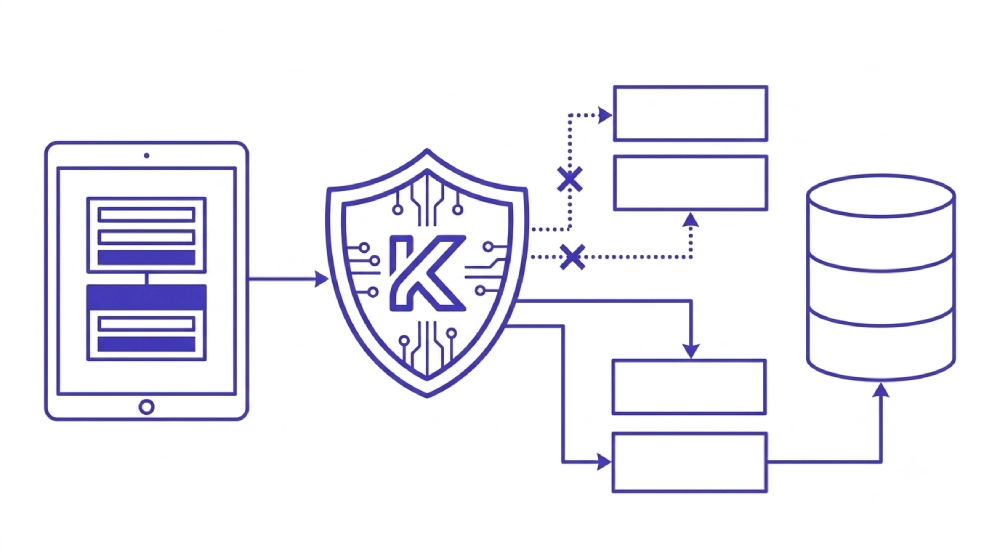
Endpoint DLP addresses the visibility problem by moving the control point from the network or the app layer down to the device where the advisor is actually working. Instead of relying on a fixed list of approved channels, an endpoint agent can see when an outbound message, file, or upload is about to carry client data, order instructions, or investment advice — and, crucially, whether it is heading to a channel the firm captures or one it doesn’t. This is the core difference between endpoint-native DLP and channel-based archiving: one watches specific doors, the other watches the person about to leave the building and can stop them from using a door that isn’t monitored.
Kitecyber’s model for this is described internally as See, Decide, Enforce, continuously. In practice, for a financial advisory firm, that looks like:
- See: the agent recognizes when an advisor is about to send client business — account numbers, trade instructions, advice language — through a channel the firm doesn't capture, such as a personal messaging app or an unmanaged chat tool on a company-managed device.
- Decide: context-aware classification determines whether the content is a regulated business communication under rules like FINRA 4511 and SEC 17a-4 (or Advisers Act 204-2 for RIAs), and whether its destination is an approved, captured channel or an off-channel one.
- Enforce: the endpoint acts in real time — warning the advisor to move the conversation to an approved channel the firm's archive already captures, blocking the send if it would leave through an unmonitored path, or logging the attempt as supervision evidence.
Importantly, this is about keeping regulated communication on the channels a firm already captures, not turning the endpoint into the system of record. Kitecyber closes the gap that lets off-channel messages escape supervision in the first place; it complements a firm’s 17a-4 or 204-2 archive rather than replacing it.
Because this happens at the endpoint and not through a network proxy, it works the same way whether the advisor is in the office, on a home network, or using a personal hotspot, which matters for firms with remote or hybrid advisory teams. It also means the advisor doesn’t have to change behavior first and get retrained second; the control stays invisible to the workflow as long as the advisor is using an approved channel, and only steps in when client business is about to slip off-channel.
What Should RIAs and Broker-Dealers Look for in Compliance Software?
Stepping back from the mechanics, the practical question for compliance officers is what to evaluate across the recordkeeping stack — which typically pairs a compliant archive (for retention and tamper-proof format) with endpoint enforcement (for keeping communication on captured channels in the first place). Not every product marketed as SEC compliance software addresses the format requirement in 17a-4, and not every DLP tool understands financial services communication patterns well enough to classify content correctly.
|
Requirement |
What to check |
Why it matters |
|
Retention accuracy |
Does the archive distinguish 4511’s six-year default from three-year general correspondence rules (and 204-2’s five-year rule for RIAs)? |
Misapplied retention periods create gaps a regulator will find |
|
Format compliance |
Is storage non-rewritable and non-erasable, or backed by an equivalent audit trail, per Rule 17a-4? |
Tamper-proof format is a distinct legal requirement from retention length |
|
Channel coverage |
Does the control detect and act on client business heading to personal devices, WhatsApp, and unmanaged chat apps, not just firm-issued tools? |
Off-channel use is where the $3B+ in penalties concentrated |
|
Content-based classification |
Does classification key on message content, not just sender or device? |
Regulators define records by content, so classification must too |
|
Endpoint-level enforcement |
Does the control sit at the device, or only at the network or app layer? |
Network and API tools miss traffic they can’t see |
Data loss prevention pricing across these categories varies by deployment model, number of endpoints, and whether the vendor bundles endpoint enforcement with broader endpoint security. Firms evaluating options should ask vendors to itemize what’s included, since a tool priced as pure DLP may not cover the SaaS, browser, and personal-device scenarios that actually drive enforcement risk — and, conversely, an archive alone won’t stop an advisor from going off-channel in the first place.
Can One Agent Cover Both DLP and Broader SEC Cybersecurity Rules?
A related but distinct question compliance teams ask is whether they need separate tools for data loss prevention, device management, and network access, or whether one platform can cover more ground. Because Kitecyber’s endpoint agent is built first for DLP and also delivers capabilities that address broader SEC cybersecurity requirements, it can help address additional SOC 2 and ISO 27001 controls from the same deployment that handles data loss prevention. That matters for compliance teams because auditors increasingly expect firms to demonstrate control over data across every channel it can move through, not just email.
This is not a case for buying a bundle of unrelated features. It’s a case for recognizing that recordkeeping, access control, and data protection are the same underlying problem viewed from different angles: who can touch client data, where can it go, and can the firm prove what happened. An agent that already sees endpoint activity for DLP purposes can also generate the audit trail and access evidence that broader cybersecurity rules require, without a second agent competing for the same device resources.
About Kitecyber
Kitecyber is an endpoint-native DLP company built for firms that need real-time control over where sensitive data goes, including regulated client communications in financial services. One lightweight agent covers endpoints, email, browser, SaaS apps, and GenAI tools, giving compliance and IT teams a single point of visibility and control at the endpoint — complementing the firm’s communications archive rather than adding another channel-specific connector to maintain. Kitecyber serves fintech, financial services, healthcare, insurance, and other regulated industries that need enterprise-grade data protection without an enterprise-sized deployment.
If off-channel communication risk or FINRA recordkeeping gaps are on your compliance roadmap, visit Kitecyber to see how endpoint-native DLP fits into your existing compliance stack.
See verified customer reviews of Kitecyber on G2 and SourceForge.
References
Frequently Asked Questions
Yes. FINRA and the SEC define a regulated communication by content, not device, so a text about client business sent from a personal phone must still be archived and retained under the same rules as firm email.
General business communications must be retained for at least three years, with the first two years stored in an easily accessible location.
Rule 4511 sets retention periods, defaulting to six years for records without a specified timeframe. Rule 17a-4 governs the storage format, requiring non-rewritable, non-erasable electronic records or an equivalent audit-trail system. (RIAs fall under Advisers Act Rule 204-2 instead, generally five-year retention.)
Because these channels sit outside firms' configured archiving connectors, so messages sent through them never reach the compliance record even though their content is regulated the same as any other business communication.
Not exactly — and they work best together. A compliance archive stores and retains messages in a tamper-proof format; it is the system of record. Endpoint DLP works upstream: it keeps client business from slipping onto channels the archive can't see, by warning or blocking off-channel sends at the point of creation. DLP closes the gap; the archive still holds the record.
The obligations overlap, but the governing rules differ: broker-dealers fall under FINRA 4511 and SEC 17a-4, while RIAs are governed by Advisers Act Rule 204-2. RIA compliance tooling should be evaluated against 204-2 and the advisory-specific communications and disclosure rules that apply to registered investment advisers.
Endpoint-native DLP that classifies content in real time typically does not add friction to legitimate messages on approved channels; it only intervenes when content is heading to an unmonitored or unapproved channel, which is the scenario creating regulatory risk in the first place.

With over a decade of experience steering cybersecurity initiatives, my core competencies lie in network architecture and security, essential in today's digital landscape. At Kitecyber, our mission resonates with my quest to tackle first-order cybersecurity challenges. My commitment to innovation and excellence, coupled with a strategic mindset, empowers our team to safeguard our industry's future against emerging threats.
Since co-founding Kitecyber, my focus has been on assembling a team of adept security researchers to address critical vulnerabilities and enhance our network and user security measures. Utilizing my expertise in the Internet Protocol Suite (TCP/IP) and Cybersecurity, we've championed the development of robust solutions to strengthen cyber defenses and operations.
Posts: 94
With over a decade of experience steering cybersecurity initiatives, my core competencies lie in network architecture and security, essential in today's digital landscape. At Kitecyber, our mission resonates with my quest to tackle first-order cybersecurity challenges. My commitment to innovation and excellence, coupled with a strategic mindset, empowers our team to safeguard our industry's future against emerging threats.
Since co-founding Kitecyber, my focus has been on assembling a team of adept security researchers to address critical vulnerabilities and enhance our network and user security measures. Utilizing my expertise in the Internet Protocol Suite (TCP/IP) and Cybersecurity, we've championed the development of robust solutions to strengthen cyber defenses and operations.
Posts: 94