Table Of Content
Related Posts
Table Of Content
Data Loss Prevention for GenAI Startups: 5 Steps to Protect Customer Data in AI Products
-
September 15, 2026
-
Quick Answer:
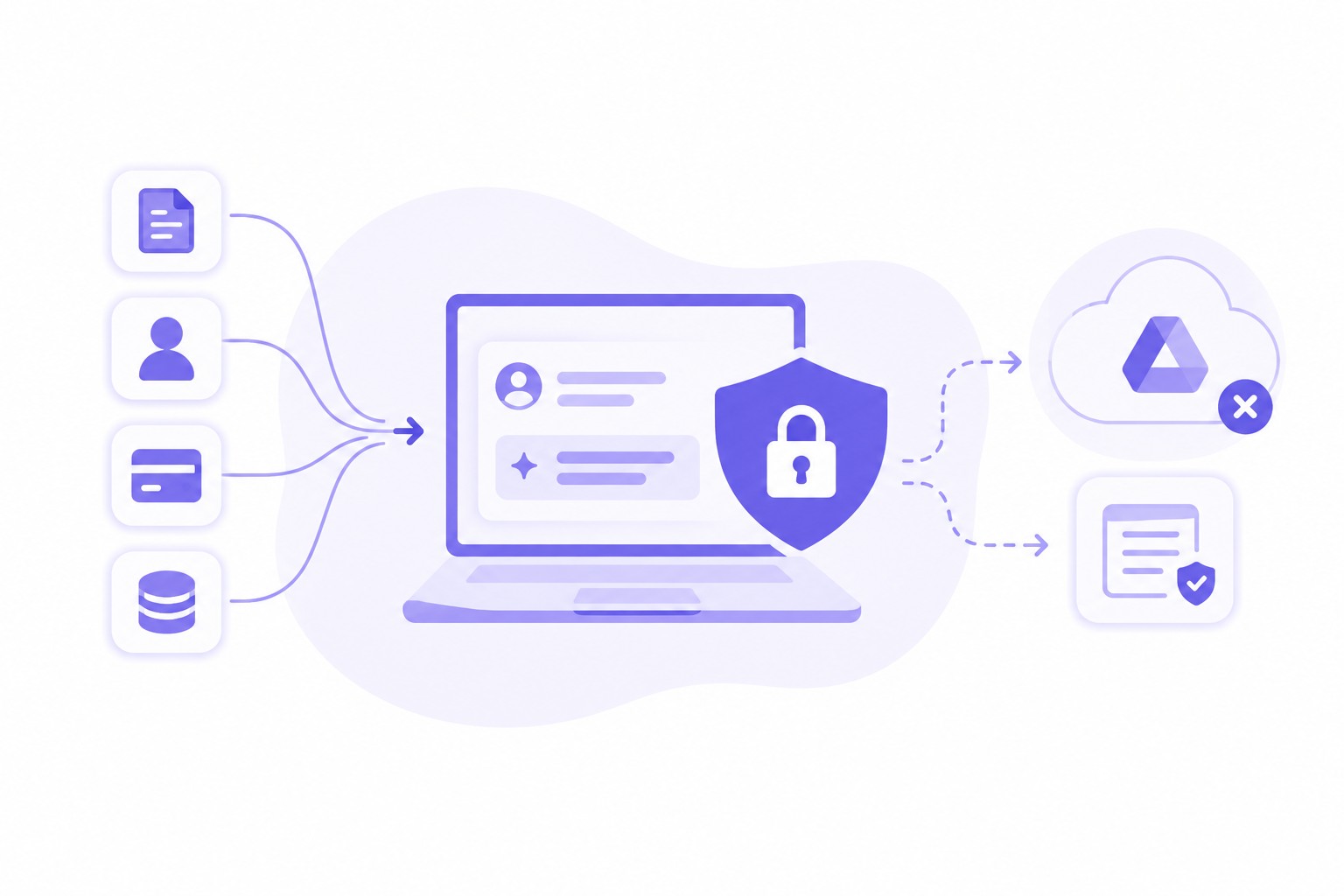
AI Security Posture Management (AISPM), also called AI Posture Management, is the continuous process of discovering, monitoring, and controlling how AI tools, models, and agents interact with your company's data and systems. It covers everything from spotting an unapproved AI app on someone's laptop to blocking a customer record from being pasted into a public chatbot. Most teams that manage AI posture well pair a discovery layer with policy enforcement at the point where employees actually use AI, which is the endpoint.
GenAI startups protect customer data by treating data loss prevention as a core engineering requirement, not a compliance afterthought: discover and classify sensitive data before it reaches a model, enforce controls at the endpoint where prompts and files originate, govern which AI tools employees and agents can actually use, build in the access and logging controls that GDPR, HIPAA , and SOC 2 already require, and monitor autonomous agents at runtime rather than trusting them by default. Startups that skip these steps tend to find out the hard way, usually through a leaked database or a support engineer pasting customer PII into a chatbot.
Kitecyber works with GenAI and AI-native companies, including DuploCloud, Sarvam, Codvo AI, Sully AI, and Scrut Automation, on exactly this problem: how to ship an AI product fast without turning every prompt, copilot, and agent into an uncontrolled export channel for customer data. That vantage point, sitting at the endpoint where prompts get typed and files get uploaded, is why this piece focuses on what actually stops leakage rather than what looks good in a policy document.
TL;DR
- Data classification has to happen before data reaches a model, not after a breach reveals what was exposed.
- Shadow AI is the default state for most companies: 81% of employees use unapproved AI tools (UpGuard, 2025 State of Shadow AI), and enterprise GenAI usage often flows through unmanaged personal accounts.
- Consumer-tier AI tools frequently retain and can train on inputs by default; enterprise tiers with Zero Data Retention are a contractual control, not a technical guarantee, unless enforced at the point of use.
- GDPR, HIPAA, and SOC 2 each impose specific, checkable requirements on AI systems handling personal data, PHI, or customer information.
- Autonomous agents need runtime authority checks and behavioral monitoring, since they can act on data at machine speed with no human in the loop.
About the Author
This article is written from Kitecyber’s work building endpoint-native DLP and GenAI security for AI-native startups and regulated industries including fintech, healthcare, and insurance, where customer data protection in AI products is a daily engineering and compliance problem, not a theoretical one.
Why Is Customer Data Protection Different for GenAI Products?
GenAI products create a new data path: customer input goes into a prompt, the prompt goes to a model (sometimes a third-party API), and the response comes back, often after the model provider has logged or retained the input. That path did not exist in traditional SaaS architecture, and most data protection tooling was never built to see it. Many consumer AI tools retain user inputs and may use them for model training by default, and their retention and opt-out terms vary by provider and have changed repeatedly over the past two years. Even after a user opts out, consumer platforms often retain chat data for a period — commonly around 30 days — for safety and abuse monitoring. A GenAI startup that routes customer support tickets or account data through a consumer-tier model API is, by default, handing that data to a third party under retention terms the startup never negotiated.
Independent shadow-AI research consistently finds that a large share of employees enter sensitive data into these tools — not through malice, but as normal work, done through a new channel that nobody classified as a data export point.
Step 1: How Do You Classify Customer Data Before It Reaches an AI Model?
Data classification software identifies what type of sensitive data exists in a file, field, or prompt, and applies that context before a decision is made about where the data can go. For a GenAI startup, this has to run at the point where a user or an internal tool is about to send something to a model, not as a nightly audit of stored data.
The distinction that matters is content over container. Older DLP approaches flagged files based on name or file type; that misses a support rep pasting a customer’s SSN into a chat window, or an engineer copying a database export into a prompt to “clean it up.” Context-aware classification looks at the actual content and its lineage, so a spreadsheet with customer PII is flagged whether it is named report.xlsx or Q3_data_final_v2.xlsx.
Practical steps:
- Inventory every place customer data enters your AI product: support tools, onboarding forms, uploaded documents, API payloads
- Classify by content type (PII, PHI, payment data, credentials) rather than by file extension
- Tag data with its origin so you can trace it if it later shows up somewhere it should not
Step 2: How Do You Enforce Data Rules at the Endpoint, Not Just in the Cloud?
Endpoint DLP solutions enforce policy on the device where an employee or an AI copilot is actually working, at the moment a file, clipboard action, or browser upload happens, rather than after the fact in a cloud log. This matters because a growing share of leakage never touches a network security tool at all: it is a copy-paste into a browser tab, a screenshot, or a local AI copilot summarizing a document that never left the laptop.
Network-based tools only inspect traffic they can see, and API-based DLP only covers the specific SaaS apps it integrates with. Neither sees a clipboard paste into a personal ChatGPT tab. That is the gap endpoint-native DLP is built to close: one lightweight agent watches files, clipboard, browser uploads, email, and what is being pasted or uploaded into GenAI tools on the device itself, and enforces the right action, whether that’s allow, block, warn, coach, log, or isolate, at that exact point.
Kitecyber’s approach follows a simple continuous loop:
| Stage | What it does |
|---|---|
| See | Discover sensitive data and monitor its movement across files, clipboard, browser, email, SaaS, and data entering GenAI tools. |
| Decide | Apply context-aware classification to determine risk in real time. |
| Enforce | Apply the right control at the point of risk, from a warning to a hard block. |
This is the “See, Decide, Enforce, continuously” model, and it works the same way whether the actor is a human employee or an autonomous agent running on the same endpoint.
Step 3: How Do You Detect and Govern Shadow AI Usage?
Shadow AI detection means identifying AI tools employees are using without security or IT approval, so those tools can be brought under governance instead of discovered after an incident. This is not a hypothetical problem. UpGuard’s 2025 State of Shadow AI report found that 81% of employees use unapproved AI tools, and a substantial share of enterprise generative AI usage flows through unmanaged personal accounts.
Building on the endpoint enforcement above, the harder question for a startup is not whether shadow AI exists (it does) but how to respond without blocking productivity outright. AI data governance for a growing company generally needs three layers:
- Discovery: know which AI apps and browser extensions are actually being used across the company, not just the ones procurement approved
- Differentiated policy: allow sanctioned enterprise-tier AI tools with contractual data protections, warn or coach on borderline tools, block clear-risk consumer apps for regulated data
- AI agent security: extend the same visibility to autonomous agents and AI-powered browser extensions that can act on data without a human clicking anything
Samsung’s well-documented 2023 incident, where engineers pasted proprietary source code and confidential meeting notes into ChatGPT, is the standard cautionary example precisely because it was not an attack. It was normal engineering behavior meeting a tool with no data boundary. AI governance exists to put that boundary back.
Step 4: How Do You Meet Compliance Requirements When Customer Data Flows Through AI?
Compliance requirements for AI products handling customer data are not new laws written for AI specifically; they are existing frameworks applied to a new data path. GDPR mandates data minimization, purpose limitation, and the right to erasure for AI systems processing personal data of EU residents, which means a startup needs to know exactly what personal data went into a model and be able to act on a deletion request. HIPAA requires Business Associate Agreements and strict access controls for any AI system handling Protected Health Information, which rules out routing PHI through a consumer AI tool with no BAA in place. SOC 2 demands comprehensive logging, monitoring, and security audits to demonstrate data privacy and reliability, which means an AI product needs an audit trail showing what data moved where and under what policy.
A startup preparing for a SOC 2 audit — or evaluating tooling for PCI DSS if it handles payment data — should look for a platform that produces this evidence as a byproduct of normal operation, not as a separate reporting project. Because a single lightweight agent handling DLP also helps address more of these overlapping controls through integrated monitoring and logging, it tends to produce more comprehensive audit evidence than a narrow point DLP tool, without adding a second deployment. As always, tooling supports compliance; the certification itself still depends on how the organization configures, operates, and documents its program.
Regulatory checklist for AI products handling customer data:
| Framework | Core requirement for AI systems |
|---|---|
| GDPR | Data minimization, purpose limitation, and right to erasure. |
| HIPAA | BAAs and access controls for PHI in AI workflows. |
| SOC 2 | Logging, monitoring, and audit evidence. |
| PCI DSS | Controls preventing payment data from reaching unmanaged AI tools. |
Step 5: How Do You Secure Autonomous AI Agents Before They Touch Customer Data?
AI agent security means applying access control and behavioral monitoring to autonomous systems that can read, decide, and act on data without a human approving each step, closing the gap that static, human-focused security models leave open. An agent that summarizes support tickets, updates a CRM, or drafts a customer email is making decisions at machine speed, and a single overly broad permission can let it move far more data than any single human action would.
Frameworks like Anthropic’s Zero Trust for AI Agents and the OWASP Top 10 for Agentic Applications (ASI01–ASI10) converge on the same basics: runtime authority checks, fine-grained access control, behavioral monitoring, and human oversight checkpoints before high-risk actions. The 2025 breaches at DeepSeek (an unsecured database that exposed over a million log lines, including chat history and internal API keys) and OmniGPT (a reported leak of 34 million chat lines, API keys, and business documents) both illustrate the same underlying failure: systems built to process large volumes of data at speed, with insufficient controls on what that data touched or where it could go once exposed. That is the exact failure mode agentic workflows introduce, at a larger scale, inside a company’s own AI product.
Practical controls for agent security:
- Scope agent permissions to the minimum data needed for the specific task, not the full dataset
- Log every action an agent takes on customer data, the same way you would log a human's
- Set enforcement points that can pause or block an agent mid-workflow if it attempts an out-of-policy action, rather than only reviewing logs afterward
About Kitecyber
Kitecyber is an endpoint-native DLP company built for the GenAI era, giving security and IT teams real-time visibility and enforcement over sensitive data across endpoints, SaaS, and AI workflows. The platform’s lightweight agent applies continuous classification and policy enforcement at the point of risk, enabling organizations to adopt AI confidently without sacrificing data protection.
See verified customer reviews of Kitecyber on G2 and SourceForge.
References
- What Is GenAI Data Security? A Practical Guide for 2026(concentric.ai)
Frequently Asked Questions
It reduces one risk (model training on inputs) but does not solve enforcement. Enterprise tiers offer Zero Data Retention and SOC 2 Type II compliance as contractual protections, but nothing stops an employee from using a personal consumer account on the same laptop unless that is detected and controlled at the endpoint.
DLP is the enforcement mechanism: it decides in real time whether a specific piece of data can move to a specific destination. AI governance is the broader policy layer covering which AI tools are approved, what data classes they can touch, and how usage is reviewed. DLP makes governance enforceable rather than aspirational.
Pricing generally scales with the number of endpoints or users covered and the breadth of channels monitored (endpoint, SaaS, email, browser, GenAI). Startups should compare vendors on what is included in a single agent versus what requires separate modules or add-ons, since point products often price DLP, web gateway, and SaaS protection separately.
No, and treating it as a binary problem is the wrong frame. The realistic goal is visibility and differentiated policy: know what's being used, allow low-risk sanctioned tools, and block or warn on tools handling regulated data.
Startups building AI products often handle more sensitive customer data per employee than a large company does, because a small support or engineering team has broad access to the whole customer base. That makes endpoint controls relevant earlier than founders expect, not later.
At minimum: what data was involved, which system or agent touched it, what policy applied at the time, and what action was taken (allowed, blocked, or flagged). This is the same evidence SOC 2 auditors and HIPAA reviewers expect to see.

Ajay Gulati
Ajay Gulati is a passionate entrepreneur focused on bringing innovative products to market that solve real-world problems with high impact. He is highly skilled in building and leading effective software development teams, driving success through strong leadership and technical expertise. With deep knowledge across multiple domains, including virtualization, networking, storage, cloud environments, and on-premises systems, he excels in product development and troubleshooting. His experience spans global development environments, working across multiple geographies. As the co-founder of Kitecyber, he is dedicated to advancing AI-driven security solutions.