Table of Content



The Conversations Your Network Can't Read: Protecting Data in Chat, Meetings and Messaging Apps
-
November 20, 2026
-
A scenario: one busy afternoon at Northwind Health
This scenario is illustrative.
Northwind Health is a 350-person healthcare billing company. At 2 p.m., a billing analyst pastes a patient claims extract into a team chat channel so a colleague can check a denial code. At 2:30, a sales lead drops a pricing spreadsheet into a desktop messaging app to reach a partner who isn’t on the company’s chat platform. At 3, a vendor’s AI notetaker joins a call about a pending acquisition, and nobody is quite sure who invited it.
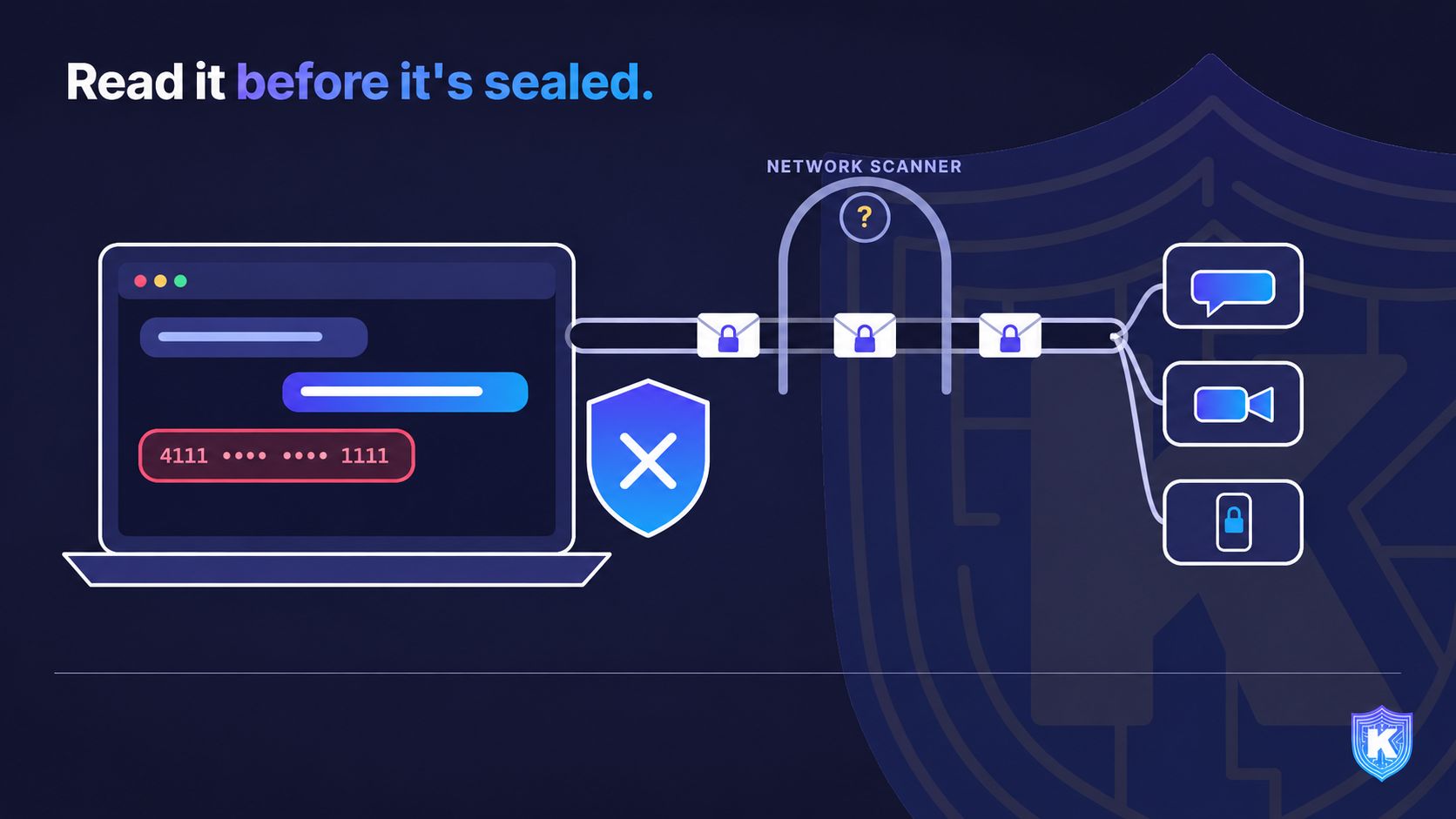
None of these people meant harm. Each was trying to get work done quickly. But by 4 p.m., patient data, pricing and deal details sit in places the security team can’t list, search or recall. And because the messaging app encrypts end to end, the company’s network inspection never saw that file at all.
The problem: conversations became a data store
Chat and meeting tools were built for speed, and people treat them like hallways. In practice they hold credentials, customer records, code and deal details, often for years. Attackers know this:
- Chat is a recognized hunting ground. MITRE ATT&CK lists messaging applications as a data source attackers mine for credentials, source code snippets, proprietary data and internal links.
- Attackers read your incident response, too. A joint FBI and CISA advisory says the Scattered Spider group searches victims' Slack, Microsoft Teams and Exchange Online for conversations about the intrusion and joins incident response calls to see how defenders are hunting them.
The risk is not only theft. Work moved onto personal messaging apps creates legal and regulatory exposure:
- Regulators have fined off-channel messaging heavily. SEC and CFTC investigations into business conversations on iMessage, WhatsApp and Signal produced more than $3 billion in total penalties from 2021 to early 2025.
- Sensitive details leak through the wrong group chat. The Pentagon's inspector general found that information the Defense Secretary sent on Signal from a personal phone, in a 19-member group that included a journalist, matched operational details classified SECRET.
For an SME, the cost shows up as a breach notice when customer data leaks, a lost deal when pricing reaches a competitor, or an audit finding when records can’t be produced.
How Gen AI changed it
Gen AI turned conversations into documents, and documents travel.
- AI notetakers record by default. In a July 2026 survey of 500 employed U.S. adults, 33.4% said an AI notetaker had been present in their work meetings . Of those, 65.3% said consent was inconsistent or absent. Every recorded call becomes a transcript and summary stored with a third party.
- The legal ground is shifting. A U.S. federal court held that one popular notetaker acted as a third-party eavesdropper because it collected and used meeting content for its own commercial purposes. That is a risk for any company whose staff bring such tools into client calls.
- Many capture paths are invisible to the meeting app. Browser extensions, desktop recorders and transcripts pasted into a personal AI account don't show up in a participant list.
- Chat history becomes AI input. Assistants that summarize channels, and people who paste threads into chatbots for a quick recap, move months of conversation into new places in seconds.
Why legacy approaches fall short
- Network-only or cloud-proxy inspection. End-to-end encrypted messengers and many desktop collaboration clients use encryption or certificate pinning that a proxy can't open. Split tunneling and home networks mean some traffic never passes the proxy at all.
- API scanning of sanctioned apps. Connecting to your official chat platform's API finds data after it is posted. It sees nothing in personal messengers, unsanctioned notetakers or a partner's workspace.
- Regex and pattern DLP. Chat is short, informal and full of fragments. Pattern rules either miss a patient ID typed with a typo or flag every nine-digit number, and the noise teaches teams to ignore alerts.
- Block-everything policies. Banning messaging apps or notetakers outright pushes the same activity to personal phones, where you have no visibility at all.
- Heavy tooling. Separate tools for chat DLP, meeting governance, device control and messaging archiving are more than a two- or three-person security team can run.
What a modern approach looks like
The principle is simple: inspect data where it is still readable, which is on the device, before an app encrypts it or uploads it. Gartner’s public summary of its 2026 DLP market overview points the same way, advising leaders to favor user-centric, adaptive, risk-based and AI-enhanced data security techniques over traditional detection alone.
- 1.Enforce on the endpoint, across every app. Apply the same policy to the browser, the desktop chat client, the encrypted messenger and the meeting app. Copy/paste, file shares and uploads are the moments that matter.
- 2.Classify by meaning, not pattern. Recognize patient data, pricing or source code from context, so short chat messages are judged correctly.
- 3.Coach before you block. A warning at the paste ("this looks like patient data; this channel is external") fixes most mistakes without stopping work. Block where the risk is clear.
- 4.Know which AI tools are in the meeting. Inventory notetakers, AI extensions and desktop AI apps, approve a short list, and make consent part of the approved setup.
- 5.Offer a sanctioned path. People reach for personal messengers when partners aren't on company tools. Give them an approved, governed option for external collaboration.
- 6.Keep evidence. Log what was warned, blocked or allowed, so audits and investigations have a record.
How Kitecyber helps
Kitecyber is an endpoint-first data and Gen AI security platform. One lightweight agent sees data on the device, where chat, meeting and messaging apps still handle it in readable form, and the same console manages it.
- Coverage for the channels network tools miss. Data Shield covers real-time copy/paste, file uploads, browsers and installed apps, including Microsoft Teams, Zoom and Slack and end-to-end encrypted apps. It also covers USB, network drives, cloud storage and local file sharing.
- Classification that understands short messages. A hybrid of LLM-based understanding and on-device processing classifies 80+ data categories (PII, PHI, PCI, IP and source code) with 90%+ accuracy, and sensitive content stays on the device. Policies can allow, warn or block in the moment.
- Context for each decision. Every decision uses six signals: device posture, OS activity, process activity, data classification, user activity and network activity. A paste into an approved internal channel is treated differently from the same paste into a personal messenger.
- Visibility into AI in your meetings and chats. Shadow AI discovery inventories AI apps, desktop AI tools, embedded AI features and AI browser extensions on each device. Admins can sanction or unsanction apps in one click and see sensitive data moving to and from AI tools.
- Data that stays governed after it's reshaped. Data lineage follows content through screenshots, encoding and file conversion, so a cropped screenshot of a claims report is still recognized.
- Protection that travels. Policies keep working offline and on home networks, with no traffic hairpinning through a cloud gateway.
What day one looks like: the agent deploys to Windows, macOS and Linux endpoints in about a day, with under 2% CPU overhead and pre-built policies for HIPAA, PCI DSS, GDPR and SOC 2. On day one, the team sees which messaging, meeting and AI tools are actually in use and where sensitive data is moving. The first week runs in warn mode to coach people; blocking follows for the clearest risks, such as regulated data into personal messengers.
SME decision-maker checklist
- Map your real channels. List every chat, meeting and messaging app in use, including personal messengers used with partners. Ask department heads, not just IT.
- Find the AI in your meetings. Which notetakers, extensions and desktop recorders are installed? Approve a short list and require consent notices.
- Search your chat for secrets. Look for passwords, API keys and customer files in channels, and rotate anything you find.
- Plan an out-of-band channel for incidents. If attackers can read your chat, don't run the response there.
- Ask vendors where they inspect. Can the tool see a paste into an end-to-end encrypted desktop app, or only web traffic and sanctioned SaaS APIs?
- Ask how they handle short, messy text. Request a test on real chat-style samples, and ask for the false-positive rate.
- Ask what works off the corporate network. Do policies hold on home Wi-Fi and offline?
Compliance angle
- HIPAA: PHI pasted into a personal messenger or recorded by an unapproved notetaker without a business associate agreement is a likely impermissible disclosure.
- PCI DSS: card data in chat expands scope; the standard expects cardholder data to be protected wherever it is stored or sent.
- GDPR: personal data in chats and recordings needs a lawful basis, purpose limits and retention rules, and AI notetakers add processor and transfer questions.
- SEC and FINRA recordkeeping: regulated firms must preserve business communications, which is what the off-channel penalties enforced.
- SOC 2 and ISO 27001: auditors expect data classification, acceptable-use rules and controls over information transfer, including messaging.
- State recording laws: California and some other states require every participant's consent before a conversation is recorded, which applies to AI notetakers.
- State recording laws: California and some other states require every participant's consent before a conversation is recorded, which applies to AI notetakers.
Key takeaways
- Chat, meeting and messaging apps now hold credentials, customer data and deal details, and attackers and regulators both know it.
- Encryption and AI notetakers put much of this activity out of reach of network and API-only tools.
- The practical fix is on the device: classify by meaning, coach at the paste, block clear risks and inventory the AI tools joining your meetings.
See it on your own endpoints. Schedule a walkthrough at kitecyber.com to see where sensitive data moves across your chat, meeting and messaging apps, and how to protect it without slowing work down.

Ajay Gulati
Ajay Gulati is a passionate entrepreneur focused on bringing innovative products to market that solve real-world problems with high impact. He is highly skilled in building and leading effective software development teams, driving success through strong leadership and technical expertise. With deep knowledge across multiple domains, including virtualization, networking, storage, cloud environments, and on-premises systems, he excels in product development and troubleshooting. His experience spans global development environments, working across multiple geographies. As the co-founder of Kitecyber, he is dedicated to advancing AI-driven security solutions.