Table Of Content
Related Posts
DLP for Your First SOC 2 Audit: What a 100-Person Company Actually Needs
-
September 16, 2026
-
Quick Answer:
AI Security Posture Management (AISPM), also called AI Posture Management, is the continuous process of discovering, monitoring, and controlling how AI tools, models, and agents interact with your company's data and systems. It covers everything from spotting an unapproved AI app on someone's laptop to blocking a customer record from being pasted into a public chatbot. Most teams that manage AI posture well pair a discovery layer with policy enforcement at the point where employees actually use AI, which is the endpoint.
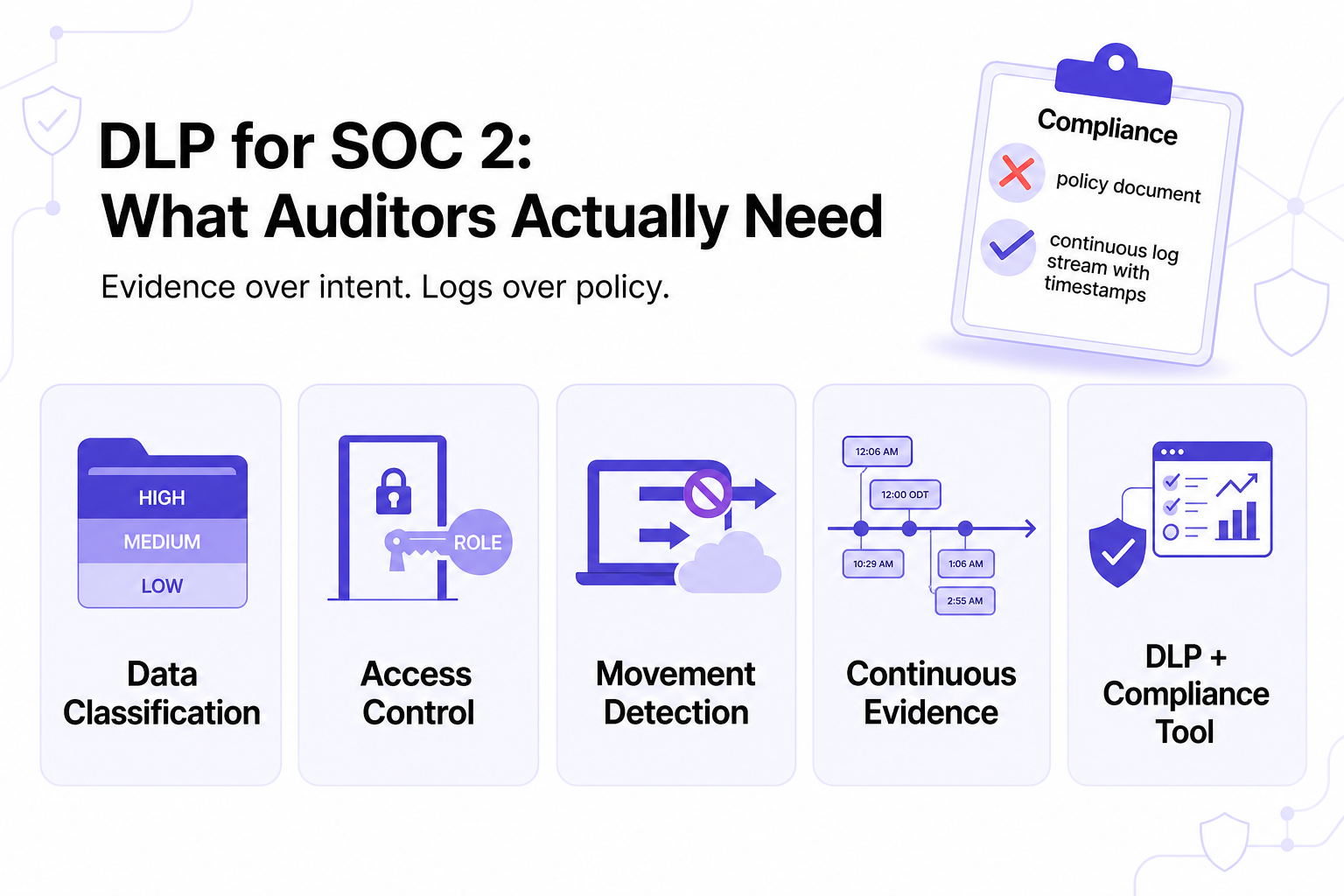
A 100-person company preparing for its first SOC 2 Type II audit needs data loss prevention (DLP) that produces continuous, timestamped evidence of enforcement, not a policy document that describes what should happen. Auditors evaluate whether an organization has implemented data classification, access controls based on sensitivity, and encryption for data in transit and at rest, and they verify the operational effectiveness of DLP tools to detect, log, and restrict unauthorized data movement over the full audit window. For a company your size, that means the DLP question is not “do we have a policy” but “can we show months of logs proving the policy was enforced.”
TL;DR
- SOC 2 Type II evaluates DLP under the Confidentiality and Privacy Trust Services Criteria, with supporting ties to Security controls on unauthorized data transmission.
- Auditors want continuous, logged evidence of enforcement, not a one-time screenshot or a policy PDF.
- A first Type II audit for a 100-person company typically takes several months to a year end-to-end, with total first-year costs varying by audit fees, tooling, and internal labor.
- A realistic 90-day sequence exists to go from selecting a DLP tool to having usable audit evidence, if you start with discovery, not policy writing.
- DLP and a compliance-automation platform (like Vanta or Scrut) solve different problems: one enforces at the endpoint, the other tracks and evidences controls across your whole environment.
About the Author: This article is written from Kitecyber’s work deploying endpoint-native DLP for growth-stage companies going through their first SOC 2 audit, where continuous enforcement logs, not static policy documents, are what auditors ultimately sign off on.
What Does SOC 2 Actually Require From DLP?
SOC 2 does not have a checkbox literally labeled “DLP.” Instead, DLP implementation maps most directly to the Confidentiality and Privacy Trust Services Criteria (TSC), which govern how an organization protects sensitive and personal information, with additional support from the foundational Security category’s common criteria around restricting unauthorized data transmission and movement.
In practice, this means an auditor is checking three things:
- Classification: sensitive data (customer records, source code, financials, PII, PHI) is identified and labeled by sensitivity, not just assumed to exist somewhere.
- Access control tied to sensitivity:people and systems can only reach data appropriate to their role, and that restriction is enforced, not just documented.
- Movement control: unauthorized transmission (uploads, email attachments, clipboard paste into unapproved apps, removable media) is detected, logged, and blocked or flagged in real time.
Auditors also look at encryption for data in transit and at rest, and secure data disposal and incident response procedures, as adjacent evidence that ties back to the same Confidentiality criteria. None of this is exotic. What trips up first-time SOC 2 companies is not knowing which of these controls is a DLP problem versus an IAM, encryption, or HR-offboarding problem. Get that mapping wrong and you either over-build DLP tooling for controls it can’t help with, or under-build it for the one area (data movement) where it’s the only category of control that actually produces evidence.
What Does an Auditor Actually Ask to See?
An auditor’s evidence request looks nothing like a policy review. Building on the criteria above, the harder question a 100-person company faces is: what document, log, or screen recording actually demonstrates compliance to the auditor sitting across from you?
For a SOC 2 Type II (as opposed to Type I), auditors are evaluating operating effectiveness across a review period, commonly three to twelve months, not a single point in time. That distinction matters enormously for DLP specifically:
| Evidence Type | What It Shows | Sufficient for Type II? |
|---|---|---|
| Written DLP policy | Intent | No, on its own |
| Screenshot of a DLP dashboard | Configuration exists at one moment | Weak, easily dismissed |
| Sample of blocked-transfer logs from one week | Enforcement happened once | Insufficient sample size |
| Continuous logs across the full review period, with timestamps, user, action, and disposition | Enforcement happened repeatedly, consistently, over time | Yes |
A policy document claims data won’t leave via USB or personal email. A continuous log proves it, showing every attempted transfer, the classification that triggered a decision, and whether it was blocked, warned, or allowed with justification. This is the single biggest gap between companies that sail through their first audit and companies that get a laundry list of exceptions: the second group has policies, the first group has logs.
Why Do Point-in-Time Controls Fail a Type II Audit?
A point-in-time control fails a Type II audit because Type II is, by definition, a test of operation over a period, not a design review. This is where legacy DLP tools and manual processes tend to break down for first-time SOC 2 companies. If your “DLP” today is a firewall rule, a browser extension configured once, or an email DLP add-on that only inspects one channel, you may be able to produce a screenshot showing it’s turned on. What you can’t easily produce is months of consistent logs showing it caught something, every time, across every channel someone might use to move data (files, clipboard, browser upload, email, SaaS apps, removable media, and increasingly, data pasted or uploaded into GenAI tools).
This matters more than most first-time SOC 2 teams expect, because endpoint-related failures are common in practice, and industry research consistently points to the endpoint as a leading source of data loss incidents and successful compromises. A DLP control that only watches network traffic or a single SaaS API will miss the channel where most of the actual risk lives, which is also the channel an experienced auditor will ask about directly: “show me what happens when someone tries to paste customer data into an unapproved AI tool” or “show me what happens when someone plugs in a USB drive.”
This is the practical argument for endpoint-native enforcement: the agent sees the action at the point it happens, classifies it by context rather than a static regex pattern, and logs the decision continuously, which is exactly the kind of longitudinal evidence a Type II auditor is trained to ask for.
What Does a Realistic 90-Day DLP Timeline Look Like?
A realistic 90-day plan gets your DLP program from a standing start to usable audit evidence, and it starts with discovery, not policy writing, because you cannot classify or control data you haven’t found yet. This is not the same as a full SOC 2 audit timeline, which typically runs considerably longer, but it is a realistic window for standing up the DLP piece of your audit prep.
- Days 1-15: Discovery and scoping. Deploy a lightweight endpoint agent across the environment to see, without enforcing yet, where sensitive data actually lives and moves: which endpoints touch customer PII, source code, or financial data, and through which apps.
- Days 16-30: Classification and policy design. Use the discovery data to build context-aware classification (this is a customer contract, this is a database export, this is source code) rather than starting from a generic policy template. This step is also where you decide which Trust Services Criteria each control is meant to help address, so your evidence collection later maps cleanly to what the auditor will ask.
- Days 31-60: Enforcement rollout.Turn on real-time enforcement (allow, block, warn, coach, log, or isolate) at the point of risk, starting with warn/coach modes to avoid disrupting normal work, then tightening to block for the highest-risk categories.
- Days 61-90: Evidence accumulation begins. From this point forward, every enforcement decision is logged continuously. This is also the point where a compliance-automation platform becomes useful, not as a replacement for DLP, but as the system that ties your DLP logs to the specific control it's meant to evidence.
By day 90, you have a meaningful stretch of continuous logs behind you. Since a Type II review period commonly spans three to twelve months, starting DLP in month one of your audit prep, not month four, is what separates a clean audit from a scramble.
How Does DLP Fit With a SOC 2 Compliance-Automation Platform?
DLP and compliance-automation software solve adjacent but different problems, and confusing the two is a common first-time mistake. A SOC 2 compliance software platform (Vanta, Scrut Automation, and similar tools) is built to track control status, pull integration evidence, manage your SOC 2 controls list, and generate the audit-ready reports your auditor will review. It is, in effect, the system of record for “are we compliant.”
DLP software is the system that actually stops or logs the unauthorized data movement in the first place. A compliance-automation platform can tell you a DLP control exists and is configured; it generally cannot, by itself, prove that endpoint-level enforcement happened consistently across every channel, because it isn’t sitting on the endpoint watching clipboard, file, and browser activity in real time. That is a distinct function, and it’s why cloud dlp solutions or endpoint DLP software still need to run underneath compliance automation rather than being replaced by it.
Because a modern endpoint agent can also cover secure web gateway, SaaS app protection, zero trust network access, and device management from the same lightweight deployment, it helps address a broader set of SOC 2, ISO 27001, HIPAA, and PCI DSS controls than a narrow point DLP product, without adding separate agents for each control area. For a 100-person company running a SOC 2 readiness assessment with limited headcount to manage tooling, that consolidation matters as much as the DLP function itself. Tooling like this supports the underlying controls, but certification still depends on how the organization configures, operates, and documents its own compliance program.
About Kitecyber
Kitecyber is an endpoint-native data loss prevention (DLP) platform built for the GenAI era, giving security and IT teams real-time visibility and control over where sensitive data goes, across files, clipboard, browser uploads, email, SaaS apps, data pasted or uploaded into GenAI tools, and removable media, from one lightweight agent covering Windows, macOS, and native Linux. Because the same agent also supports secure web gateway, SaaS governance, zero trust network access, and device management, it helps growth-stage companies address more SOC 2, ISO 27001, HIPAA, and PCI DSS controls than a point DLP product, without deploying additional tools. Kitecyber’s See, Decide, Enforce model applies context-aware classification and continuous logging at the exact point of risk, generating the kind of longitudinal evidence a Type II audit looks for. DuploCloud and Scrut Automation are among the companies referenced publicly in connection with Kitecyber’s data protection approach.
If your company is heading into its first SOC 2 Type II audit and needs a DLP that produces real evidence instead of static policy documents, visit Kitecyber to learn more or start a free trial.
See verified customer reviews of Kitecyber on G2 and SourceForge.
References
Frequently Asked Questions
No single tool makes a company compliant. DLP addresses specific Confidentiality and Privacy controls around data classification and movement; SOC 2 compliance also depends on access management, incident response, vendor management, and other controls outside DLP's scope.
Total first-year cost varies by scope, covering audit fees, compliance platforms, readiness assessments, and internal labor for a company around this size. Companies should request quotes from auditors and compliance platforms directly rather than relying on a fixed figure.
For a first-time company, the process typically takes several months to a year end-to-end, from readiness work through the completed audit report.
A checklist tells you which controls exist on paper. SOC 2 audit preparation means having the continuous logs, timestamps, and evidence trail that prove those controls operated as described across the full review period.
Context-aware classification software can identify and label sensitive data automatically based on document content and context, which is faster and more consistent than manual tagging, but someone still needs to validate the classification logic against your actual data types before the audit period starts.
Yes. A compliance-automation platform tracks and evidences control status; it does not itself detect or block unauthorized data movement at the endpoint, which is a separate, necessary function for the Confidentiality and Privacy criteria specifically.
Primarily Confidentiality and Privacy, with supporting ties to the Security category's common criteria on restricting unauthorized data transmission and movement.

Ajay Gulati
Ajay Gulati is a passionate entrepreneur focused on bringing innovative products to market that solve real-world problems with high impact. He is highly skilled in building and leading effective software development teams, driving success through strong leadership and technical expertise. With deep knowledge across multiple domains, including virtualization, networking, storage, cloud environments, and on-premises systems, he excels in product development and troubleshooting. His experience spans global development environments, working across multiple geographies. As the co-founder of Kitecyber, he is dedicated to advancing AI-driven security solutions.