Data loss prevention compliance for insurance carriers now hinges on a single architectural question: can you show one consistent policy enforced everywhere policyholder data moves, or do you have five tools each covering a slice of it? Under the NAIC Insurance Data Security Model Law (Model 668), carriers must maintain a written Information Security Program, run annual risk assessments, oversee third-party vendors, and certify compliance to their state insurance commissioner on a recurring cycle. The law is risk-based and technology-neutral: rather than naming products, it requires carriers to identify their sensitive data, control access to it, encrypt it, monitor for unauthorized activity, and keep audit trails — choosing the specific measures that fit their risk. In practice, that risk assessment points squarely at the endpoint, where a claims adjuster copying a policyholder’s SSN to a personal USB drive, or a broker moving underwriting notes into an unsanctioned app, is invisible to network-only tools. An endpoint-native DLP platform that consolidates data controls into one agent, rather than stitching them together from several point tools, is the more defensible answer going into that audit.
TL;DR
About the Author: This article is written by the Kitecyber team, whose endpoint-native
DLP platform is built for regulated industries including insurance, financial services, and healthcare, and whose customers include compliance-driven companies managing security certifications and audits as a core part of their business.
What Does the NAIC Model Audit Rule Actually Require From a DLP Program?
The NAIC Insurance Data Security Model Law is the operative standard here, not a vague “best practices” expectation. It requires a written Information Security Program, annual risk assessments, and documented oversight of third-party vendors handling policyholder data, backed by an annual certification of compliance submitted to the state insurance commissioner, typically due by February 15 or April 15 depending on the state’s adoption timeline. Licensees generally get one year to stand up the core security program after a state enacts the law, and two years to bring third-party vendor requirements into compliance.
Crucially, Model 668 is risk-based and technology-neutral. It does not prescribe specific products; instead, Section 4 lists security measures a licensee must consider as appropriate to its risk assessment — placing access controls on information systems, identifying and managing the data and systems that hold nonpublic information, encrypting nonpublic information, regularly testing and monitoring systems to detect unauthorized activity, maintaining audit trails, and securely disposing of data. The carrier decides which measures fit its risk. For an insurer, that assessment points directly at the endpoint: identifying and controlling where policyholder data moves, restricting how it can leave a device, and monitoring for unauthorized transmission are exactly the safeguards Section 4 describes — and they are hardest to evidence when the data is on removable media, in the clipboard, or on a device that is off the corporate network. A claims adjuster copying a policyholder’s SSN to a personal USB drive, or a broker moving underwriting notes into an unsanctioned chat app, happens at the device. Network-only tools cannot see it, which is why endpoint controls tend to carry the weight of demonstrating these measures in practice.
Why Do Point DLP Tools Struggle in an NAIC Audit Context?
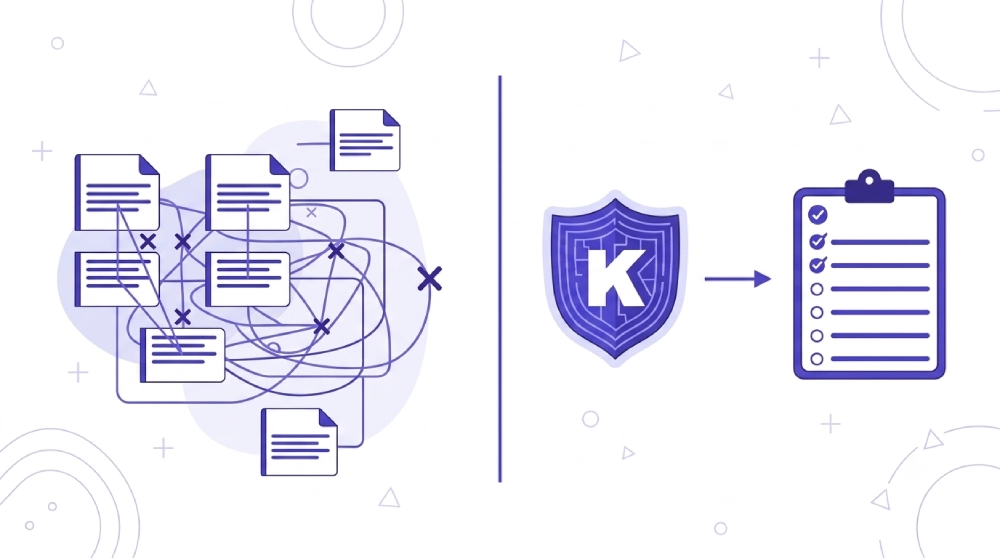
Point tools operate in silos, each with its own agent, policy engine, and console, and that structure is precisely what creates audit risk. When endpoint control, email DLP, and cloud app monitoring run as separate products, the result is fragmented visibility, inconsistent policy enforcement, and higher administrative overhead. An auditor asking “show me how you prevent unencrypted PHI or PII from leaving via USB, and show me the same policy applied consistently across every adjuster’s laptop” is asking a question that a five-tool stack answers with five different logs, five different policy definitions, and often five different definitions of what counts as “sensitive.”
This is not a hypothetical compliance gap. Managing multiple DLP point solutions creates the exact blind spots where sensitive data slips through unnoticed, alongside alert fatigue from false positives and real difficulty demonstrating comprehensive compliance during an audit. For a carrier managing claims data, medical records tied to health-related riders, payment card data, and third-party vendor feeds simultaneously, that fragmentation compounds. Each point tool has its own blind spot, and insurance data touches all of them.
The alternative is a unified control plane: one agent, one policy set, one telemetry stream, enforced consistently whether the file is on an underwriter’s laptop, in a Slack upload, or being pasted into a GenAI tool. That is the architecture that most cleanly demonstrates consistent, effective controls across the full data path — which is what an examiner reviewing a risk-based program is ultimately assessing.
How Does Endpoint-Native DLP Close the Gaps That Network Tools Miss?
Endpoint DLP solutions inspect data at the point where a user or an AI agent actually acts on it, which is the only place all of these risks (removable media, clipboard, messaging apps, unauthorized transmission, and data going into AI tools) converge. Network appliances only see traffic that crosses the network they are watching. If a claims processor works offline, uses a personal device, or pastes data into a browser-based tool before it hits the corporate network, network inspection never sees it.
Kitecyber’s model is built around this exact gap: See, Decide, Enforce, continuously. The agent sees sensitive data at the point of creation or access using context-aware classification, meaning it reads document context rather than relying purely on regex pattern matching. It decides the right action, allow, block, warn, coach, log, or isolate, based on data lineage: where the data came from, who is moving it, and where it is going. It enforces that decision in real time, at the endpoint, before the data leaves the device. This is the practical bar behind a real control: detection alone is only half of it — enforcement has to happen at the moment of risk, at the endpoint, not after a SIEM alert fires an hour later.
The analogy that makes this concrete: a network DLP appliance is like a security guard checking bags at the building’s front door. If an employee mails a document from their desk, uses the loading dock, or hands it to someone through a window, the guard at the front door never sees it. An endpoint agent is the equivalent of a rule that travels with the document itself, wherever it goes inside the building. That is why endpoint DLP solutions cover portable media, clipboard, and screen capture in a way that a network-only chokepoint structurally cannot.
Is Shadow GenAI Use a New Line Item on the NAIC Audit Checklist?
Shadow AI detection is becoming a practical necessity for carriers even though NAIC Model 668 predates the current wave of GenAI adoption. It is not a named requirement in the law, but it is squarely part of the risk surface a current risk assessment has to cover. Claims summarization, underwriting narrative drafting, and customer correspondence are exactly the kind of text-heavy workflows insurance staff turn to AI copilots for, and each of those workflows can involve policyholder PII, medical information, or financial account data pasted or uploaded into an AI tool.
The problem is structural: legacy DLP suites enforce static patterns built for known file types and known transmission channels. A ChatGPT session, a browser extension for an AI writing assistant, or an autonomous agent summarizing a claims folder does not look like a traditional data exfiltration event to a tool built five years before those channels existed. Kitecyber treats this as core DLP work, not a separate product: the same endpoint agent that blocks a USB transfer can detect and stop a claims number being pasted or uploaded into an unsanctioned GenAI app, and it can discover which AI tools are already in use across the organization before an incident forces the question. As agentic workflows become more common, insurers running AI-assisted underwriting or claims triage tools also need visibility into what those agents are allowed to read and move, not just what employees paste in.
What Should a Carrier Look for When Replacing Point Tools Ahead of an Audit?
A carrier consolidating its DLP stack ahead of an NAIC audit should evaluate replacement platforms against the specific controls its own
risk assessment surfaces, not against a generic feature list. The comparison below reflects publicly documented architecture for each vendor.
|
Vendor
|
Architecture
|
Relevant to NAIC audit
|
|
Teramind
|
Hybrid: endpoint agents plus cloud analytics; can run on-premise or private cloud
|
Strong on user activity logging, but relies on agents for offline capture and API connectors for cloud visibility
|
|
Microsoft Purview
|
Cloud-native, built into M365/Azure
|
Strong for Microsoft-centric data, limited for non-Microsoft or private endpoint scenarios without extra configuration
|
|
Cyberhaven
|
Cloud console with endpoint agents and browser extensions
|
Traces data lineage well, but requires agent or extension deployment on every device to get full coverage
|
|
Kitecyber
|
Single lightweight endpoint agent covering files, clipboard, browser, email, removable media, SaaS, and data pasted or uploaded into GenAI tools
|
One policy set and one log across the channels a risk assessment surfaces: removable media, clipboard, messaging, and unauthorized transmission
|
Carriers evaluating user activity monitoring platforms for NAIC readiness should weigh whether logging alone is enough, or whether real-time enforcement at the point of risk is needed alongside detection. A control that only detects, without the ability to block at the moment of risk, leaves open the gap a risk-based program is meant to close.
How Does Consolidation Help With Compliance Beyond the Security Audit Itself?
Because Kitecyber’s agent delivers files, clipboard, browser, email, removable media, and paste/upload coverage for GenAI tools alongside secure web gateway, SaaS governance, ZTNA, and endpoint management, the same deployment that helps address NAIC’s information-security requirements contributes to SOC 2, ISO 27001, HIPAA (for carriers with health-related lines), and PCI DSS controls a carrier is likely managing in parallel. Rather than deploying a separate agent for each framework’s checklist, the underlying telemetry, device posture, and access policy already exist and can be mapped to multiple sets of controls. For a compliance team preparing for an NAIC audit while also maintaining SOC 2 for enterprise clients, that overlap directly reduces the number of tools, contracts, and consoles that need separate audit evidence.
This consolidation also has a direct bearing on breach exposure. An insurance company data breach involving policyholder PII or claims data triggers state notification obligations on top of NAIC certification requirements, and the cost and reputational impact of that event scale with how much sensitive data was exposed before detection. Fewer tool gaps means fewer undetected paths for that data to leave.
About Kitecyber
Kitecyber is an endpoint-native DLP platform built for the GenAI era, giving security and compliance teams one lightweight agent that covers files, clipboard, browser uploads, email, removable media, SaaS and cloud apps, and data pasted or uploaded into GenAI tools. It uses context-aware classification and real-time data lineage to enforce the right action, allow, block, warn, coach, log, or isolate, at the exact point of risk, following a continuous See, Decide, Enforce model. Because the same agent also delivers secure web gateway, ZTNA, SaaS governance, and endpoint management, it maps to more compliance controls across NAIC, SOC 2, ISO 27001, HIPAA, and PCI DSS than a single-purpose DLP tool. Kitecyber works with regulated and compliance-driven companies managing security certifications and audits as a core part of their business, and offers native support for Windows, macOS, and Linux endpoints.
See verified customer reviews of Kitecyber on G2 and SourceForge.
Frequently Asked Questions