Table Of Content
Protecting Sensitive Data from Autonomous AI Agents: Why Real-Time Enforcement at the Endpoint Matters
-
August 20, 2026
-
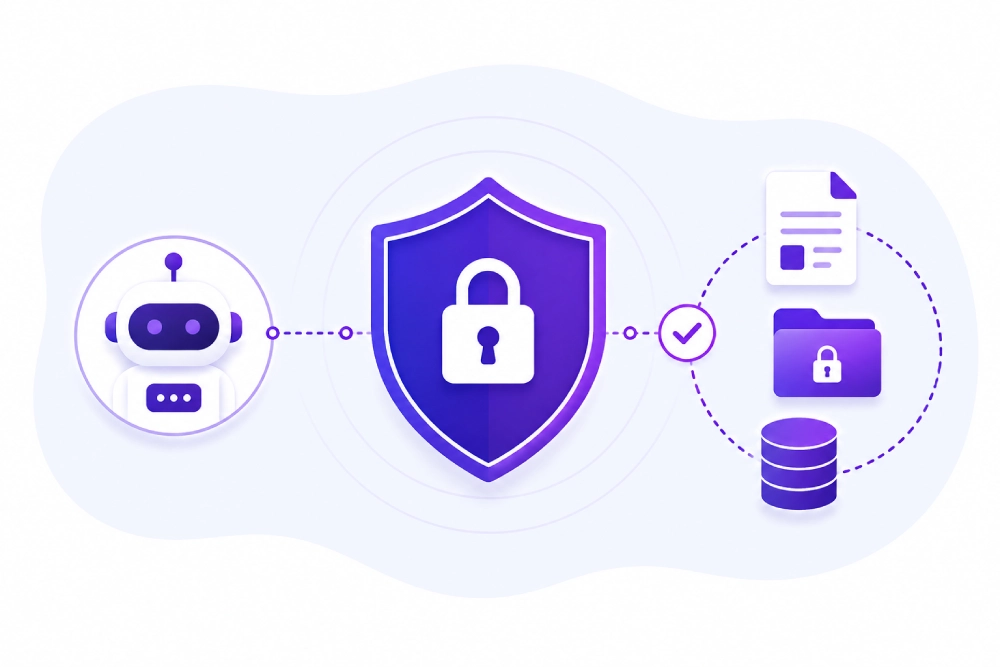
Quick Answer:
AI Security Posture Management (AISPM), also called AI Posture Management, is the continuous process of discovering, monitoring, and controlling how AI tools, models, and agents interact with your company's data and systems. It covers everything from spotting an unapproved AI app on someone's laptop to blocking a customer record from being pasted into a public chatbot. Most teams that manage AI posture well pair a discovery layer with policy enforcement at the point where employees actually use AI, which is the endpoint.
An AI agent kill switch is an emergency control that instantly revokes an autonomous agent’s credentials, tokens, and system access the moment it behaves outside approved boundaries [jumpcloud.com]. When activated, the agent’s authentication token is revoked, its API calls fail immediately, and its connections to every downstream system stop in real time [miniorange.com]. Security teams need this capability now because AI agents operate at machine speed: the fastest AI-orchestrated attacks exfiltrate data in as little as 72 minutes, with lateral movement beginning in just 27 seconds, timelines that no manual SOC workflow can match. Kitecyber builds endpoint-native data protection specifically for this problem, treating the endpoint as the point where an agent’s actions on sensitive data can actually be seen, decided on, and stopped.
TL;DR
- Autonomous AI agents can read, copy, and move sensitive data faster than any human review process, and 88% of organizations have already reported confirmed or suspected AI agent security incidents.
- Real-time enforcement at the endpoint, including the ability to revoke an agent's identity and access instantly, is essential to govern autonomous workflows before they move data to unauthorized destinations.
- Most enterprises are still exposed: 72% are piloting or running AI agents, but only 31% operate them in governed, hardened production environments.
- Kill switches work best when paired with continuous monitoring and data-level enforcement at the endpoint, not just perimeter or API-gateway controls.
- Kitecyber's See, Decide, Enforce model gives security teams a single, lightweight way to monitor agent behavior and cut off data access instantly, without stitching together multiple point tools.
About the Author: Kitecyber is a data security company built for the AI agent era, providing endpoint-native DLP, GenAI and AI-agent security, and unified access controls to technology, healthcare, and financial services companies including DuploCloud, Vanta, Sarvam, and Scrut Automation. This piece draws on Kitecyber’s work securing agentic workflows at the endpoint, where autonomous agents actually touch sensitive data.
What Is an AI Agent Kill Switch and Why Does It Matter Now?
A kill switch, in the context of AI agents, is an override mechanism that lets an IT or security administrator instantly disable an agent’s identity and revoke every credential tied to it [jumpcloud.com]. It is the agentic equivalent of pulling a plug: no negotiation, no graceful shutdown, just immediate termination of the agent’s ability to act.
This matters now because the threat model underneath enterprise software has changed. A traditional application does what its code says, predictably, every time. An autonomous agent decides what to do next based on a prompt, a goal, and whatever data and tool access it has been granted. That flexibility is the entire value proposition of agentic AI, and it’s also why things can go wrong fast. Documented incidents already include zero-click prompt injections against Microsoft 365 Copilot and hijacked GitHub Model Context Protocol servers that triggered unauthorized data exfiltration, demonstrating that autonomous agents can act without traditional user intervention.
Security researchers have pointed to the need for controls that let organizations disable agents quickly when they deviate from intended behavior [csoonline.com]. That is not a hypothetical concern. It’s the baseline requirement for running agentic workflows in production at all.
How Fast Can an Autonomous AI Agent Move Data?
Fast enough that human response times are no longer the relevant benchmark. AI-orchestrated attacks now exfiltrate data in as little as 72 minutes from initial compromise, with lateral movement inside a network beginning in just 27 seconds. Compare that to a typical manual SOC workflow, where triage, escalation, and containment can take hours or days.
This speed differential is why instant enforcement matters. Traditional detection and response processes operated on a timeline measured in hours. Autonomous agents operate in seconds, which is why security controls need to function at the endpoint in real time, not after data has already moved elsewhere.
This is why instant, auditable revocation is treated as mandatory for high-risk agent deployments in current AI agent security checklists [iternal.ai]. The control has to activate in seconds, not after a ticket gets reviewed.
Why Can't Traditional Security Tools Stop a Rogue Agent?
Traditional endpoint and network tools were built to answer a different question than the one agentic AI raises. Endpoint tools detect malware signatures. Network tools inspect traffic patterns. Static DLP enforces fixed policies written for known file types and known exfiltration paths. None of them were designed to evaluate whether an autonomous process, acting with a user’s own credentials, is doing something it shouldn’t.
Modern endpoint DLP software can monitor local file access and clipboard actions, which lets it detect when an AI agent interacts with sensitive data on a managed device. But traditional network and endpoint DLP solutions struggle with a specific, verifiable gap: they can’t reliably inspect encrypted SaaS-to-SaaS transfers, API-level data movement between connected apps, or autonomous agent actions that move data without triggering a recognizable file transfer event. An agent that reads a customer record through an API and pastes a summary into a connected tool doesn’t look like a file download. It looks like normal application behavior, because technically it is.
This is the specific gap that endpoint-native data security is built to close. Kitecyber’s approach starts from the premise that the endpoint, not the network perimeter, is where a user’s or an agent’s action on sensitive data first becomes visible: the clipboard event, the browser upload, the GenAI prompt, the SaaS API call initiated from that device. Data lineage tracked at that point in real time gives security teams the context that network inspection alone cannot.
What Does "See, Decide, Enforce" Look Like in Practice?
See, Decide, Enforce is Kitecyber’s operating model for continuous, real-time control over data movement, including movement initiated by AI agents. It runs as a loop, not a one-time check: the agent (Kitecyber’s endpoint agent, not to be confused with an AI agent) continuously observes device posture, browser activity, data movement, SaaS access, and AI interactions; evaluates each action in context, who or what is acting, on which device, with what data, going where; and enforces the appropriate control the moment an action occurs.
Building on the visibility gap described above, the enforcement piece is what actually functions as instant revocation for data-related risk. If an AI copilot or autonomous agent attempts to move regulated data to an unsanctioned destination, the system can allow, block, warn, coach, log, or isolate that specific action in real time, at the endpoint, rather than after the fact in a SIEM dashboard. That is real-time enforcement at the point of risk rather than reactive investigation after data has already left.
A few practical capabilities this enables for security teams:
- Insider risk and shadow GenAI detection: flagging when sensitive data is pasted into an unsanctioned AI tool before it leaves the device.
- AI agent identity management: tying every automated action back to a specific agent identity and device, so revocation is precise rather than a blanket shutdown.
- AI agent monitoring: continuous observation of agent behavior patterns, not periodic audits.
- Consolidation: one lightweight agent covering DLP, SWG, SaaS control, and ZTNA, instead of five tools each seeing a slice of the picture.
How Should Security Teams Build an AI Agent Governance Program?
Governance for autonomous agents needs to be treated as an extension of existing risk management, not a separate program bolted on afterward. An AI risk management framework for agents should define, in advance, what an agent is allowed to touch, what triggers automatic suspension, and who has authority to reactivate it. The Berkeley Agentic AI Profile literature makes a pointed observation here: kill switches don’t work if the agent itself is allowed to write or modify the policy governing its own behavior [law.stanford.edu]. Control logic has to sit outside the agent’s reach.
Regulatory frameworks are catching up unevenly. The EU AI Act explicitly requires strict access controls, continuous risk management, and human oversight for high-risk AI agents. GDPR, HIPAA, and SOC 2 don’t name AI agents specifically, but their data protection and access control mandates apply in full to any autonomous system processing regulated data. On the standards side, NIST SP 800-53 now includes control overlays specifically for securing AI systems, and ISO 42001 offers a certifiable framework for AI governance covering human oversight and lifecycle controls. For organizations pursuing CMMC compliance software or regulated-industry certifications, agent governance needs to be documented and auditable, not informal.
A practical governance checklist:
- 1. Inventory every agent and its data access scope before deployment.
- 2. Assign a distinct identity to each agent, separate from the human user it acts on behalf of.
- 3. Define automatic suspension triggers tied to specific behaviors, not just manual review.
- 4. Log every agent action against a data lineage trail for audit and incident response.
- 5. Test the revocation path regularly, the same way teams test backup restores.
What Should Security Teams Do Before an Agent Goes Rogue?
The honest answer is: build the monitoring and enforcement layer before deploying the agent, not after an incident forces the issue. Industry data shows why the timing matters: 72% of enterprises are already piloting or running AI agents, but only 31% have them in hardened, governed production environments. That gap, over 40 percentage points of agents running with less oversight than they should have, is where most future incidents will originate.
Stepping back from the individual controls, the underlying discipline is consolidation. Scenarios where autonomous agents move data to unauthorized destinations rarely fail because one tool was missing a feature; they fail because monitoring, identity, data protection, and access control lived in separate systems that didn’t share context in time to act. An insider threat detection software platform that can’t see AI agent identity, and an AI agent monitoring tool that can’t enforce a DLP policy, both leave the same blind spot open. Shadow AI detection only matters if it connects to an enforcement action, not just an alert.
About Kitecyber
Kitecyber is a data security company built around the endpoint, where AI agents, copilots, and users actually interact with sensitive data. Its single lightweight agent unifies endpoint and network DLP, GenAI and AI-agent security, Secure Web Gateway, SaaS app protection, and ZTNA, replacing fragmented point tools with one system operating on a continuous See, Decide, Enforce loop. This lets security teams monitor agent behavior, track data lineage, and enforce real-time controls, including revocation, at the exact point of risk rather than after data has already moved. Kitecyber works with technology, healthcare, and financial services organizations navigating HIPAA, CMMC, SOC 2, and other compliance requirements while adopting agentic workflows
References
- How to streamline compliance with cross-mapping | Vanta (vanta.com)
- Compliance Frameworks · 40+ on One Platform | RiskWatch (riskwatch.com)
- Mapping Risks to Controls Across Multiple Frameworks: Eliminating Duplicate Compliance Work (quantarra.io)
- Cross-Framework Complexity – Agency Cybersecurity (getagency.com)
- How to Manage Multi-Framework Compliance – Centraleyes(centraleyes.com)
- HIPAA Controls Mapped To NIST CSF: Key Requirements & Templates (2026) | Konfirmity(konfirmity.com)
Frequently Asked Questions
Typically a deviation from approved behavior: accessing data outside its defined scope, attempting to reach an unsanctioned destination, or exhibiting activity patterns that don't match its normal task profile. Well-designed systems combine automated triggers with a manual override.
No. A pause temporarily halts execution but may leave credentials and access intact. A kill switch revokes the agent's identity and access outright, cutting off API calls and connected system access immediately [miniorange.com].
It can stop further exfiltration once triggered, which matters given that lateral movement can begin in 27 seconds and full exfiltration in as little as 72 minutes. It cannot undo data that left before the trigger fired, which is why continuous monitoring matters as much as the switch itself.
Not by that name. But the EU AI Act requires human oversight and continuous risk management for high-risk agents, and existing frameworks like HIPAA, GDPR, and SOC 2 apply their access control requirements to any agent processing regulated data, which in practice requires a revocation capability.
Standard IAM manages who can log in and what they can access at a point in time. AI agent identity management extends that to autonomous processes acting continuously, requiring real-time behavioral evaluation, not just a one-time login check.
Partially. It can monitor local file access and clipboard actions well, but it struggles with encrypted SaaS-to-SaaS transfers and API-level movement that doesn't produce a visible file event, which is why endpoint visibility needs to be paired with SaaS and data lineage context.
Inventory which agents are already running, what data they can touch, and whether their access can be revoked in under a minute. Most teams find the answer to that last question is no, which is the actual starting point for a governance program.

With over a decade of experience steering cybersecurity initiatives, my core competencies lie in network architecture and security, essential in today's digital landscape. At Kitecyber, our mission resonates with my quest to tackle first-order cybersecurity challenges. My commitment to innovation and excellence, coupled with a strategic mindset, empowers our team to safeguard our industry's future against emerging threats.
Since co-founding Kitecyber, my focus has been on assembling a team of adept security researchers to address critical vulnerabilities and enhance our network and user security measures. Utilizing my expertise in the Internet Protocol Suite (TCP/IP) and Cybersecurity, we've championed the development of robust solutions to strengthen cyber defenses and operations.
Posts: 84
With over a decade of experience steering cybersecurity initiatives, my core competencies lie in network architecture and security, essential in today's digital landscape. At Kitecyber, our mission resonates with my quest to tackle first-order cybersecurity challenges. My commitment to innovation and excellence, coupled with a strategic mindset, empowers our team to safeguard our industry's future against emerging threats.
Since co-founding Kitecyber, my focus has been on assembling a team of adept security researchers to address critical vulnerabilities and enhance our network and user security measures. Utilizing my expertise in the Internet Protocol Suite (TCP/IP) and Cybersecurity, we've championed the development of robust solutions to strengthen cyber defenses and operations.
Posts: 84