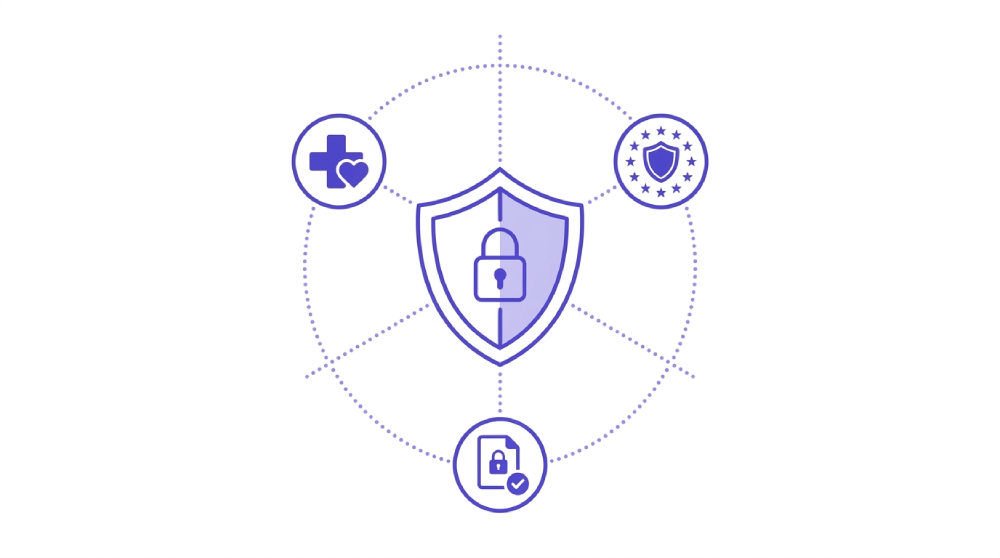
Organizations juggling HIPAA, GDPR, and CMMC obligations do not need three separate compliance programs. They need one endpoint data control set, applied consistently, that classifies sensitive data, enforces access and movement rules in real time, and generates the audit evidence each framework requires. HIPAA protects protected health information (PHI) for US healthcare entities, GDPR protects personal data of EU residents across all industries, and CMMC secures Federal Contract Information (FCI) and Controlled Unclassified Information (CUI) for the Department of Defense supply chain. The underlying mechanism these frameworks all rely on, restricting who and what can touch sensitive data, is the same. Kitecyber builds compliance support for HIPAA, GDPR, CMMC, ISO 27001, SOC 2, DPDP, FINRA, and PCI DSS directly into its endpoint DLP platform, because the control point where data is created, copied, or shared is identical no matter which regulation is being audited.
TL;DR
About the Author: This article is written from Kitecyber’s work building endpoint and network DLP for healthcare, defense-adjacent, and AI-native companies that must satisfy HIPAA, GDPR, and CMMC concurrently, and who need one data control layer rather than three overlapping compliance stacks.
What Do HIPAA, GDPR, and CMMC Actually Require at the Data Level?
Each framework names a different protected asset, but each requires the same operational proof: you know where it is, who can access it, and what happens when it moves. HIPAA classifies PHI as highly restricted and requires safeguards under its Security Rule. GDPR categorizes personally identifiable information (PII) as sensitive data requiring strict consent and lawful basis for processing. CMMC defines source code and federal project data as Controlled Unclassified Information (CUI), governed by cybersecurity maturity practices rather than privacy rights. Credentials and source code are treated as restricted or confidential assets requiring maximum access controls, encryption, and zero-trust enforcement across all three standards, even though the regulatory language differs.
This is the detail most compliance software for healthcare and defense contractors misses: HIPAA and GDPR are privacy-first frameworks concerned with individual rights and consent, while CMMC is a cybersecurity maturity standard focused on protecting government data from unauthorized access, with no privacy-rights component at all. Treating them as three unrelated checklists means building three unrelated evidence trails. Treating them as three expressions of the same underlying data-control problem means building one.
Why Does Compliance Mapping Across Frameworks Actually Work?
Framework mapping is the process of identifying common or overlapping controls across multiple security and privacy frameworks, including HIPAA, CMMC, GDPR, SOC 2, and ISO 27001 [vanta.com]. It works because most frameworks converge on a shared set of underlying practices, access control, encryption, audit logging, incident response, even when their terminology and enforcement mechanisms differ [riskwatch.com]. Mapping risks to controls across multiple frameworks eliminates duplicate work by letting one implemented control satisfy multiple framework requirements simultaneously, rather than requiring separate implementations per regulation [quantarra.io].
Practically, this looks like a shared control library:
|
Underlying control
|
Satisfies HIPAA
|
Satisfies GDPR
|
Satisfies CMMC Level 2
|
|
Data classification and discovery
|
PHI identification
|
PII identification
|
CUI identification
|
|
Access control by least privilege
|
Minimum necessary standard
|
Data minimization
|
Access control (AC) practices
|
|
Encryption at rest and in transit
|
Security Rule technical safeguards
|
Article 32 security of processing
|
System and communications protection (SC)
|
|
Audit logging of data movement
|
Breach notification evidence
|
Accountability principle
|
Audit and accountability (AU) practices
|
|
Endpoint and network DLP enforcement
|
PHI exfiltration prevention
|
Unauthorized transfer prevention
|
CUI exfiltration prevention
|
Agencies managing multi-framework compliance already map controls across SOC 2, ISO 27001, HIPAA, and CMMC to keep the work manageable as frameworks multiply
[getagency.com]. HIPAA controls have also been formally mapped to NIST CSF, showing how a well-documented crosswalk turns overlapping language into a single implementation checklist
[konfirmity.com]. The lesson is not that the frameworks are identical. It is that a unified compliance framework approach, built around one data control set, is the practical way to avoid rebuilding the same protections three times
[centraleyes.com].
Why Has AI Broken the Old Compliance Model?
Building on the control-mapping logic above, the harder question is what happens when the data itself starts moving through channels no framework anticipated. HIPAA’s Security Rule, GDPR’s Article 32, and CMMC’s practices were all written assuming data moves through files, databases, and networks that a human deliberately transfers. AI copilots and autonomous agents move data differently: they read, summarize, and act on sensitive content inside a prompt window, a clipboard, or a Model Context Protocol (MCP) session, often without a human explicitly initiating a transfer.
The shift to AI has changed the endpoint threat model. Autonomous agents and copilots can read, copy, and extract sensitive content at machine speed through natural language prompts, clipboard activity, and chained API calls that traditional DLP software and network inspection were not designed to monitor. Modern endpoint DLP solutions close this gap using inline semantic analysis, browser extensions, and context-aware policies that monitor real-time interactions, tracking clipboard activity, inspecting prompts and outputs inside GenAI applications, and scanning MCP metadata to block unauthorized local file access by autonomous agents. This is the technical basis for treating the endpoint, not the network, as the real point of enforcement for HIPAA, GDPR, and CMMC alike.
What Happens If You Get This Wrong?
The financial exposure across these three frameworks is not symmetric, and understanding the differences clarifies why endpoint-level prevention matters more than after-the-fact reporting. Regulatory enforcement and financial penalties vary significantly across GDPR, HIPAA, and CMMC, with penalties ranging from administrative fines under GDPR to civil and criminal enforcement under CMMC for defense contractors. A related but distinct point: these penalty structures all reward organizations that can demonstrate continuous, real-time control rather than periodic compliance snapshots. An annual audit that confirms encryption was configured correctly six months ago says nothing about whether an employee pasted PHI into an unsanctioned AI tool yesterday.
How Does an Endpoint-Native Control Set Satisfy All Three Frameworks at Once?
This is where consolidation stops being a convenience and becomes the compliance strategy itself. Kitecyber’s endpoint and network DLP discovers and classifies sensitive data, using document context in addition to pattern matching, so PHI, PII, and CUI are identified consistently regardless of which framework governs them. The platform operates on a continuous model: See, Decide, Enforce. It observes data movement across files, clipboard, browser uploads, GenAI prompts, SaaS apps, and removable media; evaluates each action in context, who is acting, what device, what data, where it’s headed; and enforces the right response, allow, block, warn, coach, log, or isolate, at the moment of risk.
That single enforcement layer generates the data lineage evidence auditors ask for under all three frameworks: a real-time record of where sensitive data went, not a reconstruction after a breach. Because it runs as one lightweight agent rather than a stack of point tools, healthcare organizations preparing for a HIPAA audit, companies handling EU personal data under GDPR, and defense contractors working through CMMC Level 2 requirements are all pulling evidence from the same source of truth, cutting duplicate audit prep and closing the visibility gaps that appear between disconnected tools. Customers including DuploCloud, Vanta, and Scrut Automation, several of which operate in compliance automation themselves, already run on this consolidated model rather than stitching together separate DLP and access tools per regulation.
About Kitecyber
Kitecyber is a cybersecurity company built to protect sensitive data at the endpoint, where PHI, PII, and CUI actually move through prompts, uploads, and clipboards. Its platform unifies endpoint and network DLP with GenAI and AI-agent security at the core, supported by Zero Trust Network Access and SaaS protection in one lightweight agent, replacing the fragmented point-solution stacks that leave gaps between HIPAA, GDPR, and CMMC audits. Kitecyber’s compliance support spans HIPAA, GDPR, CMMC, ISO 27001, SOC 2, DPDP, FINRA, and PCI DSS.
References
Frequently Asked Questions