Table Of Content
- What Is the Difference Between Kernel-Level and User-Space Agents?
- Why Do Kernel-Level Agents Carry More Stability Risk?
- How Do You Set Permissions Without Blocking Legitimate Work?
- What Does This Mean for Choosing an Endpoint DLP or Insider Threat Detection Tool?
- How Should Teams Balance Deep Visibility Against System Stability?
Related Posts

Table Of Content
- What Is the Difference Between Kernel-Level and User-Space Agents?
- Why Do Kernel-Level Agents Carry More Stability Risk?
- How Do You Set Permissions Without Blocking Legitimate Work?
- What Does This Mean for Choosing an Endpoint DLP or Insider Threat Detection Tool?
- How Should Teams Balance Deep Visibility Against System Stability?
Kernel-Level vs. User-Space Agents: What Architecture Choices Mean for Endpoint Security Performance and Stability
-
August 22, 2026
-
Quick Answer:
AI Security Posture Management (AISPM), also called AI Posture Management, is the continuous process of discovering, monitoring, and controlling how AI tools, models, and agents interact with your company's data and systems. It covers everything from spotting an unapproved AI app on someone's laptop to blocking a customer record from being pasted into a public chatbot. Most teams that manage AI posture well pair a discovery layer with policy enforcement at the point where employees actually use AI, which is the endpoint.
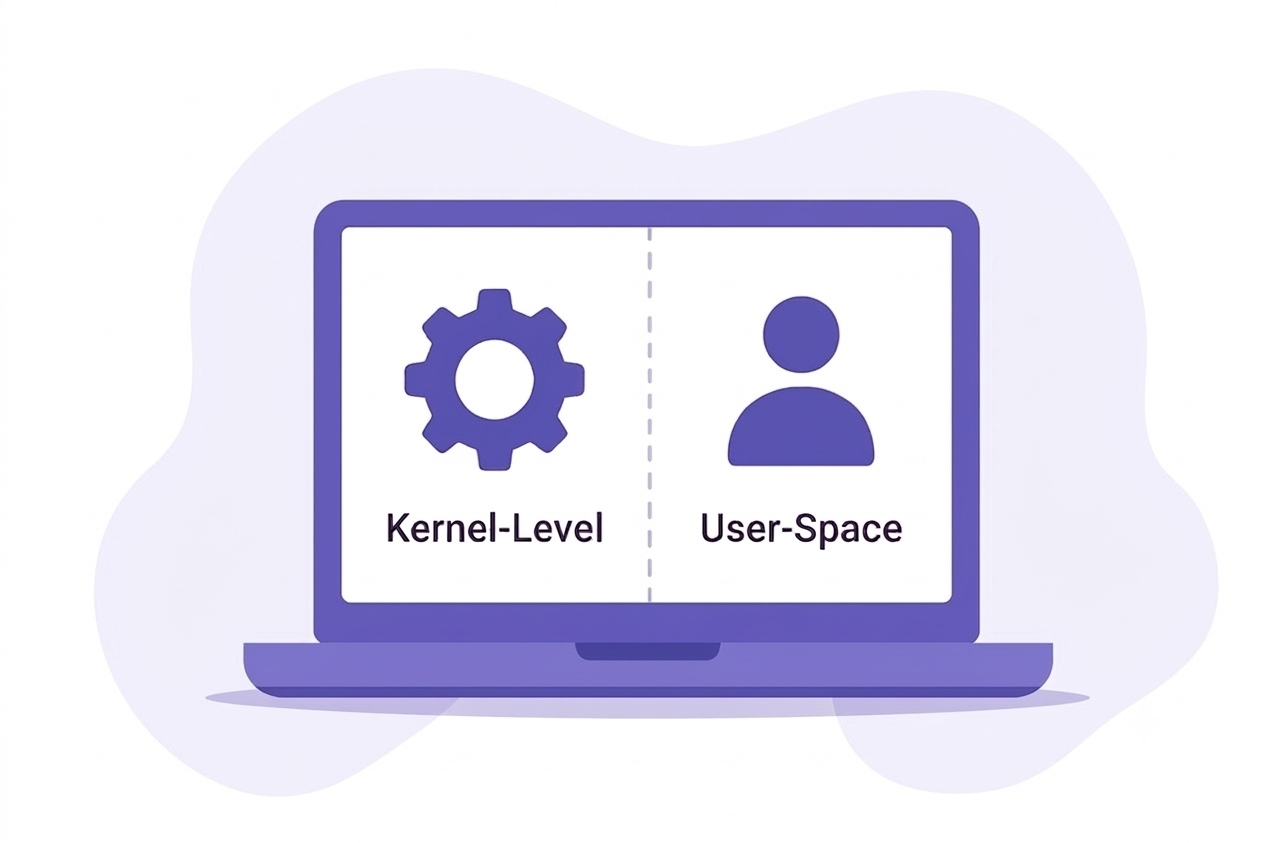
Kernel-level endpoint agents run inside the operating system’s core, giving them deep visibility into file, process, and network activity but putting the entire machine at risk if the driver fails. User-space agents run alongside normal applications, trading some depth of access for stability, lower resource overhead, and safer deployment. The choice between them determines whether your endpoint security agent introduces significant performance friction or operates transparently. It also determines what happens on the worst day: a kernel driver bug can take down a fleet of machines at once, while a user-space failure typically affects only itself.
As AI copilots and autonomous agents start reading, summarizing, and moving sensitive data at machine speed, the endpoint has become the place where data protection decisions have to happen in real time. The architecture underneath your endpoint protection platform must be built to enforce policy at that moment of risk, before sensitive data leaves the device.
TL;DR
- Kernel-level agents get privileged access to file system and network events but introduce systemic crash risk. A single bad driver update caused Blue Screen of Death failures on 8.5 million Windows machines in one documented 2024 incident.
- User-space agents avoid kernel-panic-class failures and generally impose lighter resource overhead, though the actual CPU cost depends heavily on implementation.
- Newer kernel interfaces like eBPF change the calculus: they can deliver deep visibility with modest overhead, but they still run in kernel space and still carry driver-level risk.
- AI agents can complete a full data exfiltration sequence in about 25 minutes, and some runtime security platforms now need roughly 10-millisecond detection latency to intercept autonomous transfers, a speed requirement that shapes architecture choices.
- Kitecyber's endpoint-native model favors a lightweight, user-space-friendly design that unifies data DLP, insider risk detection, and access control in one agent, built for real-time enforcement without the stability trade-offs of deep kernel hooking.
About the Author: Kitecyber builds endpoint-native data security for AI-native companies and publishes ongoing architecture comparisons against legacy endpoint and SSE vendors as part of its work replacing fragmented point solutions with one agent.
What Is the Difference Between Kernel-Level and User-Space Agents?
A kernel-level agent runs as a driver inside the operating system’s core, with direct access to the same memory space as the OS itself. A user-space agent runs as an ordinary process, communicating with the OS through defined system calls rather than sitting inside it.
That structural difference cascades into everything else: what the agent can see, how much it can slow the machine down, and what happens when something goes wrong.
- Kernel-level agents hook into low-level operations such as file system I/O requests. Windows minifilter drivers, for example, sit above the Filter Manager and intercept I/O Request Packets, using an assigned "altitude" that determines load order so they can inspect or block file access before it completes [softwareanalyst.substack.com] [docs-cortex.paloaltonetworks.com].
- User-space agents observe activity from outside the kernel, using OS-provided APIs and hooks rather than intercepting raw system calls directly.
The practical analogy: a kernel-level agent is like a security guard standing inside the building’s electrical room, able to see and interrupt every circuit before power reaches a device. A user-space agent is a guard stationed at each doorway, checking what passes through without touching the wiring. The doorway guard cannot see quite as deep into the system, but if that guard makes a mistake, the building still has power. If the electrical-room guard trips a wire, everything goes dark at once.
Why Do Kernel-Level Agents Carry More Stability Risk?
Kernel-level drivers carry severe stability risk because a flaw in kernel code does not just crash a program, it can crash the entire operating system [softwareanalyst.substack.com]. A process crash in user space is contained; the OS terminates it and moves on. A kernel crash has no such containment boundary.
This is not theoretical. In July 2024, a faulty CrowdStrike Falcon kernel driver update triggered an out-of-bounds memory read, and the result was Blue Screen of Death failures on 8.5 million Windows machines worldwide [softwareanalyst.substack.com]. That single incident is the clearest evidence available that kernel-level depth comes with a systemic downside: one bad update, and the failure mode is not “this app crashed” but “this machine, and every machine like it, is offline.”
This is the central tension IT and security teams weigh when selecting an endpoint protection platform. Deep visibility is valuable, but it has to be balanced against the blast radius of a mistake.
How Do Kernel-Level and User-Space Agents Compare on Performance?
Performance overhead is not simply a function of “kernel is fast, user space is slow.” It depends heavily on how the agent communicates with the OS. Traditional user-space agents that rely on frequent context switches and system calls can drive CPU usage up dramatically, in some measured cases by as much as 249%, because every observed event requires an expensive round trip between user space and the kernel.
Modern kernel-level approaches built on eBPF flip that expectation. eBPF programs run inside the kernel but are compiled, verified, and sandboxed before execution, letting them observe events with roughly 9% CPU overhead and minimal memory impact.
| Architecture | Typical CPU overhead | Crash blast radius | Visibility depth |
|---|---|---|---|
| Traditional kernel driver (minifilter, kernel hooks) | Low to moderate | Entire OS (system-wide crash risk) | Very high (raw I/O, syscalls) |
| eBPF-based kernel agent | Around 9% | Isolated by verifier, but still kernel-resident | High |
| Legacy user-space agent (heavy syscall polling) | Can exceed 200% under load | Contained to the agent process | Moderate |
| Modern lightweight user-space agent | Low, implementation-dependent | Contained to the agent process | Moderate to high, depending on OS hooks |
The lesson: the label “kernel” or “user space” tells you less than the actual implementation. A poorly built user-space agent can be slower than a well-built kernel one, and a poorly built kernel driver can be more dangerous than either.
Why Does AI Change the Speed Requirements for Endpoint Agents?
Stepping back from the architecture debate, a separate but urgent question is how fast an endpoint agent actually needs to react now that AI agents are operating on the endpoint. This is where the calculus shifts from “nice to have deep visibility” to “must enforce before the data is gone.”
Documented tests show AI agents can complete a full data exfiltration sequence in about 25 minutes, moving from access to extraction faster than most human review cycles. Some AI runtime security platforms now require detection latencies around 10 milliseconds to intercept these autonomous transfers before they complete. That is not a threshold legacy tools were built to hit. Malware-focused endpoint tools were designed to catch known-bad binaries, static DLP was designed to match patterns against files at rest, and network inspection was designed to look at traffic after it left the device. None of them were architected for machine-speed decisions at the point where an AI copilot reads a file and prepares to paste it somewhere else.
This is the gap Kitecyber is built to close. Rather than layering a heavy kernel driver for deep inspection and a separate DLP engine for policy, Kitecyber runs one lightweight, endpoint-native agent that continuously sees data movement across files, clipboard, browser uploads, GenAI prompts, and SaaS activity; decides each action using data lineage and context, not just pattern matching; and enforces the right response, whether that is allow, block, warn, coach, log, or isolate, at the moment the action happens rather than after a log review.
What Does This Mean for Choosing an Endpoint DLP or Insider Threat Detection Tool?
Building on the performance and stability tradeoffs above, the practical question for a buyer evaluating endpoint DLP software or insider threat detection software is not “kernel or user space” in the abstract, it is “does this agent’s architecture match the speed and stability my organization actually needs.”
A few practical guidelines:
- Ask about crash containment, not just detection accuracy. A vendor's ability to catch threats matters less if a bad update can take down the fleet. Request specifics on how driver updates are tested and rolled out.
- Measure overhead under real workloads, not idle benchmarks. CPU and memory cost differences between agents often only show up when users are actively working, not sitting idle.
- Count the agents, not just the features. Many security stacks combine a kernel-level EDR agent, a separate DLP agent, a VPN client, and a SaaS security posture management tool. Each one adds resource load and a separate point of failure. Consolidation over fragmentation is not just an efficiency argument, it is a stability argument: fewer agents means fewer places for a kernel-level bug to originate.
- Check whether enforcement happens at the point of risk.A data classification software module that flags sensitive data after the fact is doing forensics, not prevention. Real-time enforcement at the point of risk means the block or warning happens before the file leaves the device.
This is also where Kitecyber’s positioning differs from adjacent categories. Zscaler and Netskope inspect traffic through cloud-delivered SSE architectures, with Zscaler running entirely as an inline cloud service and Netskope processing traffic through its NewEdge network. Both are strong at network-level inspection, but by design they are architected around traffic passing through their cloud, not around what happens locally the instant an AI agent touches a file on the endpoint. Sophos Intercept X runs a lightweight agent for threat detection and ransomware rollback, managed through Sophos Central, but its focus is malware and exploit protection rather than sensitive data movement. Cyberhaven and Safetica both take an endpoint-first approach similar in spirit to Kitecyber. Cyberhaven uses lightweight endpoint agents and API connectors alongside data lineage tracing, while Safetica relies on a client installed directly on user devices, paired with on-device classification. Where Kitecyber differentiates is in unifying that data-security core with zero trust network access, SaaS control, and unified endpoint management in the same agent, so teams evaluating a Zscaler alternative or a Safetica alternative are not trading one gap for another.
How Should Teams Balance Deep Visibility Against System Stability?
The honest answer is that no architecture eliminates the trade-off entirely, but the right design minimizes both the frequency and severity of failure. Kernel-resident interfaces like eBPF have narrowed the old gap between “deep but risky” and “shallow but safe,” delivering strong visibility with a fraction of the overhead of legacy syscall-heavy monitoring [softwareanalyst.substack.com]. That progress matters, but it does not remove the fact that kernel-space code still shares the OS’s fate.
For most organizations, the more resilient posture is architectural minimalism: one agent, purpose-built to see data movement and enforce policy at the moment of risk, rather than several overlapping agents each reaching into the OS from a different angle. Every additional kernel-touching component is another chance for a Tuesday afternoon update to become a fleet-wide outage.
Kitecyber’s approach reflects that philosophy directly. Instead of asking IT teams to run a kernel-level EDR agent, a network DLP appliance, a VPN client for zero trust network access, and a separate SaaS security posture management tool, Kitecyber consolidates endpoint DLP, GenAI and AI agent security, secure web gateway protection, SaaS governance, ZTNA, and unified endpoint management into a single lightweight agent built around one shared trust engine. Data protection sits at the center; the other controls unify around it rather than existing as separate stacks competing for kernel access.
References
- The CISO Guide to Endpoint Control and Prevention (ECP): The Next Architecture for Endpoint Security (softwareanalyst.substack.com)
- Cortex XDR Agent for Linux Requirements (docs-cortex.paloaltonetworks.com)
Frequently Asked Questions
Not necessarily. Kernel-level access provides deeper visibility into raw system events, but modern user-space designs using OS-provided hooks can achieve strong visibility for data movement and application behavior without touching the kernel at all.
A faulty kernel driver update caused an out-of-bounds memory read, and because kernel code runs with full system privileges, the failure crashed the operating system itself rather than just one process, resulting in Blue Screen of Death failures across 8.5 million Windows machines [softwareanalyst.substack.com].
No. eBPF reduces overhead substantially, to around 9% CPU in typical use, and adds a verification step before code runs, but the code still executes inside the kernel, so it does not eliminate kernel-level risk entirely.
Because AI agents can complete a full exfiltration sequence in about 25 minutes, and some runtime security tools now require roughly 10-millisecond detection latency to intercept an autonomous transfer before it finishes, far faster than most legacy detection and response cycles were designed for.
Data lineage traces the origin, movement, and use of sensitive information across systems and workflows. It matters for insider threat detection because it reveals not just what data moved, but the context in which it moved, the user or agent that moved it, and whether that movement matches the user's role and responsibilities. An employee downloading customer records to a personal cloud drive creates a different risk profile than an engineer accessing the same data to debug a production issue. Lineage captures that distinction, enabling real-time decisions rather than forensic conclusions after the fact.

Ajay Gulati
Ajay Gulati is a passionate entrepreneur focused on bringing innovative products to market that solve real-world problems with high impact. He is highly skilled in building and leading effective software development teams, driving success through strong leadership and technical expertise. With deep knowledge across multiple domains, including virtualization, networking, storage, cloud environments, and on-premises systems, he excels in product development and troubleshooting. His experience spans global development environments, working across multiple geographies. As the co-founder of Kitecyber, he is dedicated to advancing AI-driven security solutions.