



Detection Alone Falls Short:What Regulators Now Expect for AI, and Why It Lands on the Endpoint

Quick Answer: AI Security Posture Management (AISPM), also called AI Posture Management, is the continuous process of discovering, monitoring, and controlling how AI tools, models, and agents interact with your company's data and systems. It covers everything from spotting an unapproved AI app on someone's laptop to blocking a customer record from being pasted into a public chatbot. Most teams that manage AI posture well pair a discovery layer with policy enforcement at the point where employees actually use AI, which is the endpoint.

Kitecyber | Data & Gen AI Security

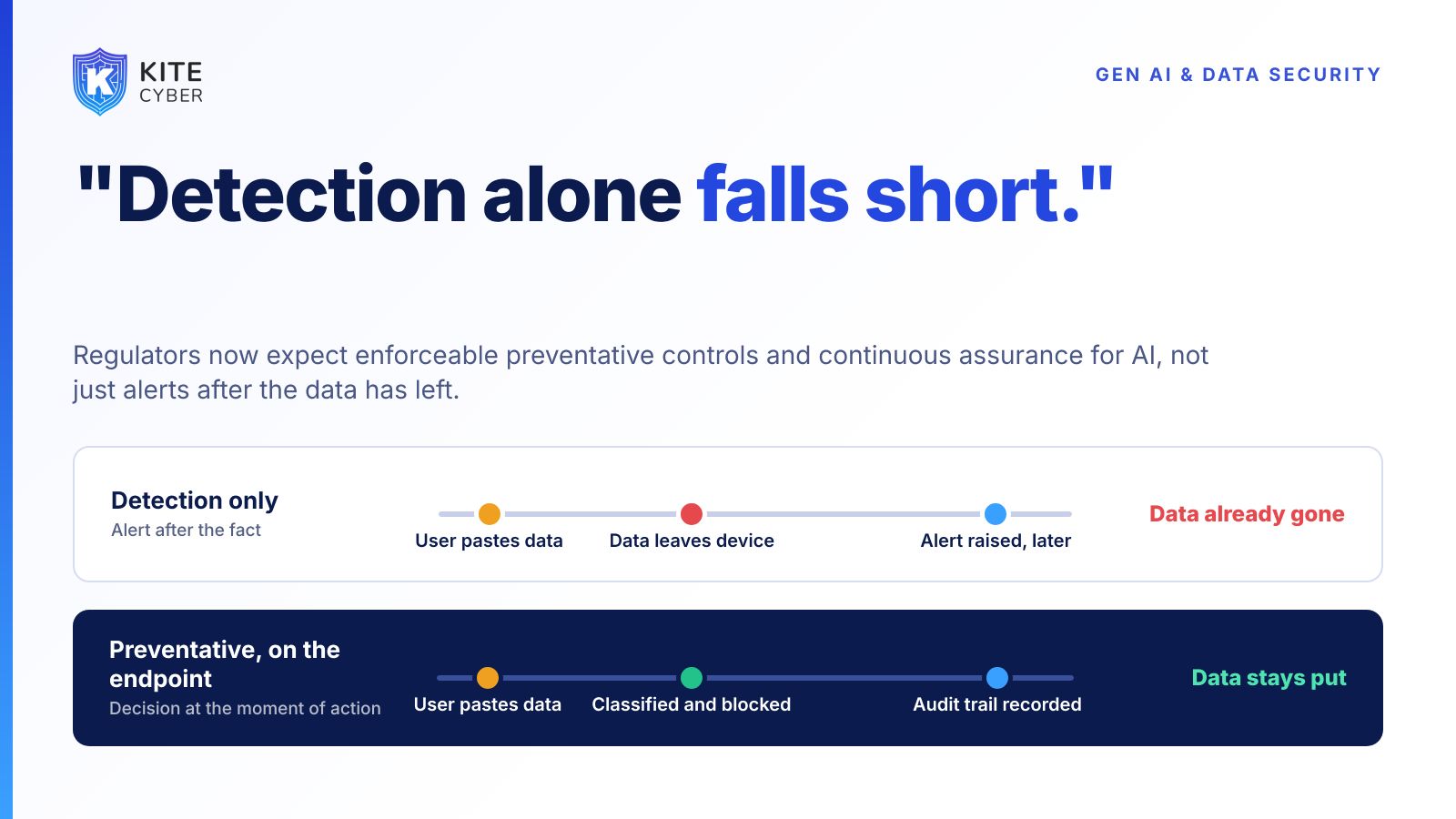
A Zscaler blog on Australia’s APRA standards quotes the regulator’s April 2026 AI letter: it expects enforceable preventative controls and continuous assurance, and says policy direction and after-the-fact detection on their own fall short. For AI use, that expectation has to be met where the data and the tools actually are.

On 6 November, Zscaler published a blog on APRA’s CPS 230 and CPS 234 standards. Its closing section extends the argument to AI. Per Zscaler, APRA’s April 2026 letter on artificial intelligence notes that AI agents, AI built into supplier platforms and staff using unapproved AI tools bring new identities, new data flows and new fourth-party dependencies, and that APRA expects enforceable preventative controls and continuous assurance, with policy direction and after-the-fact detection alone falling short. Zscaler also reports that both standards are now fully in effect, so the question for financial institutions has moved from design to whether the evidence holds up.

APRA regulates Australian financial institutions, but the shift in wording is broader than one jurisdiction. Written policy and alerts that fire after a leak are no longer being treated as sufficient for AI.

What "preventative" and "continuous" demand in practice

Read plainly, the expectation has three parts, each of which is hard to meet from a distance:

Why the endpoint is the natural enforcement point

The device is where a person types a prompt, an agent reads files, and data is copied between applications. It is also where context is richest:

Network-level controls remain valuable and complement this. But traffic that is encrypted, local, or never routed through the gateway, such as a local agent writing to a file or an app on a personal account, is easier to judge with on-device context.

A practical checklist

Where Kitecyber fits

Kitecyber’s Gen AI and data security runs on the endpoint, combining device posture, operating system and process activity, user activity, network activity and data classification across 80+ categories. It discovers Gen AI tool use, applies allow, warn or block policy at the moment of action, and records an audit trail that can serve as ongoing evidence. The lightweight agent (under 2% CPU) typically deploys in about a day. It is not a substitute for governance, and the right control set depends on your regulatory obligations.

Book a Kitecyber walkthrough at kitecyber.com to see preventative AI controls and audit evidence in one view.

Ajay Gulati

Ajay Gulati is a passionate entrepreneur focused on bringing innovative products to market that solve real-world problems with high impact. He is highly skilled in building and leading effective software development teams, driving success through strong leadership and technical expertise. With deep knowledge across multiple domains, including virtualization, networking, storage, cloud environments, and on-premises systems, he excels in product development and troubleshooting. His experience spans global development environments, working across multiple geographies. As the co-founder of Kitecyber, he is dedicated to advancing AI-driven security solutions.

Scroll to Top