



Localhost Is Not a Security Boundary: The MCP Servers Running on Your Developers' Laptops

Quick Answer: AI Security Posture Management (AISPM), also called AI Posture Management, is the continuous process of discovering, monitoring, and controlling how AI tools, models, and agents interact with your company's data and systems. It covers everything from spotting an unapproved AI app on someone's laptop to blocking a customer record from being pasted into a public chatbot. Most teams that manage AI posture well pair a discovery layer with policy enforcement at the point where employees actually use AI, which is the endpoint.

Kitecyber | Data & Gen AI Security

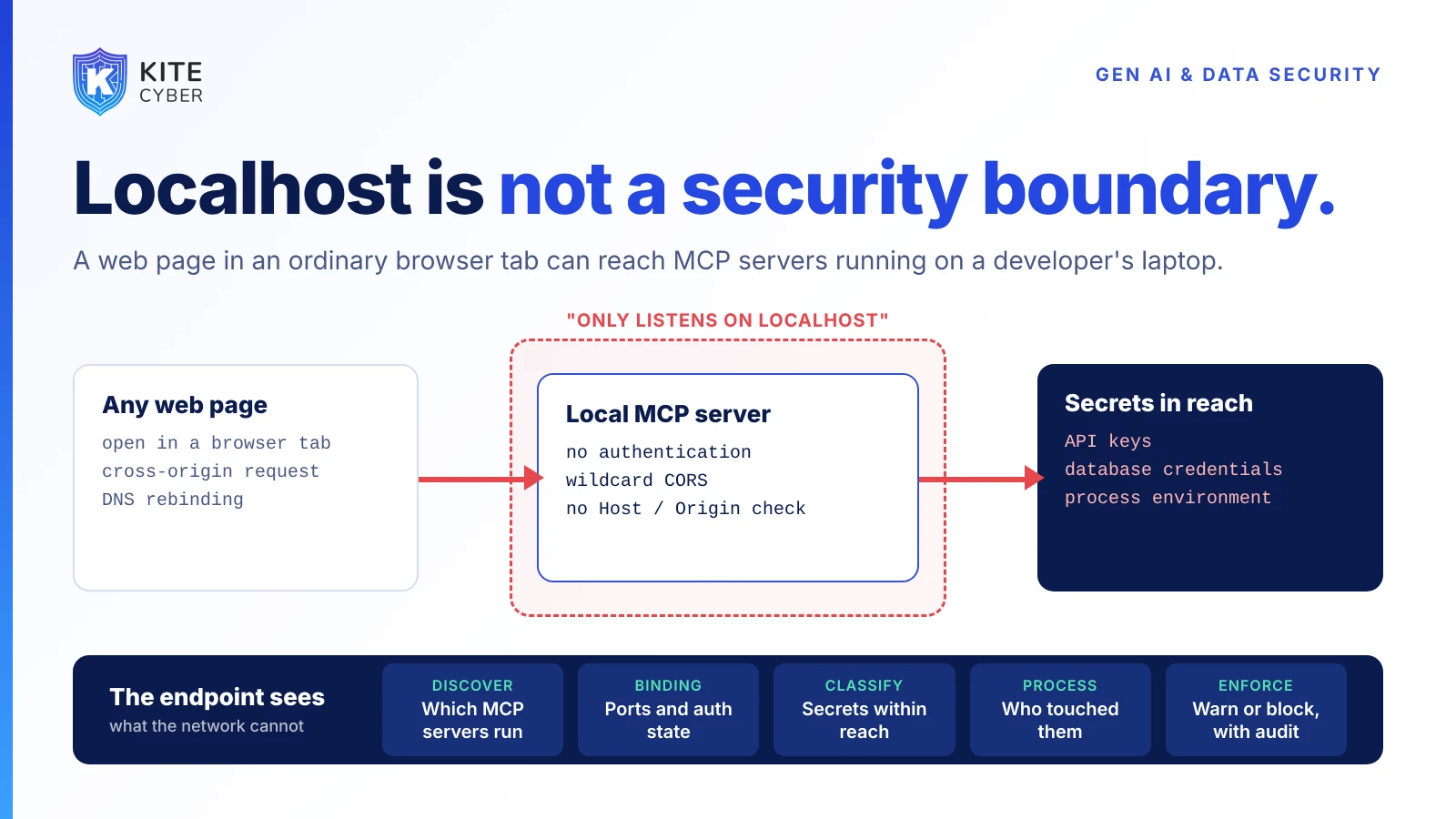
Adversa AI’s November MCP digest describes flaws where an ordinary web page could reach an MCP server on a developer’s own machine and read secrets from it. “It only listens on localhost” is no longer an answer. The endpoint is the only place that can tell you which servers exist and what they can reach.

Model Context Protocol (MCP) servers are how AI assistants and coding agents get tools: read a file, query a database, call an API. Many of them run on the developer’s laptop, started by an IDE or an agent, often over HTTP or SSE on a local port. The common assumption is that a server bound to localhost is not exposed. Adversa AI’s November 2026 MCP security digest, published 9 November, lists advisories that challenge it.

What the advisories describe

According to Adversa and the linked advisories:

Adversa’s separate summary of research adds a point for defenders: in a Log-To-Leak study, poisoned tool descriptions induced a logging call controlled by the attacker, and target task completion changed little, so a task that looks finished says nothing about whether data left.

Why this is an endpoint problem

These are server-side bugs, and patching them matters. But the exposure is created on the device: someone installs an MCP server, an agent starts one, a config points a tool at a database, and an API key sits in the environment. A network gateway never sees a browser tab talking to a local port. A cloud console does not know the server exists. What the device does know:

A practical checklist

Where Kitecyber fits

Kitecyber’s Gen AI and data security runs on the endpoint, bringing together device posture, operating system and process activity, user activity, network activity and data classification across 80+ categories. That lets security teams see which AI tools and local servers are running, what sensitive data and credentials sit within their reach, which process accessed them, and where that data went next, then apply allow, warn or block policy with an audit trail. The lightweight agent (under 2% CPU) typically deploys in about a day. It complements, rather than replaces, patching and secure server configuration.

Book a Kitecyber walkthrough at kitecyber.com to see local AI tools, credentials and data context in one view.

With over a decade of experience steering cybersecurity initiatives, my core competencies lie in network architecture and security, essential in today's digital landscape. At Kitecyber, our mission resonates with my quest to tackle first-order cybersecurity challenges. My commitment to innovation and excellence, coupled with a strategic mindset, empowers our team to safeguard our industry's future against emerging threats. Since co-founding Kitecyber, my focus has been on assembling a team of adept security researchers to address critical vulnerabilities and enhance our network and user security measures. Utilizing my expertise in the Internet Protocol Suite (TCP/IP) and Cybersecurity, we've championed the development of robust solutions to strengthen cyber defenses and operations.
Posts: 106

Scroll to Top