Table of Content



Who Holds the Master Key to Your Browser? Governing AI Extensions and AI Browsers
-
November 16, 2026
-
A scenario: the helpful sidebar
Here is an illustrative scenario.
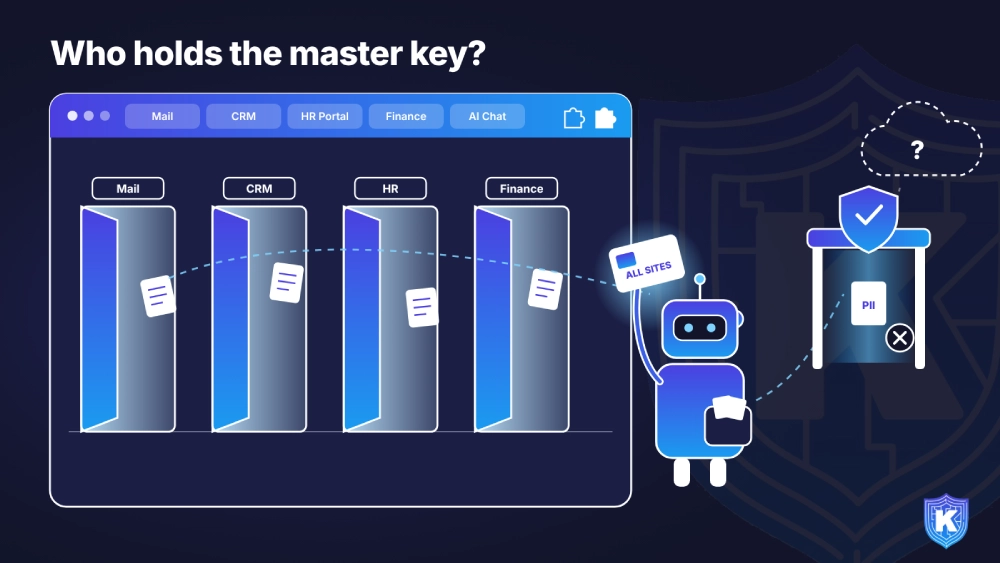
At a 600-person logistics company, an account manager installs a free “AI sidebar” extension to summarize long email threads. It takes ten seconds. The permission prompt says the extension can “read and change all your data on all websites,” and she clicks Add, as most people do.
For weeks the tool works as promised. It also reads every tab she opens: the CRM with customer pricing, the HR portal during open enrollment, the finance dashboard. Every half hour it sends what it has collected to a server no one at the company has heard of. Nothing trips an alert. The traffic is encrypted, the domain is new, and she did nothing that looks like data theft.
The two-person security team finds out only when a news report names the extension. By then the question isn’t how to stop it. It’s what left, and since when.
The problem: a privileged insider nobody hired
- In January 2026, researchers found two Chrome extensions with more than 900,000 combined users that copied full ChatGPT and DeepSeek conversations, plus the URL of every open tab, to an outside server every 30 minutes (The Hacker News). Tab URLs alone can expose internal domains, session tokens and user IDs.
- A month later, 30 fake "AI assistant" extensions with more than 300,000 installs were caught stealing credentials, email content and browsing data. Half of them targeted Gmail specifically (BleepingComputer).
- By March, one managed detection provider reported "several dozen" incidents of this "prompt poaching" in a single month (Infosecurity Magazine).
How Gen AI changed it
- The prompt became a data channel. Employees paste contracts, code and customer lists into AI sidebars. A malicious or data-harvesting extension can read those prompts and the answers too.
- Assistants became agents. AI browsers and browser agents don't just read; they click, fill in forms and complete tasks while signed in. Gartner lists indirect prompt injection, erroneous agent actions and credential loss on phishing pages among the risks, and OpenAI's own CISO has called prompt injection "a frontier, unsolved security problem" (Computerworld).
- The line between chat and action is fading. In October 2026, Gartner noted that assistants able to decide on their own to execute work, including through "browsers or computer controls," remove "a visible decision point between prompt and execution." Vendor guardrails help, but Gartner says they are not a replacement for DLP and other security controls (Gartner First Take).
- Attackers follow the installs. Fake AI extensions copy the names and look of popular ones. One that stole conversations had carried a "Featured" badge in the store (The Hacker News).
Why legacy approaches fall short
- Network and cloud-proxy inspection sees encrypted traffic leaving for a domain. It can't tell which extension sent it, which page the data came from, or whether the employee meant to share it. And it sees nothing when the laptop is off the VPN.
- URL blocklists chase domains that change weekly. A data-harvesting extension can move to new infrastructure in hours.
- Store ratings and one-time allowlists are weak signals. Extensions update silently, and a trusted one can change owners or behavior overnight.
- Browser-only tools help, but cover only part of the problem. Gartner's 2026 market guide for secure enterprise browsers notes that these tools focus on web-based AI and miss AI usage such as "embedded AI applications, device AI assistants, local AI models on endpoints" (Gartner).
- Blanket bans push people to personal laptops and phones, where you see nothing at all.
What a modern approach looks like
- 1. Inventory every AI surface on the device. Extensions, AI browsers, desktop assistants, command-line tools and local models, with who has them and which versions.
- 2. Judge by access, not popularity. An extension that can read every site and tab deserves the same review as a new SaaS vendor with admin rights.
- 3. Approve a short list, and say so. Give people sanctioned AI tools that meet the need, then remove the rest through browser and device management. Good approved options cut workarounds.
- 4. Protect the data, not just the tool. Classify content at the moment it's pasted, uploaded or moved, so a sensitive record is caught whichever AI tool is on the other end.
- 5. Treat AI browsers as agents. Gartner's advice is to block them by default. If you pilot, keep to small groups and low-risk tasks that are easy to verify and roll back (Computerworld), and require human approval for consequential actions.
- 6. Make it continuous. Re-check the inventory weekly. New installs and silent updates are where the risk comes from.
How Kitecyber helps
- One inventory of every AI tool. The AI Apps & Agents view lists Gen AI apps with category, sanction status, usage time and data uploaded and downloaded per app. A Gen AI Extensions view shows AI browser extensions in Chrome and Edge, with versions and user and device counts. Shadow AI discovery covers browser tools, desktop apps, CLIs and embedded AI features.
- Sanction in one click. Mark approved apps as sanctioned, then filter by user, group, tag or endpoint over 1, 7 or 30 days to see who still uses the rest.
- Stop sensitive data at the paste. Data Shield tracks sensitive data pasted or uploaded into Gen AI tools such as ChatGPT, Claude and Gemini, and can allow, warn or block on the device before it leaves. Classification covers 80+ data categories, including PII, PHI, payment data and source code.
- Web and Gen AI control without hairpinning. The endpoint-first secure web gateway monitors SaaS, web and Gen AI traffic, including agentic and Gen AI apps that evade URL filters, and keeps enforcing policy when the laptop is offline or off the VPN.
- Remove what you don't approve. Device Shield's app control and remote actions let IT remove unapproved apps, such as an AI browser that hasn't passed review.
SME decision-maker checklist
- 1. Can we list every AI browser extension, AI browser and desktop AI app in use today, by user and device, within an hour?
- 2. Do we review extension permissions the way we review a new SaaS vendor? Who signs off?
- 3. Have we published a short list of approved AI tools, and is it easier to use than the alternatives?
- 4. If someone pastes customer records into an unapproved AI tool, would we warn them, block it, or never know?
- 5. Do our controls still work when a laptop is off the VPN or offline?
- 6. What is our stated position on AI browsers: blocked, piloted with guardrails, or undecided?
- 7. Quick win this week: export the extension list from your browser or device management console and remove any AI extension nobody can justify.
Compliance angle
- GDPR: an extension that reads personal data behaves like a processor with no contract (Article 28) and weakens the "appropriate technical and organisational measures" Article 32 requires.
- HIPAA: PHI visible in a browser tab can flow to a service with no business associate agreement.
- SOC 2: auditors look for logical access controls and vendor risk management. Unmanaged extensions sit outside both.
- ISO 27001:2022: Annex A controls on inventory of assets (5.9) and installation of software on operational systems (8.19) apply directly to extensions and AI browsers.
- PCI DSS 4.0: payment data viewed in a browser can be read by any extension with access to the page, which undermines your cardholder data controls.
- EU AI Act: organizations that deploy AI systems must take measures to ensure staff AI literacy (Article 4). That starts with knowing which AI tools are in use.
Key takeaways
- AI extensions and AI browsers often hold access to every tab an employee opens. Treat them as privileged third parties, not harmless add-ons.
- Inventory and approval come first. You can't govern AI tools you haven't found.
- Protect the data at the moment it moves on the device, so the right decision happens whichever AI tool is involved.

Ajay Gulati
Ajay Gulati is a passionate entrepreneur focused on bringing innovative products to market that solve real-world problems with high impact. He is highly skilled in building and leading effective software development teams, driving success through strong leadership and technical expertise. With deep knowledge across multiple domains, including virtualization, networking, storage, cloud environments, and on-premises systems, he excels in product development and troubleshooting. His experience spans global development environments, working across multiple geographies. As the co-founder of Kitecyber, he is dedicated to advancing AI-driven security solutions.