


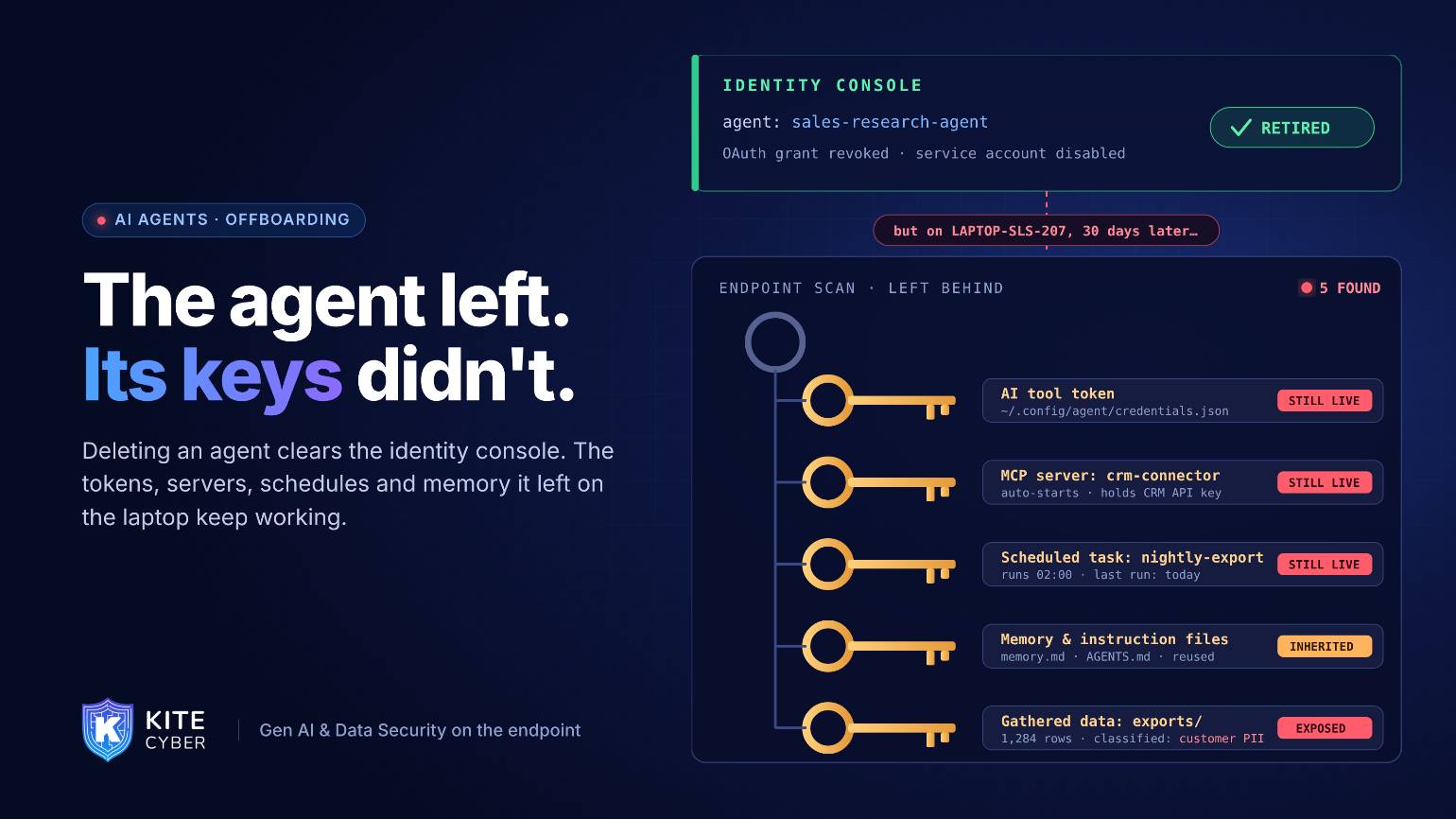

The Agent Was Retired. Its Keys Weren't: Offboarding AI Agents Starts on the Device

Quick Answer: AI Security Posture Management (AISPM), also called AI Posture Management, is the continuous process of discovering, monitoring, and controlling how AI tools, models, and agents interact with your company's data and systems. It covers everything from spotting an unapproved AI app on someone's laptop to blocking a customer record from being pasted into a public chatbot. Most teams that manage AI posture well pair a discovery layer with policy enforcement at the point where employees actually use AI, which is the endpoint.

Kitecyber | Data & Gen AI Security

Every company has an exit checklist for people. Almost none has one for AI agents, and agents leave more behind than people do.

When an employee leaves, the routine is familiar: collect the laptop and badge, revoke logins, reassign open work, keep the records. In a 12 November 2026 column for Help Net Security, Sprinto CEO Girish Redekar described AI agents as “vendor employees who never sleep and never get offboarded.” Deleting an agent removes its name from a screen. It does not remove the credentials it held, the work it left running or the decisions someone may ask about later.

The scale makes this urgent:

As Redekar put it, an agent can disappear from the inventory months before its credentials leave the permissions list.

What an agent leaves on a laptop

Most retirement guidance, such as Nudge Security’s 4 November guide, focuses on the identity layer: revoke OAuth grants, rotate API keys, disconnect MCP servers, disable service accounts. All of that is right. But many agents run on endpoints, and the device keeps its own copy of the agent’s life:

None of these show up in an identity console. All of them are visible on the device.

Two exits to plan for

When an agent is retired. Revoke at the identity layer, then confirm on every device that the process no longer runs, its tokens are gone, its MCP registrations are removed and nothing it scheduled still fires.

When the person who ran it leaves. Nudge Security recommends reviewing every agent running under a departing employee’s OAuth credentials, moving business-critical ones to a service account with a new owner and revoking the rest. On the device side, the same review should list every agent, assistant and local server the person ran, and what data each one could reach.

An agent exit checklist

Where Kitecyber fits

Kitecyber runs on the endpoint and combines device posture, operating system and process activity, user activity, network activity and data classification. That gives security teams a per-device view of which AI agents, assistants and MCP servers are installed and running, which credentials and sensitive data sit within their reach, and where their data goes, including agents left behind by a departing employee. After retirement, Kitecyber shows whether anything tied to the agent still runs or connects, and can block sensitive data from leaving through it. Identity tools revoke the keys; Kitecyber confirms nothing on the device is still using them.

Ajay Gulati

Ajay Gulati is a passionate entrepreneur focused on bringing innovative products to market that solve real-world problems with high impact. He is highly skilled in building and leading effective software development teams, driving success through strong leadership and technical expertise. With deep knowledge across multiple domains, including virtualization, networking, storage, cloud environments, and on-premises systems, he excels in product development and troubleshooting. His experience spans global development environments, working across multiple geographies. As the co-founder of Kitecyber, he is dedicated to advancing AI-driven security solutions.


Scroll to Top