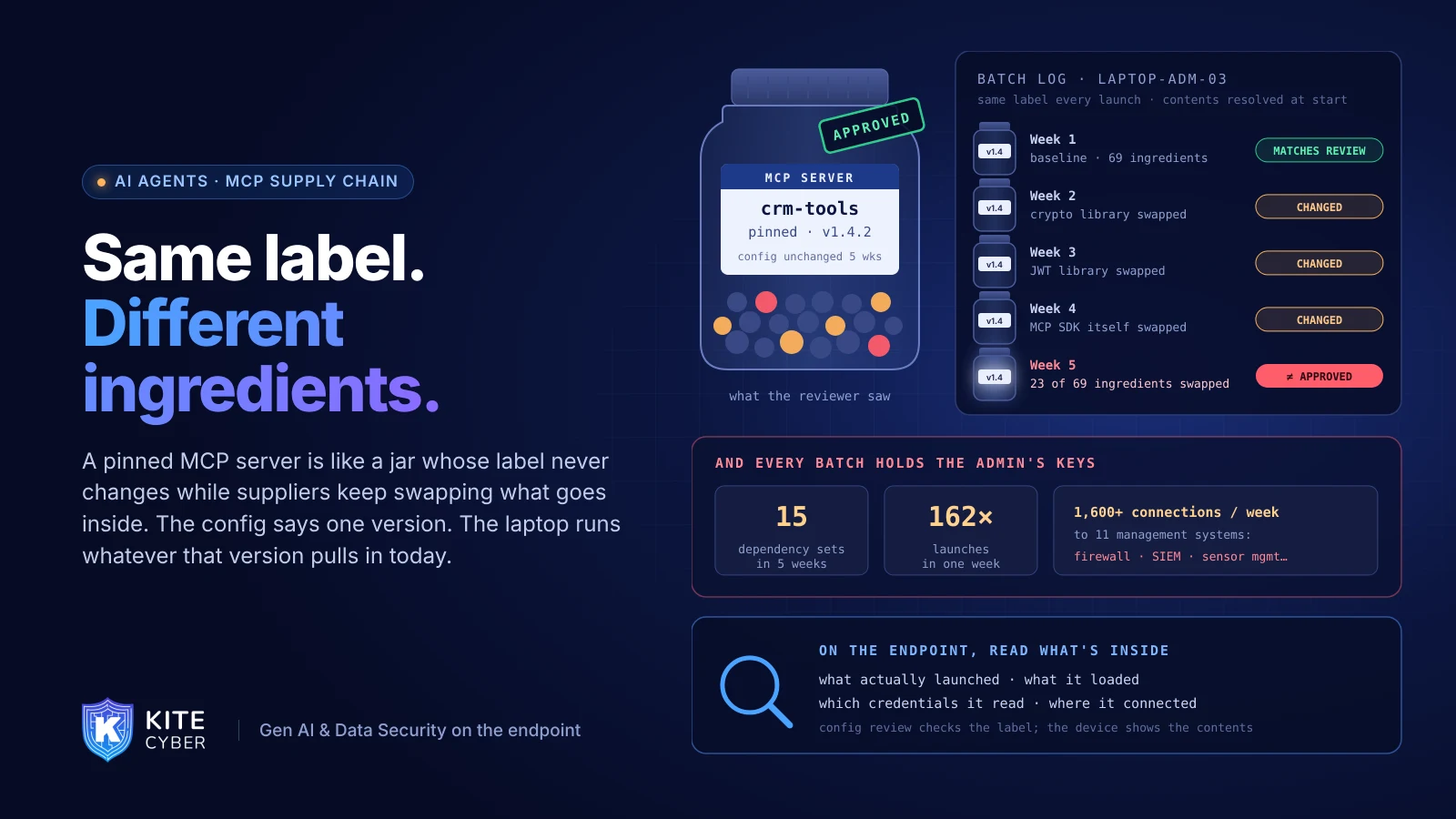
Security reviews approve a configuration. Agents run whatever that configuration resolves to on the day they start, and that can be different every time.
On 13 November 2026, Help Net Security reported on research by Corelight into MCP servers running on an administrator’s workstation in its own lab. One server was configured to run a single fixed release. Over five weeks, with that configuration untouched, it ran with 15 different sets of dependencies. Twenty-three of its 69 packages changed version, including the cryptography library, the JSON Web Token library and the MCP software development kit itself.
The numbers around it are what make this a security problem rather than a tidiness problem:
Pinning a package’s version doesn’t necessarily pin the packages it depends on. Corelight’s fix was to freeze five servers: pinned to a commit, installed once from a hash-pinned lock file, launched directly, with update checks turned off.
The same week, the tokens became the target
The day before, Help Net Security covered wfx-loot, a credential stealer that a threat actor pushed into tens of thousands of GitHub repositories from 10 November. It collects Actions secrets, cloud and SSH credential files, shell histories, and tokens for AI tools including OpenAI, Anthropic, Cursor and Copilot.
And on 12 November, Microsoft’s Defender Research and AI Red Team published “Trained to betray,” showing that poisoned fine-tuning data and backdoored model checkpoints could make coding agents issue unsafe tool calls on ordinary triggers. Their conclusion: treat post-training artifacts as part of the software supply chain, and enforce controls at the tool-execution boundary.
Put those together and the picture is clear. The AI toolchain on a developer or admin laptop is a supply chain that refreshes itself, and the credentials it holds are now a named target.
Why config review can't see this
Most MCP governance today checks what is declared: which servers are approved, which versions are listed in a config file, which tools they expose. That is necessary, and it is a snapshot. Drift happens at launch time, on the device, and it leaves no trace in the file a reviewer looks at.
Questions a config review can’t answer:
All five are answered on the endpoint, by watching processes, file access and network activity in context.
A practical checklist
Where Kitecyber fits
Kitecyber runs on the endpoint and combines device posture, operating system and process activity, user activity, network activity and data classification. For MCP servers, that means seeing which servers and agents actually run on each device, what started them, which files and credentials they read, and where they connect, so drift shows up as a change in behavior rather than going unnoticed in a config file. Kitecyber can apply allow, warn or block policy when sensitive data or credentials head somewhere new. It complements dependency pinning and supply chain controls: they decide what should run, and Kitecyber shows what did.
Book a Kitecyber walkthrough at kitecyber.com to see the MCP servers and AI tools running across your endpoints today.