
One Integration per Agent Doesn't Scale: Securing Every AI Agent on the Device

Quick Answer: AI Security Posture Management (AISPM), also called AI Posture Management, is the continuous process of discovering, monitoring, and controlling how AI tools, models, and agents interact with your company's data and systems. It covers everything from spotting an unapproved AI app on someone's laptop to blocking a customer record from being pasted into a public chatbot. Most teams that manage AI posture well pair a discovery layer with policy enforcement at the point where employees actually use AI, which is the endpoint.
Kitecyber | Data & Gen AI Security Security vendors are building native protections for individual agent products. That is welcome. But your employees’ laptops will run many agents, and the list changes monthly. On 3 November CrowdStrike announced that Falcon Guardian AI Detection and Response now works natively inside Anthropic’s Claude Cowork, delivered in partnership with Anthropic. By the announcement’s description, the integration covers agents from creation through execution, detects malicious activity and potential data exfiltration, and brings the agent under the Falcon platform’s control plane on Windows and Mac. The next day, CrowdStrike added Agent Insider Threat Detection and AI Ecosystem Detections aimed at coding assistants, MCP servers and agent frameworks. On the platform side, Google Cloud’s plugin for the Antigravity Marketplace bundles safety guardrails, including IAM checks and blocking of destructive CLI commands, with its developer skills. Each of these is a sensible response to a real demand. It also shows a pattern worth planning around: agent security is increasingly delivered one platform at a time.

The arithmetic of a real laptop

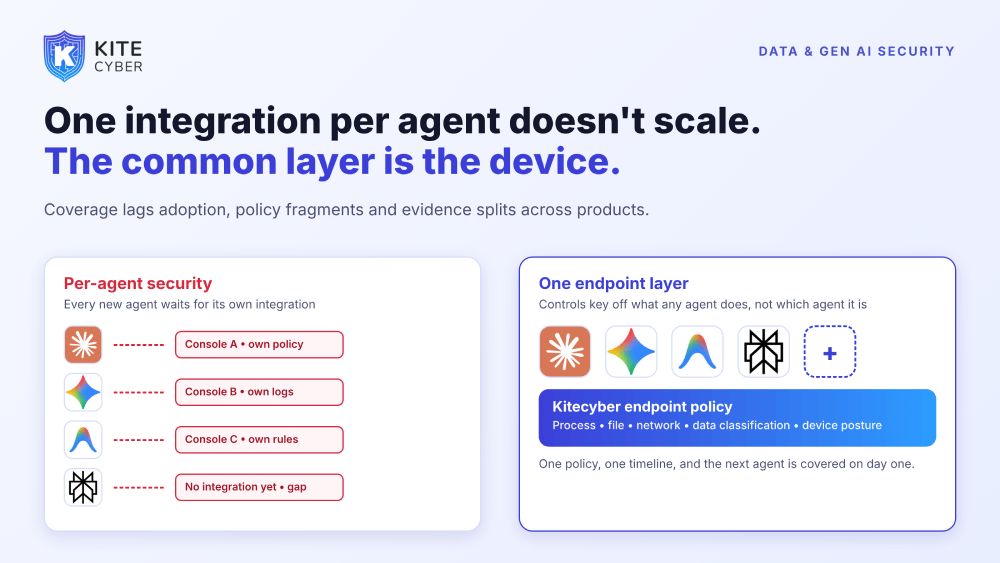
Look at what a single engineer’s machine may run on an ordinary Thursday: a desktop agent, one or two coding assistants in the IDE and the terminal, a browser with built-in AI features, several local MCP servers, a handful of extensions and perhaps a local model runtime. Some are approved. Some are personal installs. Next month the mix will be different. If protection depends on an integration for each, three problems follow:

What stays constant across agents

Every agent, whatever its brand, does a small number of things on the device:
Those behaviors are visible at the operating-system level, and they are the same whether the agent is built by a large vendor, an open-source project or an internal team. Controls placed there apply to the next agent automatically, because they key off what the agent does, not which agent it is.

A layered way to think about it

Native integrations and endpoint-level controls are not rivals. They answer different questions.

A practical test for your own environment: pick any AI tool that is not on the approved list and ask whether you would know it had read a file classified as confidential, and whether you could stop it from sending that file out. If the answer depends on that tool having a vendor integration, there is a gap.

What to ask vendors, including us

Where Kitecyber fits

Kitecyber’s Gen AI and data security runs on the endpoint and combines device posture, operating system and process activity, user activity, network activity and data classification (80+ categories). Because it observes behavior at the device level, one policy can apply across AI tools and agents, with graduated allow, warn and block decisions and an audit trail, rather than a separate setup per product. A lightweight agent (under 2% CPU) and typical deployment in around a day keep it practical.
Book a Kitecyber walkthrough at kitecyber.com to see how a single endpoint policy covers the agents your teams use today and the ones they will try next.
With over a decade of experience steering cybersecurity initiatives, my core competencies lie in network architecture and security, essential in today's digital landscape. At Kitecyber, our mission resonates with my quest to tackle first-order cybersecurity challenges. My commitment to innovation and excellence, coupled with a strategic mindset, empowers our team to safeguard our industry's future against emerging threats. Since co-founding Kitecyber, my focus has been on assembling a team of adept security researchers to address critical vulnerabilities and enhance our network and user security measures. Utilizing my expertise in the Internet Protocol Suite (TCP/IP) and Cybersecurity, we've championed the development of robust solutions to strengthen cyber defenses and operations.
Posts: 104
With over a decade of experience steering cybersecurity initiatives, my core competencies lie in network architecture and security, essential in today's digital landscape. At Kitecyber, our mission resonates with my quest to tackle first-order cybersecurity challenges. My commitment to innovation and excellence, coupled with a strategic mindset, empowers our team to safeguard our industry's future against emerging threats. Since co-founding Kitecyber, my focus has been on assembling a team of adept security researchers to address critical vulnerabilities and enhance our network and user security measures. Utilizing my expertise in the Internet Protocol Suite (TCP/IP) and Cybersecurity, we've championed the development of robust solutions to strengthen cyber defenses and operations.
Posts: 104
Scroll to Top