
Agents in a Box: What Windows Execution Containers Solve, and What Still Needs Endpoint Telemetry

Quick Answer: AI Security Posture Management (AISPM), also called AI Posture Management, is the continuous process of discovering, monitoring, and controlling how AI tools, models, and agents interact with your company's data and systems. It covers everything from spotting an unapproved AI app on someone's laptop to blocking a customer record from being pasted into a public chatbot. Most teams that manage AI posture well pair a discovery layer with policy enforcement at the point where employees actually use AI, which is the endpoint.

Kitecyber | Data & Gen AI Security

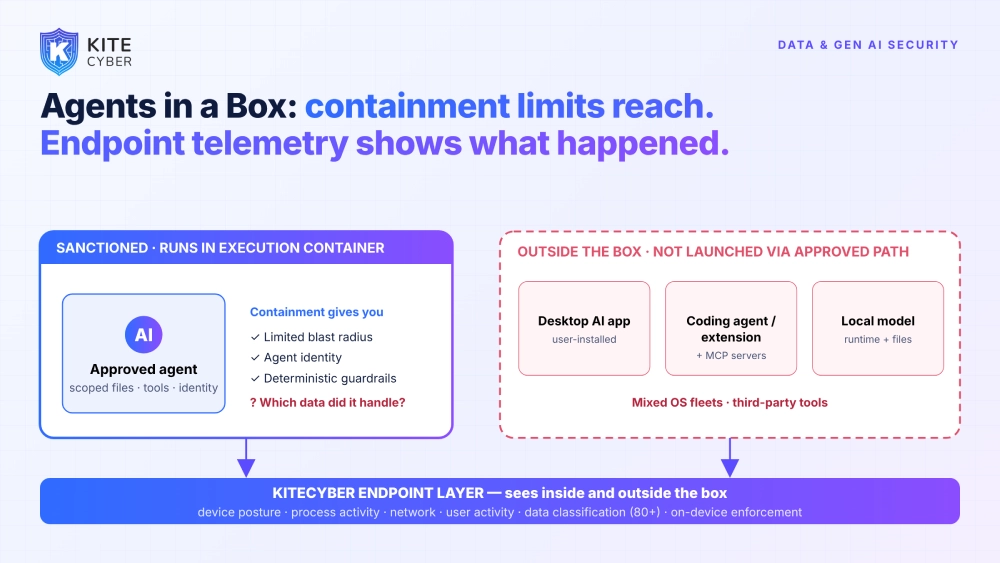
Containment answers “what can this agent reach?” Security teams also have to answer “what did it do, and what was it holding when it did it?”

On 7 October, Microsoft laid out its vision for Windows as a platform for “hybrid intelligence”: AI agents that run locally when needed, call the cloud when appropriate, and operate with built-in security and manageability. A headline item was that Microsoft Execution Containers (MXC) are now generally available on Windows, alongside identity and manageability capabilities meant to help organizations control what agents can access and understand which agent performed an action.

This is a meaningful step. Running an agent inside a boundary is exactly the right instinct. It also raises a question every security team should ask before declaring the problem solved: what does a container tell you, and what does it leave out?

What containment does well

A container narrows an agent’s blast radius. It constrains the files, processes and resources the agent can touch, and it gives administrators a place to attach policy. Paired with agent identity, it helps answer attribution questions. These are deterministic controls wrapped around a non-deterministic system, which is a sound design principle.

Where the gaps remain

A practical way to layer the controls

Where Kitecyber fits

Kitecyber’s Gen AI and data security runs on the endpoint, where agents execute. It combines device posture, operating system and process activity, network activity, user activity and data classification (80+ categories), and enforces policy on the device. That complements platform containment: the container limits reach, and Kitecyber shows what AI tools are present, what data they handle and how policy applies to each. A lightweight agent (under 2% CPU) and typical deployment in around a day keep it practical.
Book a Kitecyber walkthrough at kitecyber.com to see every agent on your endpoints, inside the box and outside it.
With over a decade of experience steering cybersecurity initiatives, my core competencies lie in network architecture and security, essential in today's digital landscape. At Kitecyber, our mission resonates with my quest to tackle first-order cybersecurity challenges. My commitment to innovation and excellence, coupled with a strategic mindset, empowers our team to safeguard our industry's future against emerging threats. Since co-founding Kitecyber, my focus has been on assembling a team of adept security researchers to address critical vulnerabilities and enhance our network and user security measures. Utilizing my expertise in the Internet Protocol Suite (TCP/IP) and Cybersecurity, we've championed the development of robust solutions to strengthen cyber defenses and operations.
Posts: 103

Scroll to Top