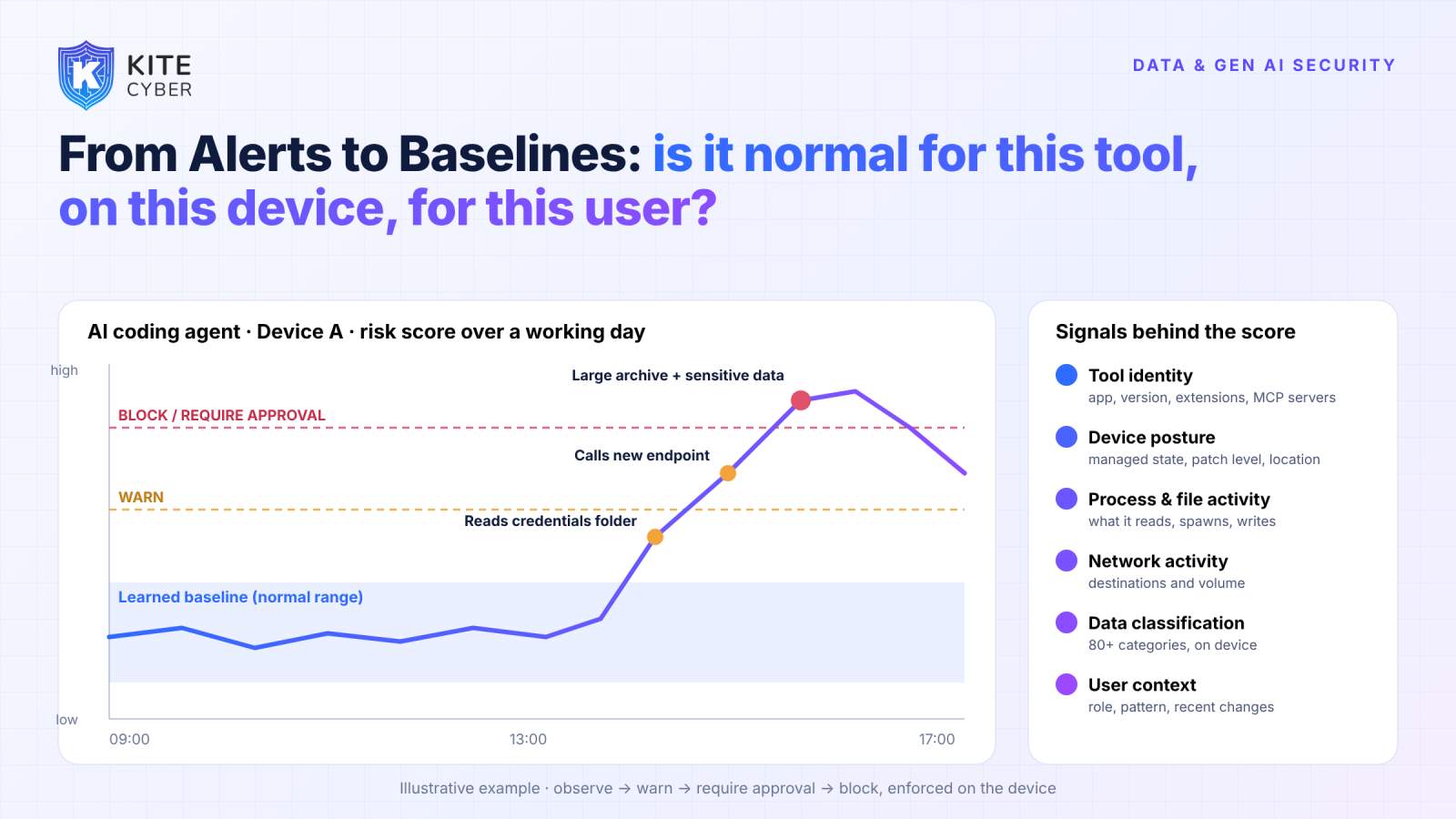
A single alert says something happened. A baseline says whether it was normal for that tool, on that device, for that person.
Two announcements from the past few weeks point the same way. Microsoft’s 19 October post on securing the “agentic insider” describes a Dynamic Agent Risk model in which signals from Sentinel, Entra, Intune, Purview, Global Secure Access and Defender feed a context analysis that produces a continuously updated risk view. Netskope’s 29 October AI Risk AISecOps Agent, as described in its announcement, emphasizes patterns across activity rather than one-off alerts. Different vendors, same conclusion: static allow and block lists are not enough for tools whose behavior changes.
Why single alerts fail for AI tools
A coding agent that reads a repository is normal. The same agent reading a credentials folder, then calling a new endpoint, then writing a large archive is a sequence. Any one event might look benign; together they tell a story. Likewise a user pasting text into an approved chatbot is routine, until the volume, the classification of the content and the time of day change.
Alert-by-alert review also buries analysts. Agents act quickly and often, so volume rises fast and context rarely travels with each event.
What a good baseline needs
A useful baseline answers “normal for whom?” at the level where behavior actually happens: this tool, on this device, run by this user.
Cloud-side logs supply some of these. The process, file, posture and local classification signals only exist on the endpoint.
From baseline to action
A baseline is only useful if it changes decisions. A sensible progression is to observe first, then warn the user when a tool drifts, then require approval for riskier actions, and block when sensitive data and an unfamiliar destination coincide. Scoring lets the response scale with the risk instead of treating every deviation as an incident, and keeps legitimate work moving.
Two cautions apply. First, baselines learn what is common, not what is acceptable, so pair them with explicit policy. Second, tell users why an action was warned or blocked; understanding reduces workarounds.
Where Kitecyber fits
Kitecyber’s Gen AI and data security runs on the endpoint and combines device posture, process and operating system activity, network activity, user activity and data classification (80+ categories). That is the raw material for per-device, per-tool baselines, and policy enforcement happens on the same device. The signals can complement platform-level risk scoring from identity, SIEM and network tools by supplying consistent endpoint facts. A lightweight agent (under 2% CPU) and typical deployment in around a day keep it practical.
Book a Kitecyber walkthrough at kitecyber.com to see what normal looks like for AI on your endpoints, and when it stops being normal.