Table Of Content
Related Posts

Best DLP Software for Regulated Teams Protecting Client Files and Privileged Documents
-
September 16, 2026
-
Quick Answer:
AI Security Posture Management (AISPM), also called AI Posture Management, is the continuous process of discovering, monitoring, and controlling how AI tools, models, and agents interact with your company's data and systems. It covers everything from spotting an unapproved AI app on someone's laptop to blocking a customer record from being pasted into a public chatbot. Most teams that manage AI posture well pair a discovery layer with policy enforcement at the point where employees actually use AI, which is the endpoint.
For a small or mid-sized organization handling privileged or client-sensitive material, the best data loss prevention (DLP) software is one built to classify data by matter and relationship, not just by pattern matching, because privileged material does not look like a credit card number or a social security number. It looks like an ordinary Word document, email thread, or PDF, and its sensitivity comes entirely from context: which client it belongs to, which matter it relates to, and who is authorized to see it. Kitecyber approaches this as an endpoint-native DLP problem: one lightweight agent that classifies documents by context, tracks where matter files move, and enforces protection in real time at the laptop, browser, or inbox, whether the organization has three staff or thirty and whether or not it has a dedicated IT security hire.
TL;DR
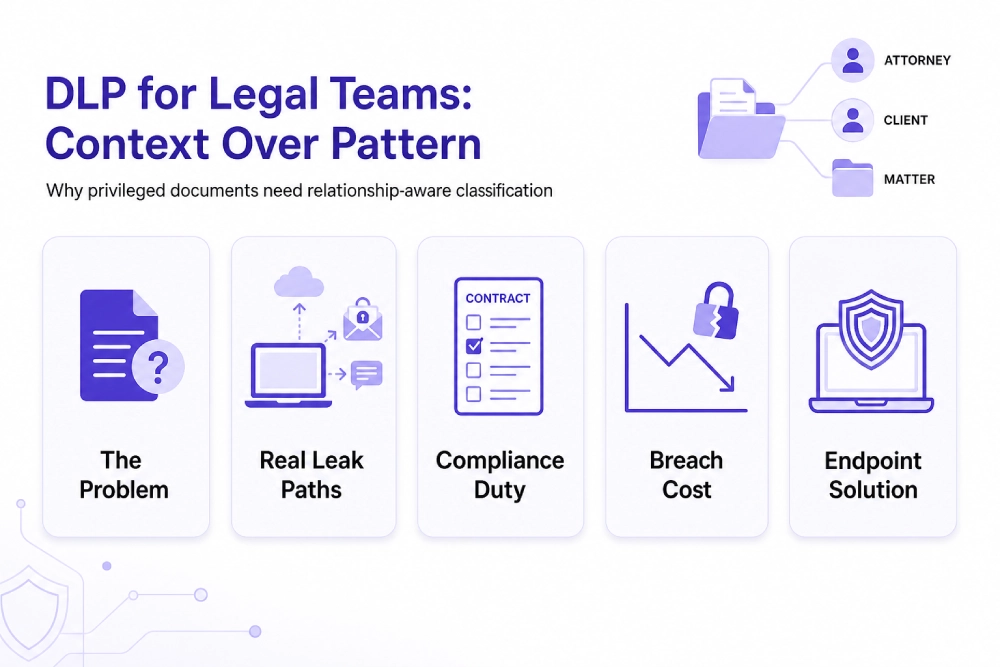
- Privileged and client documents are sensitive because of relationship and matter context, not a detectable pattern, so regex-only DLP tools frequently miss them.
- The real leak paths at small firms are mundane: misdirected email, discovery files synced to personal cloud drives, contract reviewers or co-counsel with loose access, and paralegals pasting client facts into AI drafting tools.
- A meaningful share of law firms have reported a security breach, and small-firm breach costs carry real financial weight, before reputational and malpractice fallout.
- Technology competence and confidentiality obligations mean firms are expected to take reasonable, documented steps to prevent unauthorized access to client data, in general terms under ABA Model Rules 1.1 and 1.6.
- Endpoint-native DLP with context-aware classification fits firms without a security team because it enforces policy automatically, rather than requiring someone to write and maintain detection rules.
About the Author: This article is written from Kitecyber experience building endpoint-native DLP for regulated and professional-services organizations that handle privileged, confidential, or highly regulated data without a dedicated security analyst on staff.
Why Is Privileged Legal Data Harder to Classify Than Regular Sensitive Data?
Privileged legal data is hard to classify because its sensitivity is relational, not structural. A social security number has a recognizable format a scanner can flag anywhere it appears. A privileged document has no such signature. The same paragraph of text describing a settlement negotiation is entirely ordinary in a marketing deck and highly sensitive in a client matter file. The distinguishing factor is who wrote it, which matter it belongs to, and who is on the distribution list, none of which a pattern-matching engine can see.
This is exactly the gap that legacy DLP was not built to close. Traditional DLP tools, built around regular expressions and file fingerprints, work well for structured data like payment card numbers or national ID formats. They perform poorly on unstructured legal content because there is no consistent string to match. A DLP tool that only understands patterns will either stay silent on a leaking privileged memo or, worse, generate so many false positives on ordinary business correspondence that attorneys learn to ignore its alerts entirely. Context-aware classification, which looks at document metadata, matter folder structure, sender and recipient relationships, and content meaning rather than just format, is what actually distinguishes a privileged communication from routine correspondence.
Where Does Client and Matter Data Actually Leak From a Small Firm?
The realistic leak paths at a small firm are rarely sophisticated attacks. They are everyday workflow habits that quietly move privileged material outside its intended boundary.
- Email misdirection. Autocomplete sends a privileged memo to the wrong recipient with a similar name, or a paralegal replies-all on a thread that includes opposing counsel.
- Discovery material on personal devices. An attorney reviews document productions on a personal laptop or tablet over a weekend, outside any managed environment.
- Cloud sync of a matter folder. A matter folder set up on a shared drive gets synced to a personal Dropbox or Google Drive account by a well-meaning associate trying to work remotely.
- Contract reviewers and outside counsel. Temporary reviewers, co-counsel, or expert witnesses are given broad folder access for one task and retain it long after the task ends.
- AI drafting tools. An associate pastes client facts, deposition excerpts, or settlement terms into a public GenAI chatbot to draft a summary or brief, and that pasted data needs to be classified and governed the moment it enters the tool.
None of these require malicious intent. They are the byproduct of attorneys and staff trying to get work done efficiently, often outside business hours, on whatever device is closest. That is precisely why enforcement has to happen at the endpoint, the point where a file is opened, copied, uploaded, or pasted, rather than relying on staff to remember a policy document.
What Do Technology Competence and Confidentiality Obligations Actually Require?
Professional responsibility rules for lawyers generally require reasonable efforts to prevent unauthorized access to client information, alongside a broader duty of technology competence. Firms may also be subject to state bar ethics opinions, and depending on the data handled, healthcare-related client matters can bring HIPAA into scope, alongside general privacy laws such as CCPA or GDPR where applicable. Firms that represent healthcare providers, handle medical records as part of litigation, or manage personal injury and workers’ compensation matters involving protected health information should evaluate whether HIPAA safeguards apply to that specific matter data.
None of this requires a firm to interpret specific rule language on its own or treat a security vendor’s blog as legal advice. What it does mean practically is that a firm should be able to show, if asked, what technical steps it took to prevent client data from leaving its control. A DLP platform that logs classification decisions, blocked transfers, and policy enforcement in real time gives a firm exactly that kind of documented, defensible record, which matters more after an incident than before one.
How Costly Is a Data Breach for a Small Law Firm in Practice?
The financial exposure is measurable and material for a firm of any size. The ABA’s 2023 Cybersecurity TechReport found that roughly 29 percent of law firms reported experiencing a security breach, with common causes including lost or stolen devices, hacker attacks, website exploits, and physical break-ins. Small-firm breach costs are commonly cited in the tens of thousands of dollars per incident, according to industry breach-cost surveys.
That figure understates the real damage. A breach involving privileged material carries consequences beyond the direct incident response cost: lost client trust, damaged professional reputation, regulatory investigations, and potential malpractice exposure or ethics violations. For a firm that competes on client relationships and referrals, reputational damage from a leaked matter file can outlast the direct financial cost by years.
What Are the Best DLP Options for a Small Law Firm, and What Are the Honest Trade-offs?
The financial exposure is measurable and material for a firm of any size. The ABA’s 2023 Cybersecurity TechReport found that roughly 29 percent of law firms reported experiencing a security breach, with common causes including lost or stolen devices, hacker attacks, website exploits, and physical break-ins. Small-firm breach costs are commonly cited in the tens of thousands of dollars per incident, according to industry breach-cost surveys.
That figure understates the real damage. A breach involving privileged material carries consequences beyond the direct incident response cost: lost client trust, damaged professional reputation, regulatory investigations, and potential malpractice exposure or ethics violations. For a firm that competes on client relationships and referrals, reputational damage from a leaked matter file can outlast the direct financial cost by years.
Building on the leak paths and obligations above, the practical question is which DLP approach fits a firm without a dedicated security team. Virtual data room platforms such as Ideals, Intralinks, Firmex, and ShareVault are well suited for M&A, litigation, and multi-party legal transactions where documents move between many outside parties in a controlled, deal-specific environment. They are not, however, built to protect day-to-day matter files sitting on attorney laptops or moving through everyday email and cloud apps, which is where most of the leak paths above actually occur.
|
Option |
Best fit |
Honest limitation
|
|
Virtual data rooms (Ideals, Intralinks, Firmex, ShareVault) |
Deal-specific document exchange in M&A or litigation |
Not designed for ongoing matter file protection across daily attorney workflows |
|
Microsoft Purview |
Firms already deep in Microsoft 365 wanting native sensitivity labels |
Cloud-native to M365 and Azure; requires private endpoints rather than certain network-dependent appliances |
|
Endpoint Protector |
Firms wanting granular device and USB control across Windows, macOS, Linux |
Focused primarily on endpoint-level enforcement rather than broader network traffic inspection |
|
Cyberhaven |
Firms prioritizing data lineage tracing to see exactly how a file moved |
Requires agent or browser extension deployment on every device to capture full lineage |
|
Kitecyber |
Firms wanting endpoint-native DLP with GenAI and shadow AI protection, designed for small teams without a dedicated security analyst |
One lightweight agent covers endpoints, browser activity, email, SaaS apps, and GenAI paste and upload activity with context-aware classification |
Virtual data rooms are best for firms running a specific deal or litigation exchange where documents pass between many outside parties for a defined period; the limitation is that they leave everyday matter files on attorney laptops and inboxes unprotected once the deal closes. Microsoft Purview suits firms already standardized on Microsoft 365 who want native sensitivity labels without adding a new vendor; its limitation is that its strongest controls are built around the Microsoft stack, so protection outside M365 and Azure workflows is thinner. Endpoint Protector fits firms that need granular device and removable-media control across mixed operating systems; the trade-off is that it concentrates on endpoint-level enforcement rather than broader network or app-layer visibility. Cyberhaven is a strong choice for firms that want to trace exactly how a file moved across its lifecycle through data lineage; the limitation is that achieving full lineage requires deploying an agent or browser extension on every device, which adds rollout overhead for small IT teams.
Kitecyber’s fit for this environment comes down to what a single small-firm IT person actually needs: context-aware classification that recognizes matter files and privileged threads without hand-written detection rules, real-time enforcement when someone tries to sync a matter folder to a personal cloud account or paste client facts into a public chatbot, and full visibility into where a document has traveled if a client or bar inquiry ever asks. Because the same agent also goes beyond pure DLP to cover network and app-layer enforcement, it helps address more of the technical safeguards firms are expected to document under HIPAA, SOC 2, and general confidentiality obligations, without deploying a second or third tool. Certification and audit outcomes still depend on how the firm configures, operates, and documents its own program; the tooling supports that work rather than guaranteeing the result.
About Kitecyber
Kitecyber is an endpoint-native DLP company built for the GenAI era, giving IT and security teams real-time visibility into where sensitive data goes and who, or what, is moving it. One lightweight agent classifies data by context across endpoints, browser activity, email, SaaS and cloud apps, and removable media, and extends that same context-aware classification to what gets pasted or uploaded into GenAI tools. Because this same agent also goes beyond core DLP to support network and app security needs, it helps regulated organizations, including law firms handling healthcare-related matters, address more compliance controls without deploying separate point tools. Kitecyber works with fintech, healthcare, insurance, and other regulated organizations that need enterprise-grade DLP without an enterprise-sized security team.
If your firm is ready to see how endpoint-native DLP handles matter files, privileged threads, and shadow GenAI use in practice, visit Kitecyber to learn more or start a free trial.
See verified customer reviews of Kitecyber on G2 and SourceForge.
References
Frequently Asked Questions
Encrypted email and secure client portals address one leak path, message content in transit, using protocols like S/MIME or encrypted portals. They do not address cloud sync, personal device use, or GenAI paste-ins, which is why firms typically need broader endpoint coverage alongside secure communication tools.
Endpoint-native DLP can detect when a GenAI application is being used and enforce a block, warning, or on-screen guidance at the moment content is pasted, based on the context of the data rather than just its format.
The underlying obligation to protect protected health information is the same, but a law firm typically encounters PHI as part of specific matters, such as personal injury or healthcare litigation, rather than as its core business, which changes how discovery and classification need to work.
Small-firm breach costs are commonly cited in the tens of thousands of dollars per incident, not counting reputational damage, lost client trust, or potential malpractice and ethics exposure.
No. Data rooms secure a specific deal or exchange, but everyday matter files living on attorney laptops and syncing to cloud drives need separate, continuous protection.
Regex DLP looks for patterns like a formatted number. Context-aware classification evaluates document metadata, sender and recipient relationships, and matter structure, which is necessary for privileged content that has no consistent format to match.
Not necessarily. Platforms built for context-aware classification and automated enforcement are designed to reduce manual rule-writing, which matters for firms where IT is one person's part-time responsibility rather than a full team.

With over a decade of experience steering cybersecurity initiatives, my core competencies lie in network architecture and security, essential in today's digital landscape. At Kitecyber, our mission resonates with my quest to tackle first-order cybersecurity challenges. My commitment to innovation and excellence, coupled with a strategic mindset, empowers our team to safeguard our industry's future against emerging threats.
Since co-founding Kitecyber, my focus has been on assembling a team of adept security researchers to address critical vulnerabilities and enhance our network and user security measures. Utilizing my expertise in the Internet Protocol Suite (TCP/IP) and Cybersecurity, we've championed the development of robust solutions to strengthen cyber defenses and operations.
Posts: 98
With over a decade of experience steering cybersecurity initiatives, my core competencies lie in network architecture and security, essential in today's digital landscape. At Kitecyber, our mission resonates with my quest to tackle first-order cybersecurity challenges. My commitment to innovation and excellence, coupled with a strategic mindset, empowers our team to safeguard our industry's future against emerging threats.
Since co-founding Kitecyber, my focus has been on assembling a team of adept security researchers to address critical vulnerabilities and enhance our network and user security measures. Utilizing my expertise in the Internet Protocol Suite (TCP/IP) and Cybersecurity, we've championed the development of robust solutions to strengthen cyber defenses and operations.
Posts: 98