Table Of Content
Related Posts


Securing AI Agents on Endpoint Devices: Closing the New Security Blind Spot
-
July 10, 2026
-
Quick summary :
Autonomous AI agents are quietly becoming one of the most significant data security blind spots in enterprise environments today. Unlike a human employee who clicks, pauses, and considers, an AI agent reads files, summarizes documents, calls APIs, and uploads outputs at machine speed – all within the same trusted session your security tools already approved. In 2026, the question is no longer whether your organization uses AI agents. The question is whether your security controls were actually built to handle them.
AI agents running on endpoint devices represent a fundamentally new data security challenge that most organizations are not equipped to handle. Unlike human users who move data deliberately and slowly, AI agents can read, copy, summarize, and upload sensitive information at machine speed, creating a new enforcement requirement at the endpoint itself, the exact moment and place where data moves, not somewhere downstream on the network.
TL;DR
- AI copilots and autonomous agents have changed the endpoint threat model: data can be exfiltrated at machine speed before any network-level tool can intervene.
- Legacy endpoint tools were built to detect malware, not govern agentic workflows or classify what an AI agent is doing with sensitive data.
- Real-time, endpoint-native enforcement is the only architecture that keeps pace with AI-speed data movement.
- A consolidated single-agent approach eliminates the blind spots that exist between fragmented point solutions.
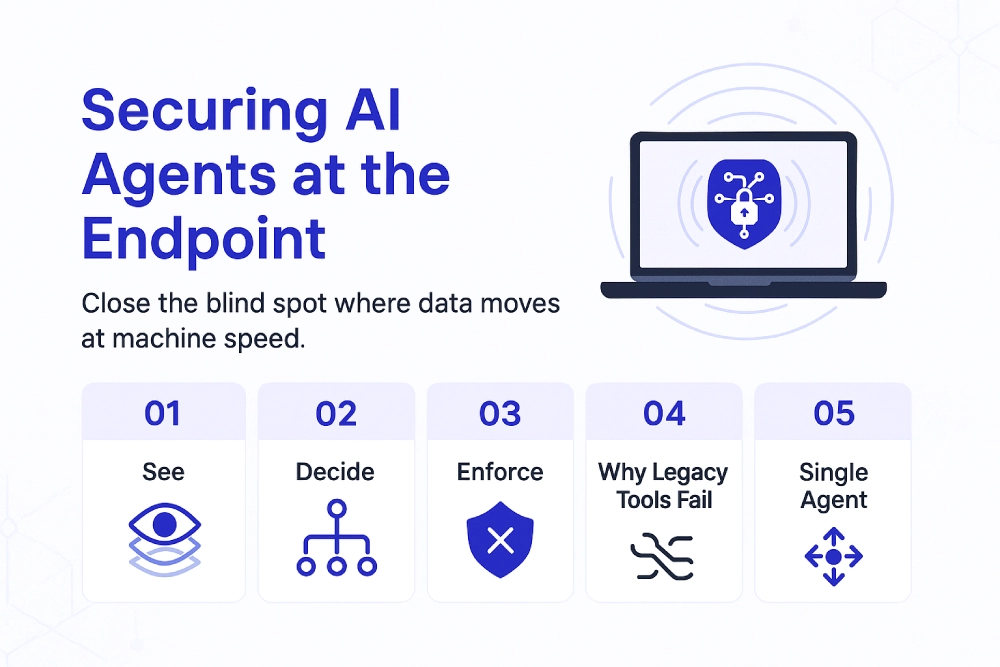
- Organizations need a platform that can See, Decide, and Enforce continuously, not react after the fact.
About the Author: Kitecyber is a Bay Area cybersecurity company built around one premise: data protection must happen at the endpoint, where work actually occurs. The Kitecyber team works directly with AI-native companies and regulated enterprises navigating the shift to agentic AI, making the insights in this article grounded in real deployment experience rather than theoretical analysis.
What has changed about the endpoint threat model in 2026?
The endpoint is where sensitive data is accessed and moved. What has changed is who, or what, is now acting on it. As of 2026, AI agents are not peripheral experiments; they are embedded into daily workflows across engineering, finance, legal, and customer operations [teamt5.org]. These agents can browse the web, query databases, access files, and send emails autonomously, often with permissions inherited from the user who authorized them [resilientcyber.io].
This creates a threat model that no legacy tool was designed for. Traditional endpoint security focuses on malware and exploits. Network inspection tools analyze traffic after it leaves the device. Static DLP enforces rules against known patterns. None of these architectures can evaluate, in real time, whether an AI agent reading a directory of source code files is doing something legitimate or quietly staging an exfiltration [crowdstrike.com].
The risk is not hypothetical. AI agents represent a “triple threat” in 2026: agentic risk from autonomous action, identity governance gaps because agents carry human-delegated credentials, and pervasive visibility challenges because most security stacks have no instrumentation at the layer where agents operate [blog.enterprisemanagement.com].
Why do legacy DLP and SSE tools miss AI agent activity?
Building on the threat model shift described above, the harder question is why the existing security stack fails specifically at this layer rather than just struggling to keep pace.
Legacy endpoint data loss prevention tools were designed around human-speed activity: a user copies a file, pastes text, or uploads a document. Detection logic assumes a human is in the loop and that there is time to inspect. AI agents invalidate both assumptions. They act at machine speed and at scale, and they do so through application APIs and browser sessions that look, at the network level, like normal user traffic [zenity.io].
Legacy SSE vendors such as Netskope and Zscaler provide strong network-layer inspection. Network-layer tools, however, operate downstream of the endpoint application layer where AI agents interact with sensitive data directly. Forcepoint and similar legacy DLP platforms apply policy at the file or channel level, but they lack the endpoint context to govern AI agent data access in real time.
The gap is not a product deficiency in isolation. It is an architectural mismatch. These tools were designed for a world where humans moved data and networks carried it. Agentic workflows break both assumptions simultaneously.
What does "endpoint-native" AI agent security actually mean?
Endpoint-native security means that detection, classification, and enforcement all happen on the device, before data leaves the application context where it originated. This is not the same as installing an agent that phones home to a cloud policy engine. The key distinction is that the enforcement decision is made at the point of risk, with full context about what process is running, what data it is touching, what the user’s identity is, and where the data is headed.
Practically, this means an endpoint-native platform must be able to:
- Identify AI agent processes and copilot sessions as distinct activity types, not just browser or application traffic
- Classify data by document context and content, not only by file name or regular expression matching
- Track data lineage across clipboard, browser upload, SaaS destination, and GenAI prompt in a single audit trail
- Enforce the right action (allow, block, warn, log, or isolate) at the moment the action is attempted, not after it completes [crowdstrike.com]
A SaaS data protection platform that relies purely on API-based cloud scanning will always be operating on data that has already moved. Endpoint-native enforcement closes that window entirely.
How should organizations govern agentic workflows without blocking productivity?
A related but distinct question is whether strong enforcement creates friction that slows down the legitimate AI adoption organizations are investing in. The answer depends entirely on how policy is applied.
Rule-based, static DLP tends to generate high false-positive rates because it cannot distinguish context. An engineer pasting code into a sanctioned internal AI tool gets blocked by the same rule that would stop an exfiltration attempt, because the policy cannot tell the difference. This is where context-aware, real-time classification matters.
A well-designed governance model for agentic workflows should follow this structure:
- Discover which AI agents and copilots are active across the endpoint fleet, including unsanctioned or shadow GenAI apps that employees have installed independently.
- Classify the data those agents are accessing, using document-level context rather than pattern matching alone.
- Evaluate each interaction against policy: who authorized the agent, what data it is touching, what the destination is, and whether that combination is expected.
- Enforce proportionally: allow low-risk interactions silently, coach users when a borderline action is detected, block only when the risk is clear, and log everything for audit continuity.
This is Kitecyber’s See, Decide, Enforce model applied specifically to agentic workflows. The goal is not to block AI adoption but to make it governable, which is the foundation for organizations that want to innovate with confidence rather than restrict by default.
About Kitecyber
Kitecyber is a next-generation cybersecurity platform built to protect sensitive data at the endpoint, where work actually happens. Its single lightweight agent unifies endpoint data loss prevention, AI agent security, secure web gateway, SaaS data protection, ZTNA, and device management into one platform governed by a shared policy engine. Kitecyber was built specifically for the AI agent era, giving security teams real-time visibility and enforcement across agentic workflows, GenAI prompts, SaaS uploads, and private app access, without the fragmentation of legacy point solutions. Leading organizations use Kitecyber to protect sensitive data while adopting AI with confidence.
Ready to close the AI agent blind spot in your endpoint security stack? Visit kitecyber.com to explore the platform or start a free trial.
References
- Securing AI Where Executes: Endpoint AI Agent Security | White Paper (crowdstrike.com)
- Understanding AI Agent Security: A Practical Guide for Security Teams (zenity.io)
- When AI Becomes Corporate Routine: Using Endpoint Detection to Uncover Defensive Blind Spots Early – TeamT5 (teamt5.org)
- The Agentic AI Governance Blind Spot – by Chris Hughes (resilientcyber.io)
- The “Triple Threat” of 2026: Why Your AI Workforce Is Your Biggest Security Blind Spot (blog.enterprisemanagement.com)
Frequently Asked Questions
Endpoint DLP enforces policy at the device before data leaves the application. Network DLP inspects traffic after it is in transit. For AI agents operating inside browser sessions and application APIs, network DLP often sees only encrypted or aggregated traffic and cannot reconstruct agent-specific actions. Endpoint enforcement is the more effective layer for governing AI agent activity.
These platforms provide strong network-layer visibility and SaaS access controls, but they lack endpoint-level process context. They cannot distinguish an AI agent from a human user at the application layer, nor can they enforce policy on clipboard activity or local file access before data reaches the network.
Shadow GenAI refers to AI tools and copilots that employees install or use without IT or security team awareness. These tools often have broad file and clipboard access and may send data to external AI services. Without endpoint visibility, these interactions are entirely invisible to the security stack [teamt5.org].
Automation scripts follow deterministic paths and are typically reviewed before deployment. AI agents operate autonomously, adapt their behavior based on inputs, and can take actions that were not explicitly programmed, making their data access patterns much harder to predict or govern [resilientcyber.io].
Depending on the data involved, frameworks including HIPAA, GDPR, CMMC, PCI DSS, and SOC 2 all have provisions that apply when sensitive data is processed or transmitted by automated systems. AI agents acting on regulated data must be subject to the same controls as human users handling that data.
When the agent is built to operate across DLP, secure web gateway, SaaS control, ZTNA, and AI agent governance from a single policy engine, yes. The consolidation benefit is not just cost reduction; it eliminates the visibility gaps that exist between tools from different vendors that do not share context.
Endpoint-native solutions that use a single agent architecture can typically be deployed across an organization's device fleet within days, without requiring network redesign or hardware changes. Policy tuning takes additional time, but initial visibility is available immediately.

Ajay Gulati
Ajay Gulati is a passionate entrepreneur focused on bringing innovative products to market that solve real-world problems with high impact. He is highly skilled in building and leading effective software development teams, driving success through strong leadership and technical expertise. With deep knowledge across multiple domains, including virtualization, networking, storage, cloud environments, and on-premises systems, he excels in product development and troubleshooting. His experience spans global development environments, working across multiple geographies. As the co-founder of Kitecyber, he is dedicated to advancing AI-driven security solutions.