Evaluating a data loss prevention vendor in 2026 comes down to one question: can the tool see and stop sensitive data movement at the moment it happens, including movement through AI copilots and agents, without requiring five other tools to fill the gaps?
Most DLP evaluations still get anchored on old checklists built for email and file-share leakage. That model misses how data actually leaves organizations today: through clipboard actions, GenAI prompts, SaaS-to-SaaS transfers, and autonomous agents acting on a user’s behalf. Kitecyber builds endpoint-native DLP specifically for this environment, so this scorecard reflects both what we’ve learned building the product and what buyers consistently tell us they wish they’d asked before signing a contract.
TL;DR
About the Author: Kitecyber builds endpoint-native data security for AI-native and technology companies, including DuploCloud, Lily AI, Vanta, Sarvam, and Scrut Automation, and works directly with security and IT teams evaluating DLP replacements for legacy SSE, VPN, and point-DLP stacks.
What Does "Endpoint-Native Enforcement" Actually Mean?
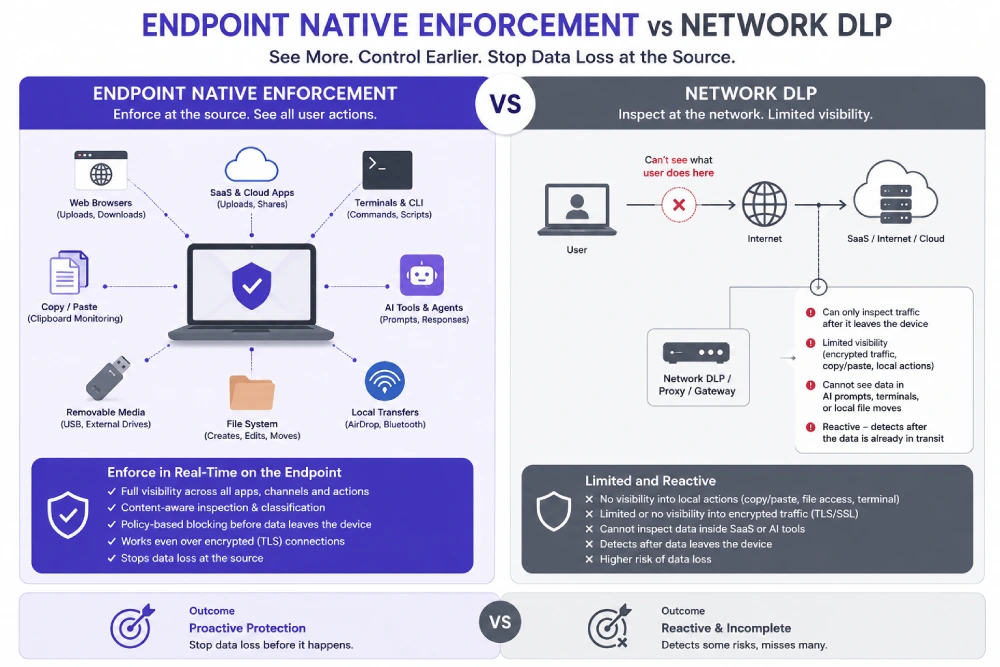
Endpoint-native enforcement means the policy decision and the enforcement action both happen on the device itself, at the moment a user or an AI agent tries to move data, rather than after traffic reaches a network chokepoint. This distinction matters more in 2026 than it did five years ago because so much sensitive data now moves in ways that never touch a corporate network at all: a browser-based GenAI prompt, a paste into a SaaS chat window, an autonomous agent calling an API on a user’s behalf. Leading DLP vendors now run agents at the OS level that intercept clipboard actions, browser uploads, and GenAI prompt submissions in real time, using context-aware classification and API-level tool-call monitoring to block, redact, or log sensitive content before it leaves the device.
Network DLP, by contrast, was architected for a world where data flowed through a small number of predictable egress points: the corporate email gateway, the web proxy, the VPN concentrator. Traditional network DLP still does that job reasonably well for outbound perimeter traffic like email and file uploads over inspected web sessions. What it cannot do is see encrypted SaaS-to-SaaS data movement or API-level transfers, and it has no mechanism to observe an AI agent that reads, transforms, and re-uploads data without generating a file transfer event or even a browser session. The data simply moves in a shape that network DLP was never built to inspect.
Below is an infographic that shows the difference between Endpoint Native Enforcement and Network DLP:
Why Has AI Changed What DLP Needs to Cover?
AI copilots and autonomous agents have turned the endpoint into the primary point of data risk, not a secondary one. Employees regularly paste confidential data into GenAI tools, exposing trade secrets and personal data that never touches a monitored network path. That reality alone should reframe how security teams scope a DLP evaluation: the question is no longer “does this tool stop USB exfiltration and email leakage,” it’s “does this tool understand what happens when an employee pastes a customer list into a chatbot.”
The agentic layer makes this worse. Organizations struggle to enforce purpose limitations on AI agents, meaning an agent granted access for one task can be redirected or repurposed to pull data well outside its intended scope, and many cannot terminate a misbehaving agent once it starts acting. Think of it like giving a new contractor a building keycard that opens every door instead of just the one room they need, then discovering there’s no way to deactivate the card remotely if they start wandering. That’s the operational reality inside many organizations running agentic workflows today, and it’s why “AI agent security tools” has become its own line item in serious DLP evaluations rather than a footnote.
What Belongs on a DLP Buyer's Scorecard?
A scorecard for evaluating enterprise DLP solutions should weight capability by how directly it maps to where data actually moves in 2026, not by how long the feature list is. Buyers should look for support for attribute-based conditions, exception workflows with justification, and clear explanations for why an alert fired combined with reasonable operational effort and integration depth rather than a checklist of standalone features.
|
Evaluation Criterion
|
What to Ask the Vendor
|
Why It Matters
|
|
Endpoint coverage
|
Does enforcement happen on-device across Windows, macOS, and Linux?
|
Off-network and remote work data never reaches a network chokepoint
|
|
GenAI and agent visibility
|
Can it inspect prompts and agent tool-calls in real time, not just log them after the fact?
|
Agents can exfiltrate data without a file transfer event
|
|
Data classification method
|
Is classification context-aware (document meaning) or pattern-matching only (regex)?
|
Pattern matching alone produces high false-positive rates
|
|
Deployment model
|
Single lightweight agent, or multiple agents stitched together?
|
Fragmented agents create blind spots between tools
|
|
Alert quality
|
Are false positives actively reduced, and are root causes explained?
|
Analysts burn out triaging noisy, unexplained alerts.
|
|
SaaS coverage
|
Does it extend to SaaS security posture management for sanctioned and shadow apps?
|
SaaS-to-SaaS transfers bypass network inspection entirely
|
|
Compliance mapping
|
Does it map controls to HIPAA, GDPR, PCI-DSS, SOC 2, ISO 27001, or CMMC out of the box?
|
Reduces audit prep and evidence-gathering time
|
|
Data lineage
|
Can you trace where a piece of sensitive data has traveled, not just where it currently sits?
|
Lineage turns an incident response guess into a documented fact
|
Detection accuracy, GenAI protection, and deployment flexibility remain the three criteria that separate vendors that work in production from vendors that look complete only in a demo.
How Should Compliance Requirements Shape the Evaluation?
Compliance frameworks should function as a filter on the scorecard above, not a separate checklist run in parallel. The most commonly cited frameworks driving DLP adoption in 2026 are GDPR, HIPAA, PCI-DSS, SOC 2, and ISO 27001, with the NIST Cybersecurity Framework and CIS Controls anchoring broader organizational compliance programs. Organizations in defense and government supply chains have an additional layer: CMMC compliance software needs to demonstrate data classification, access control, and audit logging that maps directly to CMMC practice families, not a generic “compliance dashboard” bolted onto an unrelated product.
Practically, this means a healthcare company evaluating HIPAA DLP should confirm the vendor classifies PHI by document context, not just by keyword matching, and can show an auditor exactly where that data moved. A defense contractor evaluating CMMC compliance software should confirm device-level enforcement and access logging exist across every endpoint, not just cloud-connected ones. Kitecyber builds compliance mapping for HIPAA, GDPR, CMMC, ISO 27001, SOC 2, DPDP, FINRA, and PCI DSS directly into its data lineage and classification layer, so evidence for an audit is a byproduct of normal enforcement rather than a separate reporting project.
Why Is Consolidation a Scoring Criterion, Not Just a Convenience?
Consolidation earns its place on the scorecard because every additional agent on an endpoint is another gap between what each tool sees and what the others miss. Endpoint DLP adoption is accelerating faster than network DLP because endpoint-based approaches secure remote work and off-network data portability that a network appliance simply cannot reach. That adoption curve is a signal buyers should take seriously when comparing a point-solution DLP vendor against a platform that unifies DLP with SaaS security posture management, secure web gateway functions, and zero trust access in one agent.
Kitecyber’s approach reflects this directly: See, Decide, Enforce, continuously. One lightweight agent observes endpoint posture, browser behavior, data movement, SaaS access, and AI interactions; evaluates each action against policy in context; and enforces the right response, allow, block, warn, coach, log, or isolate, at the point of risk. That’s a materially different operating model from stitching together a network DLP appliance, a separate CASB, a separate SWG, and a separate endpoint agent, each with its own console and its own blind spot at the seams.
About Kitecyber
Kitecyber is a data security company built around one lightweight agent that delivers endpoint DLP, network DLP, GenAI and AI agent security, SaaS security posture management, secure web gateway protection, and zero trust network access, all unified around a single data-security core. Rather than stitching together legacy SSE, VPN, and point DLP tools, Kitecyber gives IT and security teams real-time enforcement at the point of risk, with data lineage and context-aware classification built in. It’s used by AI-native and technology companies including DuploCloud, Lily AI, Vanta, Sarvam, and Scrut Automation to protect sensitive data as AI adoption accelerates across the business.
If your organization is evaluating DLP vendors for 2026, visit Kitecyber to see how endpoint-native enforcement, GenAI security, and consolidation can help you innovate with confidence.
Frequently Asked Questions