Table of Content

Top 10 Solutions for Securing Data, Gen AI and AI Agents on the Endpoint (2026)
-
November 23, 2026
-
Summary:
The weeks before someone resigns are when customer lists, pricing and source code are most likely to walk out the door, and AI tools now make that data easier to reshape and carry. Companies that watch data movement on the device, in context, can protect what matters without treating every employee like a suspect.
Kitecyber | Data & Gen AI Security | Last updated: November 2026
Disclosure: This guide is written by Kitecyber, and Kitecyber is listed first. Every other entry is described from the vendor’s own public documentation and announcements as of November 2026, not from lab testing. We have tried to be fair about strengths and limitations, including our own.
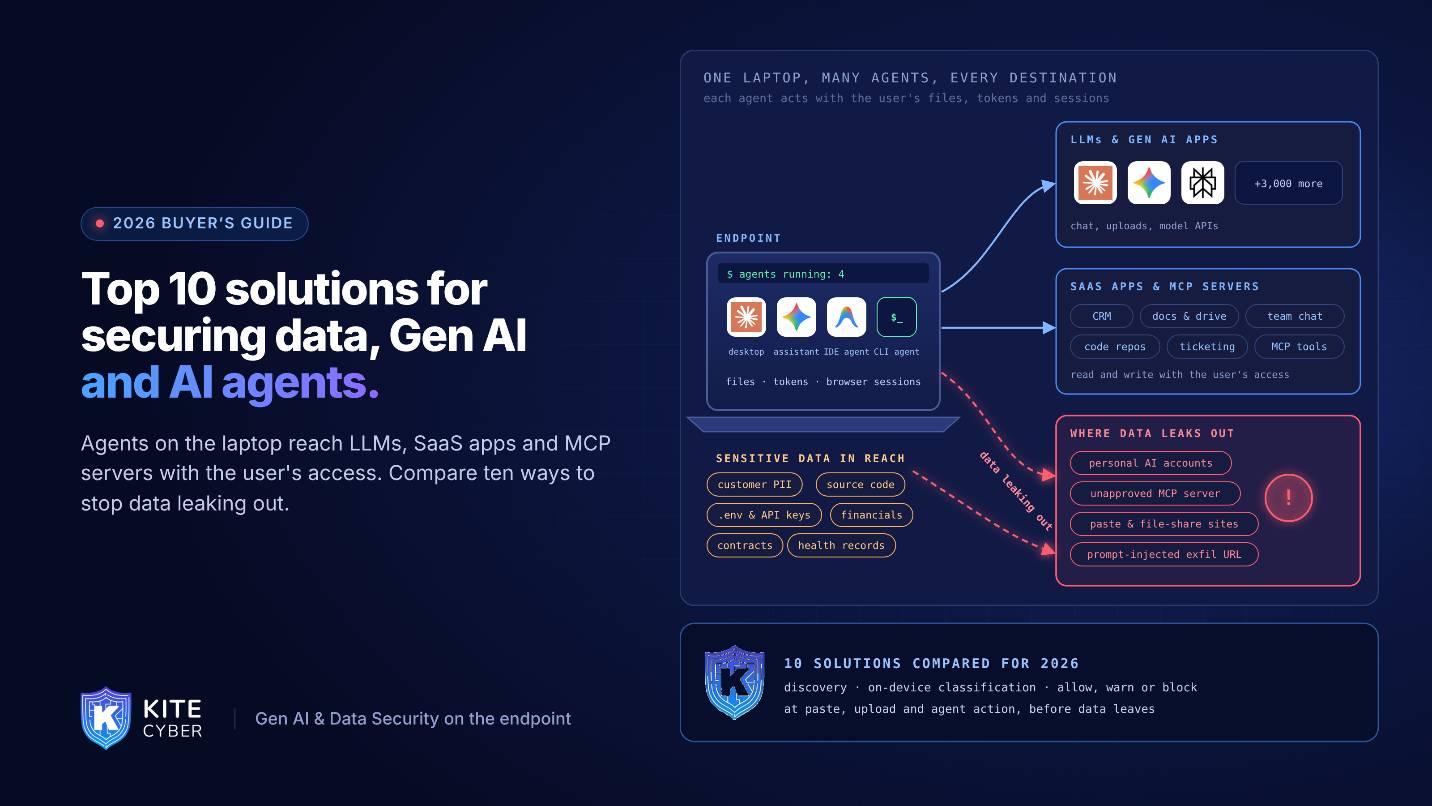
Two years ago, securing Gen AI meant watching what employees pasted into a chatbot tab. In 2026, AI runs on the device itself. Desktop assistants read files and screens. Coding agents such as Claude Code, Codex, Gemini CLI, Antigravity and Grok Build run shell commands with the developer’s credentials. MCP servers connect those agents to internal systems. Much of that activity never touches a browser, and some of it never crosses the network in a form a proxy can read.
That shift is why the endpoint has become the most important place to secure data and AI usage. This guide compares ten solutions, from large platform vendors to Kitecyber’s endpoint-native approach, using criteria built for how AI actually works on laptops today.
Key takeaways
- AI risk has moved beyond the browser.Look for coverage of desktop apps, CLIs, IDEs, local models and MCP servers, not only web chat.
- Context decides accuracy.The best decisions combine who the user is, which process or agent acted, what the data is, the device’s posture and where data is going.
- Large platforms are adding AI controls quickly,mostly as extensions of products you may already own (Microsoft 365, an EDR agent, or an SSE network).
- Coverage still varies by operating system and channel. Several products enforce best on Windows or in Chromium browsers, and report-only elsewhere. Test on your real devices.
- Run a proof of concept with the six tests at the end of this guide before you buy.
What to look for: eight evaluation criteria
- 1.AI app and agent discovery. Does it find AI in the browser, desktop apps, CLIs, IDE extensions, local models and MCP servers, including unsanctioned tools?
- 2.On-device data classification. Can it understand what data is involved (PII, PHI, PCI, source code, credentials) at the moment of use, accurately enough to act on?
- 3.Real-time enforcement. Can it allow, warn or block at paste, upload, file read and agent action, before data leaves the device?
- 4.Corporate versus personal accounts. Can it tell a company ChatGPT or Claude workspace from a personal one?
- 5.Coverage beyond the browser.Does enforcement work for native apps and encrypted or certificate-pinned traffic, on both Windows and macOS?
- 6.Agent visibility. Can it show which skills, connections and privileges an agent has, and tell an agent’s actions apart from the human’s?
- 7.Deployment and performance. How many agents, gateways or browser extensions does it need, and how long does rollout take?
- 8.Compliance and integrations. Does it produce audit evidence and integrate with your SIEM, EDR and identity provider?
At a glance
| # | Solution | Best for | Endpoint and AI agent coverage | Watch for |
|---|---|---|---|---|
| 1 | Kitecyber | Endpoint-native data, Gen AI and agent security in one agent | Single agent; AI app and agent discovery; agent skills, connections and privilege; on-device classification and enforcement | Endpoint-first; fewer integrations than legacy suites |
| 2 | Microsoft Purview | Microsoft 365 E5 organizations | Endpoint DLP for Gen AI sites, DSPM for AI, Agent 365 | Strongest on Windows, Edge and Microsoft workloads |
| 3 | CrowdStrike Falcon Data Protection + Falcon Guardian | CrowdStrike Falcon customers | Falcon sensor, browser extension, network inspection, Claude Code hooks, Agent Graph | Desktop and CLI inspection is Windows and report-only today |
| 4 | Palo Alto Networks | Palo Alto platform customers securing coding agents | Cortex AES + Prisma AIRS hooks for Claude Code, Cursor, Codex, Copilot, Antigravity | Multiple products and subscriptions |
| 5 | Netskope One | SSE-standardized enterprises | Client AI Discovery, endpoint DLP, AI Guardrails, Agentic Broker for MCP | Enforcement depends on traffic passing through Netskope |
| 6 | Zscaler | Large Zscaler Zero Trust Exchange customers | AI Endpoint Security discovery and controls, inline DLP for AI | Add-on licensing; developer tools often bypassed |
| 7 | Forcepoint | Regulated, policy-heavy DLP programs | Endpoint shadow AI and local agent discovery, AI connectors, AI Agent Gateway | Shadow AI access control requires Cloud Web Security |
| 8 | SentinelOne (Prompt Security) | SentinelOne customers and developer-heavy teams | AI usage control for 15,000+ services and coding assistants, MCP gateway | Separate product alongside the Singularity agent |
| 9 | Proofpoint | Email-centric data protection programs | Agentic Data and AI Security system, endpoint insider threat management | AI coverage depends on licensed modules |
| 10 | Cyberhaven | Lineage-led data security and insider risk teams | Agentic Data Security across endpoints, browsers, CLIs and IDEs | Smaller vendor than others on this list |
The 10 solutions
1. Kitecyber
Overview: Kitecyber delivers data loss prevention and Gen AI security from a single lightweight endpoint agent. Classification and enforcement happen on the device, so sensitive data is detected and controlled at the moment of action, for both human and AI-agent activity. The same agent also provides device management (UEM), a secure web gateway, zero-trust access and SaaS protection.
Endpoint and AI capabilities:
- Decisions combine six signals in real time: device posture, OS activity, process activity, data classification (80+ categories, 90%+ accuracy), user activity and network activity.
- Shadow AI discovery covers browser tools, desktop apps, CLIs and embedded AI features.
- Tracks and blocks sensitive data pasted or uploaded into ChatGPT, Claude and Gemini before it leaves the device.
- Data lineage follows content through screenshots, encoding and conversion.
- Hybrid LLM and on-device classification keeps sensitive content on the device.
AI agent coverage: Agent behavioral security monitors loaded agent skills, mapped connections and inherited privilege to surface over-permissioned, risky agents. Kitecyber generates a full incident report within minutes when a suspicious mix of agent activity and sensitive data appears, without needing a threat database or historical baseline.
Strengths: one agent instead of several point products; under 2% CPU; deploys in about a day with pre-built policies for GDPR, SOC 2, HIPAA, PCI DSS, ISO 27001, FINRA, CMMC, NIST 800-53 and CIS; SaaS, self-hosted or bring-your-own-keys; ISO/IEC 27001 certified and SOC 2 Type II audited. Rated 4.8/5 on G2 (54 reviews) and 4.9/5 on SourceForge (89 reviews and ratings), where reviewers highlight ease of deployment, consolidation and support.
Limitations: endpoint-first by design, so it does not offer agentless protection for unmanaged personal devices. Some reviewers note fewer integrations than long-established suites and ask for more reporting customization.
Best for: mid-market and enterprise teams that want data, Gen AI and AI agent security on the device without stitching together DLP, SWG, MDM and AI security tools.
2. Microsoft Purview
Overview: Purview is Microsoft’s data security and compliance suite, including DLP, Data Security Posture Management (DSPM), insider risk management and sensitivity labels.
Endpoint and AI capabilities: Windows devices onboarded to Purview can warn or block users from sharing sensitive information with third-party Gen AI sites in a browser, such as pasting card numbers into ChatGPT. DSPM for AI reports AI usage and data exposure with one-click policies. Coverage for third-party AI apps relies on device onboarding and the Purview browser extension, with a direct integration in Edge.
AI agent coverage: Microsoft Agent 365 brings Entra, Purview and Defender controls to agents. Agent instances can be included in DLP, audit, insider risk and retention policies like users, mainly for Microsoft 365 workloads.
Strengths: often already licensed with Microsoft 365 E5; sensitivity labels govern what Copilot can read; deep compliance tooling.
Limitations: strongest inside the Microsoft ecosystem. Independent reviews note the Purview Chrome extension is Windows only, macOS coverage is more limited, and network-level detection of AI interactions needs a separate SASE integration. Local coding agents are outside its core focus.
Best for: Microsoft-centric organizations rolling out Copilot and governing AI through existing labels and DLP.
3. CrowdStrike Falcon Data Protection and Falcon Guardian
Overview: Falcon Data Protection adds DLP to the Falcon agent already used for EDR. CrowdStrike’s AI Detection and Response (AIDR) capabilities move into Falcon Guardian when AIDR reaches end of support on 30 November 2026.
Endpoint and AI capabilities: The Falcon Endpoint collector monitors AI through the Falcon browser extension (Chrome and Edge, Windows and Mac, with block, redact and report) and network inspection for desktop AI apps and CLIs (currently Windows and report-only). Policies can report, transform (redact, mask, encrypt) or block prompts.
AI agent coverage: A Claude Code collector enforces policy through native hooks on prompts and tool calls, plus collectors for Copilot Studio and an MCP proxy. Falcon Guardian adds Agent Graph, which links what an agent was asked to do with OS-level process and file activity, and an AI kill switch.
Strengths: no second agent for Falcon customers; correlation with EDR, identity and Next-Gen SIEM; strong prompt-attack detection.
Limitations: several capabilities are new or in transition to Falcon Guardian; data protection is an extension of an XDR platform; enforcement outside Chromium browsers and Claude Code is still maturing.
Best for: CrowdStrike customers who want AI and data controls in the same console as endpoint detection.
4.Palo Alto Networks (Cortex AES, Prisma AIRS, AI Access Security)
Overview: Palo Alto Networks covers AI across several products: Prisma AIRS for AI runtime, agent and model security; AI Access Security for employee use of Gen AI apps; Enterprise DLP; Prisma Access Browser; and Cortex Agentic Endpoint Security (AES).
Endpoint and AI capabilities: Cortex AES discovers AI artifacts, agents and extensions on endpoints, assesses risk and enforces policy locally, including one-click removal of insecure packages, extensions and AI tools.
AI agent coverage: Cortex AES integrates with Prisma AIRS to secure AI coding tools including Claude Code, Cursor, Codex, GitHub Copilot and Antigravity. AIRS inspects prompts, MCP tool calls and web calls for prompt injection, sensitive data and credential leaks; AES deploys the hooks centrally, enforces verdicts and records them by device, agent and session. Prisma AIRS Agent Security adds agent discovery, identity and supply-chain scanning.
Strengths: among the broadest AI security portfolios; strong for coding agents; integrates with Strata and Cortex.
Limitations: spread across multiple products and subscriptions; reviewers report heavier deployment outside an existing Palo Alto stack.
Best for: Palo Alto platform customers securing developer endpoints and building AI agents.
5. Netskope One
Overview: Netskope One is a security service edge (SSE) platform with DLP, CASB, SWG and an AI security portfolio.
Endpoint and AI capabilities: The Netskope Client’s AI Discovery (Windows and macOS) periodically scans for AI agents such as Claude Desktop, ChatGPT Desktop, Claude Code and Codex, local LLMs, local MCP servers and AI extensions in browsers and IDEs. Netskope identifies 3,300+ Gen AI apps, supports instance-aware policies for corporate versus personal accounts, and applies Netskope One DLP with 3,000+ classifiers.
AI agent coverage: Agentic Broker provides visibility and control over MCP traffic, with risk scoring of public MCP servers and DLP for agentic workflows. AI Guardrails inspects prompts and responses for injection and jailbreaks.
Strengths: deep SaaS and AI app intelligence; corporate versus personal instance control; fast monthly release cadence.
Limitations: enforcement relies on traffic passing through Netskope, and endpoint AI discovery is signature-based and periodic. Full inline AI controls sit in higher licensing tiers.
Best for: organizations standardized on Netskope SSE that want AI governance in the same policy engine.
6. Zscaler
Overview: Zscaler applies its Zero Trust Exchange proxy to Gen AI with allow, caution, block and isolate controls and inline DLP, plus an AI security suite.
Endpoint and AI capabilities: AI Endpoint Security discovers AI on managed devices, including local models, AI browser extensions, agent skills and IDE coding assistants, and applies the same AI policy engine used for cloud traffic.
AI agent coverage: Endpoint AI Controls detect threats such as malicious agent skills, model spoofing and over-permissioned AI extensions on the device.
Strengths: one policy from endpoint to cloud for Zscaler customers; browser isolation for risky AI apps; global scale.
Limitations: prompt-level DLP and AI features are add-ons; independent reviews note that certificate-pinned developer tools are often placed on bypass lists, which limits inline inspection for coding agents.
Best for: large enterprises already routing traffic through Zscaler Internet Access.
7. Forcepoint
Overview: Forcepoint is a long-standing DLP vendor, named a Leader in the IDC MarketScape for Worldwide DLP 2025, with DSPM, data detection and response, and an AI Data Security platform.
Endpoint and AI capabilities: The Forcepoint endpoint agent (Windows and macOS) reports AI applications and locally running agents for shadow AI visibility. API connectors cover ChatGPT Enterprise, Microsoft Copilot and Claude Enterprise, with audit logging of prompts, responses and file transfers. Forcepoint offers 1,700+ classifiers and risk-adaptive policies.
AI agent coverage: Agentic activity detection within sanctioned AI apps, plus an AI Agent Gateway for governing agent permissions.
Strengths: mature policy engine; on-premises, cloud and hybrid deployment; strong regulatory templates.
Limitations: Forcepoint’s documentation states that shadow AI access control requires Cloud Web Security in addition to the endpoint agent.
Best for: regulated organizations with established DLP programs extending them to AI.
8. SentinelOne (Prompt Security)
Overview: SentinelOne acquired Prompt Security in 2025 and sells it as part of the Singularity Platform.
Endpoint and AI capabilities: AI Usage Control inventories AI tools and code assistants, including shadow AI, and redacts sensitive data or enforces policy across 15,000+ AI services. It supports developer tools such as GitHub Copilot, Cursor and Claude Code.
AI agent coverage: Agentic AI Security discovers agents and shadow MCP servers through an MCP gateway, browser extension, security plugins and API integrations, enforces least-privilege policies and keeps a searchable audit log of agent actions.
Strengths: one product for employee AI use, homegrown AI apps and agents; redaction rather than hard blocking; strong developer coverage.
Limitations: runs as a separate product alongside the Singularity endpoint agent; pricing and some performance claims are not published.
Best for: SentinelOne customers and developer-heavy organizations.
9. Proofpoint
Overview: Proofpoint combines email DLP, cloud DLP and endpoint insider threat management. In September 2026 it announced the Proofpoint Agentic Data and AI Security system.
Endpoint and AI capabilities: The system connects AI activity with data sensitivity, identity, access and behavior in the Proofpoint Knowledge Graph, and translates existing business policies into runtime controls across employees and AI agents. Endpoint insider threat management adds user activity context.
AI agent coverage: Detection, investigation and protection-optimization agents reason across intent and access to surface risky actions by people and AI agents.
Strengths: strong human-risk and email heritage; investigation automation; large enterprise footprint.
Limitations: independent reviews describe it as strongest in email, with web upload and AI prompt coverage depending on which modules are licensed. Many agentic capabilities are newly announced.
Best for: organizations where email and insider risk are central to their data protection program.
10. Cyberhaven
Overview: Cyberhaven’s Flow platform is built on data lineage, combining DLP, DSPM and insider risk management. It is smaller than the other platform vendors here, but it is frequently cited for AI data security.
Endpoint and AI capabilities: Agentic Data Security (November 2026) discovers AI tools and agents across endpoints, browsers, CLIs and IDEs, including models, plan types (free versus enterprise) and extensions, and monitors MCP tool calls over stdio or the network.
AI agent coverage: It records prompts, tool calls, file reads, commands and destinations, ties each action to the person or system behind it, and applies existing policies to agent actions with warn or block controls.
Strengths: data lineage across transformations; strong investigation workflows; personal versus corporate AI account controls.
Limitations: smaller company than the platform vendors; teams still rely on separate SIEM and EDR tools for broader threat detection.
Best for: data security and insider risk teams that want lineage-based investigation of human and agent activity.
How to choose
| Your environment | Start your shortlist with |
|---|---|
| Microsoft 365 E5, Copilot rollout | Microsoft Purview, plus an endpoint control for non-Microsoft AI and agents |
| Standardized on CrowdStrike or SentinelOne | Falcon Data Protection and Falcon Guardian, or Prompt Security |
| Standardized on an SSE network | Netskope One or Zscaler |
| Palo Alto platform, heavy use of coding agents | Cortex AES with Prisma AIRS |
| Regulated, policy-heavy DLP program | Forcepoint or Proofpoint |
| Lineage-led insider risk program | Cyberhaven |
| Want one endpoint agent for data, Gen AI, agents, device management and web security | Kitecyber |
Many organizations will combine a platform they already own with an endpoint-native control that fills gaps in AI agent and non-browser coverage.
Proof-of-concept checklist: six tests to run
- 1.Paste on a Mac. Paste a test customer record into ChatGPT in Chrome and in the ChatGPT desktop app on macOS. Is it warned or blocked, or only logged?
- 2.Personal versus corporate. Upload the same file to a personal and a corporate Claude or ChatGPT account. Does policy treat them differently?
- 3.Coding agent reads a secret. Ask Claude Code, Codex or Gemini CLI to read a .env file and send it to a new domain. What is detected, and when?
- 4.New MCP server.Add an unapproved MCP server to a coding agent. Is it discovered, flagged or blocked?
- 5.Changed form. Screenshot or encode sensitive data, then upload it to an AI app. Does protection follow the data?
- 6.Attribution. Can you tell whether the user or the agent performed an action, on which device, with which data?
Record results per operating system. Several products behave differently on Windows and macOS.
See Kitecyber in action
Kitecyber secures data, Gen AI and AI agents from one lightweight endpoint agent, with full context on device, process, data, user and network activity, and enforcement at the moment of action.
Frequently Asked Questions
Controls that run on laptops and desktops to discover AI tools and agents, classify the data they handle and enforce policy at the moment of use, before data leaves the device.
Desktop AI apps, CLIs and coding agents often run outside the browser, use certificate-pinned or encrypted connections, or act on local files and credentials before anything crosses the network.
Not necessarily. Several platforms on this list now cover agents, but coverage varies widely. Test agent discovery, MCP visibility and enforcement on the agents your teams actually use.
Some can. Netskope, Cyberhaven and Kitecyber document corporate versus personal controls, and vendor tenant restrictions can help. Verify it in your proof of concept.
It depends on what you already run. Extensions of existing platforms can be quick for current customers. Kitecyber typically deploys in about a day; multi-product suites can take weeks.

Ajay Gulati
Ajay Gulati is a passionate entrepreneur focused on bringing innovative products to market that solve real-world problems with high impact. He is highly skilled in building and leading effective software development teams, driving success through strong leadership and technical expertise. With deep knowledge across multiple domains, including virtualization, networking, storage, cloud environments, and on-premises systems, he excels in product development and troubleshooting. His experience spans global development environments, working across multiple geographies. As the co-founder of Kitecyber, he is dedicated to advancing AI-driven security solutions.