Table Of Content
Related Posts

Voice and Meeting Assistants as a New Data Exposure Channel: What Security Teams Must Monitor in 2026
-
August 20, 2026
-
Quick Answer:
AI Security Posture Management (AISPM), also called AI Posture Management, is the continuous process of discovering, monitoring, and controlling how AI tools, models, and agents interact with your company's data and systems. It covers everything from spotting an unapproved AI app on someone's laptop to blocking a customer record from being pasted into a public chatbot. Most teams that manage AI posture well pair a discovery layer with policy enforcement at the point where employees actually use AI, which is the endpoint.
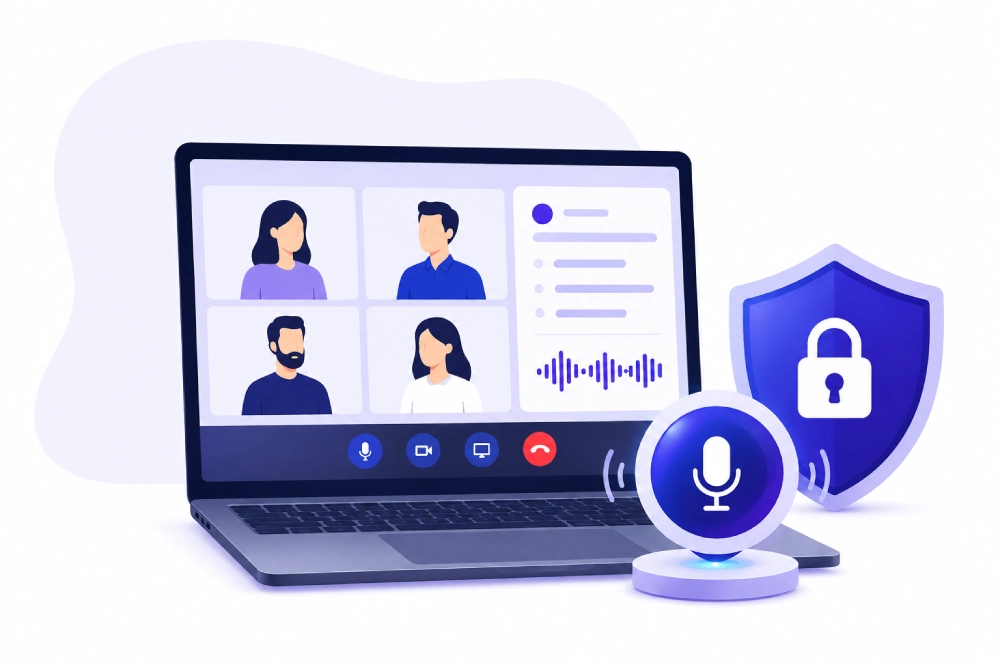
Voice and meeting assistants have become one of the fastest-growing sources of unmonitored data exposure in the enterprise, because they capture the exact conversations where passwords, contract terms, patient details, and strategic plans get spoken out loud. The voice recognition market is experiencing significant growth, and meeting assistants are now integral to nearly every enterprise meeting, meaning security teams face a new listening challenge. Security teams that only monitor files and email are missing where sensitive data actually leaks first: the spoken word, captured, transcribed, stored, and often synced to third-party servers before anyone reviews it. Kitecyber approaches this problem from the endpoint, where the recording app, the browser tab, and the clipboard actions around a meeting assistant occur, giving security teams a real chance to catch exposure before it leaves the device.
TL;DR
- Meeting assistants and voice AI tools capture unstructured, high-sensitivity data (verbal passwords, legal terms, patient details) that traditional DLP was never built to inspect.
- Real breaches have already occurred through this channel, including incidents involving transcription and voice documentation providers that exposed significant volumes of personal data.
- Retention policies vary sharply by vendor: some platforms discard content after the meeting, others retain prompt or transcript data for up to 30 days for abuse monitoring.
- Regulatory pressure is rising, with the EU AI Act's Article 50 mandating transparency disclosures for AI assistants and frameworks like ISO/IEC 42001:2023 formalizing AI governance expectations.
- Endpoint-native monitoring, not network inspection alone, is the practical way to see and control what a meeting assistant records, stores, and shares.
About the Author: This article reflects Kitecyber’s focus as an endpoint-native data security provider working with AI-native and technology companies including DuploCloud, Lily AI, Sarvam, and Scrut Automation, helping security teams extend data loss prevention to the browser and application layer where AI tools like meeting assistants actually run.
What Makes Voice and Meeting Assistants a Distinct Data Exposure Channel?
A voice or meeting assistant is any AI-driven tool that records, transcribes, or summarizes spoken conversation, and it creates exposure risk because it converts ephemeral speech into a permanent, searchable, and shareable data asset. Before these tools existed, a sensitive comment made in a meeting disappeared once the meeting ended. Now it becomes a transcript stored in a vendor’s cloud, indexed for search, and often surfaced automatically in follow-up emails or shared drives.
This matters because meeting audio routinely includes information nobody intended to write down: verbal passwords shared during IT support calls, personal health details disclosed in HR conversations, or legal strategy discussed on a client call [ticnote.com]. Traditional data loss prevention tools were built to scan documents and outbound emails for patterns like credit card numbers. They were not designed to intercept a live audio stream being processed by a third-party AI service in real time. That gap is exactly why this channel deserves its own line item in a 2026 security program rather than being treated as a subset of general SaaS risk.
What Documented Incidents Show About the Real Risk?
The risk here is not theoretical; it has already produced large-scale breaches. Recent incidents involving transcription and voice documentation providers have exposed significant volumes of personal data, making voice transcription infrastructure a material healthcare-adjacent exposure vector. Separately, a late-2024 API key exposure in Granola’s beta application left meeting transcripts vulnerable to unauthorized access, and a November 2025 network security incident at TrueRCM exposed sensitive patient data connected to voice and documentation workflows.
These incidents share a common mechanism: sensitive spoken content gets captured, sent to a processing backend, and stored somewhere outside the direct control of the organization whose employees generated it. Building on that pattern, the harder question for security teams is not whether a breach can happen through this channel, but whether they would even know it was happening while it occurred. Most organizations have no logging on what a meeting assistant captured, where it sent that data, or which third-party model processed it.
How Do Retention and Processing Policies Differ Across Vendors?
Retention policy is the single most important variable in assessing exposure risk from any given assistant, because it determines how long sensitive spoken content persists after the conversation ends. These policies vary meaningfully across major platforms:
|
Platform |
Retention Behavior |
|---|---|
|
Zoom AI Companion |
Processes meeting content in real time, does not retain it after the meeting or use it to train models |
|
Microsoft Copilot |
Retains prompt data for up to 30 days by default for abuse monitoring, unless “zero data retention” is separately approved |
|
Google Gemini |
Retains prompts for 30 days when using Grounding with Google Search |
A related but distinct concern is that these defaults are configurable, and most end users never touch the settings. An employee using the default configuration of a meeting assistant may be unknowingly extending a 30-day retention window on a conversation that included client financials or unreleased product plans. Security teams cannot assume every assistant behaves like the most privacy-conservative option; the difference between “processed and discarded” and “retained for a month” has to be verified per tool, per configuration, not assumed.
What Regulatory Obligations Apply to Meeting and Voice AI Data?
Meeting and voice AI tools fall under overlapping compliance frameworks that treat spoken content as regulated data the moment it touches health, financial, or personal information. GDPR and HIPAA strictly govern the consent and handling of sensitive voice data, which means an assistant recording a healthcare consultation or a European customer call triggers the same consent and data-handling obligations as any other processing of personal data. The EU AI Act adds a more specific requirement: Article 50 explicitly mandates transparency disclosures for AI assistants, meaning organizations must disclose when an AI system is interacting with or recording a person.
On the standards side, ISO/IEC 42001:2023 provides the first certifiable international standard specifically for AI management systems and data governance, giving security and compliance teams a concrete framework to audit against rather than relying on vendor self-attestation. Stepping back from the regulatory detail, the practical takeaway is that “the vendor says it’s compliant” is not sufficient evidence for an audit. Security teams need their own visibility into what a meeting assistant is doing on the endpoint, independent of vendor claims.
Why Isn't Traditional DLP Enough to Catch This Exposure?
Traditional data loss prevention tools were built to scan documents, emails, and network traffic for known patterns, and that architecture fundamentally cannot see what happens inside a meeting assistant’s local capture and processing flow. Static DLP looks at data at rest or in transit across sanctioned channels. It doesn’t see a browser extension capturing audio, a desktop app writing a transcript to local storage, or a copilot summarizing a screen-share and pushing that summary to a personal cloud drive.
This is the same blind spot AI has created across the broader endpoint threat model: copilots and agents can read, summarize, and move data at machine speed, often crossing boundaries that were never explicitly authorized. AI-driven breaches through third-party SaaS and open-source tools now account for a significant share of incidents, underscoring that AI-adjacent tools, not just traditional malware, are now a primary breach vector. Attacker-driven tactics including phishing and deepfakes have emerged as material initial-access vectors. None of these categories are things a network firewall or a static DLP rule was designed to catch, because the exposure happens at the point where a human or an AI agent interacts with content on the device itself.
How Should Security Teams Monitor Voice and Meeting AI in 2026?
The practical answer is to treat meeting and voice assistants as another category of application requiring endpoint-level data classification and enforcement, not a separate problem needing a separate tool. This is where consolidation matters more than adding another point solution. A useful checklist for security teams:
- Inventory every meeting assistant in use, sanctioned and unsanctioned, across browser extensions, desktop apps, and native platform features like Zoom AI Companion or Copilot.
- Classify transcript and recording data using content, not just file type, so a transcript containing patient information or contract terms is flagged the same way a spreadsheet with that data would be.
- Track data lineage from capture to storage, confirming whether a transcript stays local, moves to a vendor cloud, or gets forwarded into a third-party AI service for further summarization.
- Apply real-time enforcement at the endpoint so that if a meeting assistant tries to upload a recording containing regulated data to an unsanctioned destination, the action is blocked or flagged at the moment it happens, not discovered in a quarterly audit.
- Extend AI agent monitoring tools to cover meeting bots specifically, since many operate as autonomous agents that join calls, capture data, and act on it without a human reviewing every output.
This is precisely the model Kitecyber built around: See, Decide, Enforce, continuously. One lightweight agent observes what’s happening on the endpoint, including browser activity, clipboard actions, and application behavior around meeting tools, decides whether a given data movement is within policy based on real content classification, and enforces the right control (allow, warn, coach, block, or isolate) at the point of risk rather than after the fact.
How Does an Endpoint-Native Approach Change the Outcome?
An endpoint-native approach changes the outcome because it puts the enforcement point where the assistant actually runs, rather than relying on inspecting network traffic after the fact. Think of it like the difference between a smoke detector in the room where a fire starts versus a sensor that only checks the air outside the building. Network-based tools and legacy network inspection can see traffic leaving the network, but they can’t see a locally-running transcription app writing a file to disk, or an employee copying a sensitive transcript snippet into a personal notes app. The endpoint is where that decision actually gets made, so it’s where enforcement has to happen.
This also connects to insider risk management software use cases, since not every exposure through a meeting assistant is malicious. Most is accidental: an employee shares a recording link too broadly, or a default retention setting keeps a sensitive transcript longer than compliance policy allows. Coaching and warning controls at the endpoint, rather than blanket blocking, tend to reduce this kind of risk without disrupting legitimate meeting workflows.
About Kitecyber
Kitecyber is a next-generation cybersecurity company that protects sensitive data at the endpoint, where employees and AI tools actually interact with it. Its platform combines endpoint DLP solutions, AI agent monitoring tools, secure web gateway protection, SaaS governance, and zero trust network access into one lightweight agent, replacing fragmented point solutions with a single trust engine. Built for the era of copilots and autonomous agents, Kitecyber gives IT and security teams the real-time visibility needed to let employees adopt AI tools, including meeting and voice assistants, with confidence rather than restriction. The company serves AI-native and technology organizations across regulated industries, supporting compliance needs spanning HIPAA, GDPR.
References
Frequently Asked Questions
Yes. Most meeting and voice assistants are delivered as SaaS or browser-based tools, so they should be governed under the same SaaS security platform policies applied to other cloud applications, including access control and data movement monitoring.
Modern data classification software increasingly analyzes transcript text and document context, not just file patterns, which allows it to flag a transcript containing regulated data even if the file itself is a plain text export.
Zero trust network access reduces risk around who can reach the systems where recordings and transcripts are stored, particularly for private infrastructure, but it does not by itself inspect what a meeting assistant captures or where it sends that content afterward.
Unified endpoint management software gives IT visibility into which devices have meeting assistant apps or extensions installed, which is a prerequisite step before applying any data-specific policy to those tools.
No. Retention policy, model training practices, and data residency differ significantly by vendor, as shown by the contrast between Zoom AI Companion's real-time, non-retained processing and Microsoft Copilot's default 30-day retention window.
What's the difference between endpoint DLP solutions and network-based monitoring for this use case?
Endpoint DLP solutions observe the data at the point of capture and action, such as a recording being saved or shared, while network-based monitoring only sees traffic that crosses the network boundary, missing local processing and storage entirely.
Yes. Vulnerabilities like CVE-2025-49457 in Zoom show that meeting client software itself is part of the attack surface, reinforcing why endpoint-level visibility, not just platform settings, is necessary.

Ajay Gulati
Ajay Gulati is a passionate entrepreneur focused on bringing innovative products to market that solve real-world problems with high impact. He is highly skilled in building and leading effective software development teams, driving success through strong leadership and technical expertise. With deep knowledge across multiple domains, including virtualization, networking, storage, cloud environments, and on-premises systems, he excels in product development and troubleshooting. His experience spans global development environments, working across multiple geographies. As the co-founder of Kitecyber, he is dedicated to advancing AI-driven security solutions.