TL;DR
- Legacy SSE stacks were built for perimeter inspection, not endpoint-native data protection in an AI-driven environment.
- AI agents and copilots have fundamentally changed the endpoint threat model; sensitive data can be exfiltrated at machine speed before network tools see it.
- Consolidation is accelerating in 2026; companies are cutting fragmented SaaS and security stacks significantly to reduce cost and complexity [vantagepoint.io].
- A practical consolidation migration requires phased replacement: map coverage gaps first, replace the highest-risk controls second, then sunset legacy tools.
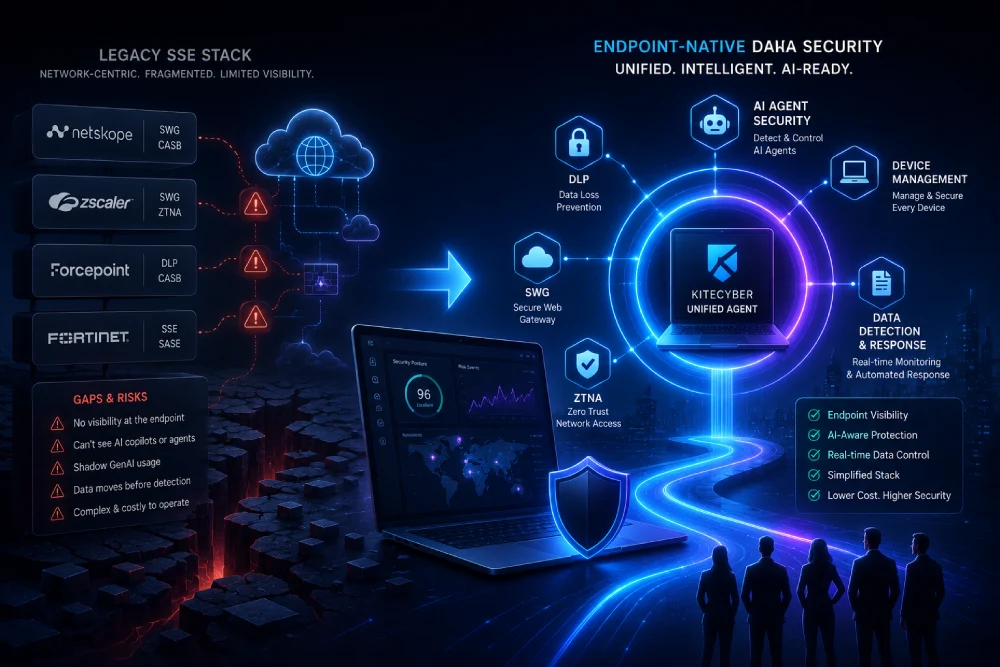
- Kitecyber delivers endpoint-native data security through one lightweight agent, unifying DLP, AI agent security, SWG, ZTNA, and device management under a single control plane.
About the Author: Kitecyber is a Bay Area-based cybersecurity company specializing in endpoint-native data protection for mid-sized technology companies, with customers including DuploCloud, Lily AI, Vanta, Sarvam, and Scrut Automation. Kitecyber’s platform was purpose-built for the AI agent era, giving it a direct perspective on the gaps that legacy SSE stacks leave exposed.
Why Are Mid-Sized Teams Replacing Their SSE Stacks Right Now?
The consolidation wave is not a trend – it is a response to compounding cost and architectural failure. Platform consolidation has accelerated sharply in 2026, with companies actively reducing their SaaS and security tool portfolios to eliminate redundancy and close coverage gaps [vantagepoint.io]. For mid-sized security teams specifically, the problem is acute: they rarely have the headcount to manage four or five point solutions, and they cannot afford the gaps that appear between them.
The deeper issue, though, is not just tool sprawl. It is that the threat model has shifted underneath the existing stack. Legacy SSE architecture assumes that dangerous data movement happens at the network boundary. In 2026, the boundary is gone. An engineer using a GitHub Copilot session, a sales rep pasting customer records into a GenAI summarization tool, or an autonomous AI agent querying an internal database can all move sensitive data without ever triggering a network-level alert. SSE was not designed to see any of this.
What Does “Legacy SSE” Actually Mean, and Why Does It Fall Short?
Legacy SSE describes a class of cloud-delivered security platforms – typically combining Secure Web Gateway, Cloud Access Security Broker, and Zero Trust Network Access – that route traffic through a cloud proxy to inspect and control it. Vendors like Netskope and Zscaler built category-defining products on this model. Forcepoint offers enterprise DLP and SSE through a web and cloud security suite. Fortinet approaches SSE from a network security and SASE foundation.
The architectural limitation is consistent across all of them: they inspect traffic on the wire, after it has left the endpoint. By the time a cloud proxy sees a data event, an AI agent may have already completed multiple operations on that data. There is also a practical deployment burden for mid-sized teams: cloud proxy architectures typically require traffic steering, connector management, and ongoing tuning that strains lean IT teams.
The legacy DLP vendors face a parallel problem. Safetica covers endpoint and cloud DLP for mid-market, but operates within a traditional policy-enforcement model. Cyberhaven provides data detection and response with data lineage tracing. Nightfall uses an API-based approach to detect sensitive data across SaaS and cloud apps. Netwrix addresses data access governance and identity risk. Each solves a defined slice of the problem. None of them operate as a unified, endpoint-native control plane that sees the endpoint, the user, the data, and the AI interaction simultaneously.
How Has AI Changed the Endpoint Threat Model?
This is the central question that any consolidation project must answer, because it determines what architecture you are consolidating toward. AI has changed the endpoint threat model in three specific ways.
First, speed. An AI copilot or autonomous agent can read, summarize, copy, and transmit sensitive data in seconds. Human insiders move data deliberately and relatively slowly. Machines do not.
Second, opacity. AI agents operating on a user’s behalf may access data through API calls, browser sessions, or agentic workflows that do not look like traditional data exfiltration to legacy tools. A static DLP rule matching credit card patterns does not catch an AI agent summarizing a financial document and uploading the summary to an external service.
Third, ubiquity. Shadow GenAI adoption means employees are using AI tools that IT never sanctioned. A Secure Web Gateway can block known GenAI domains, but it cannot understand the context of what data is being sent to a permitted tool, or enforce a policy based on the sensitivity of the content in the prompt.
The endpoint is now the only place where all three of these risks are simultaneously visible: the user identity, the device posture, the data content, and the application or agent making the request.
What Should a Practical SSE Replacement Actually Look Like?
Building on the threat model shift above, the harder question is execution. Replacing a production SSE stack at a mid-sized company is not a weekend migration. Here is a structured approach.
Step 1: Map your current coverage model, not your tool list.
Before cataloguing vendors, map what you are actually protecting: web traffic, private app access, data-at-rest, data-in-motion, device posture, SaaS access, and AI interactions. Identify which controls are actively enforced versus which are licensed but dormant. Legacy stacks frequently include significant shelfware [vantagepoint.io].
Step 2: Identify the endpoint data coverage gap.
The most common gap in legacy SSE stacks is the absence of real-time, endpoint-native data context. Network DLP and cloud proxies see traffic; they do not see what happens before data leaves the endpoint. Map this gap explicitly.
Step 3: Prioritize highest-risk controls for first replacement.
For most mid-sized teams, the priority order is: (1) endpoint and network DLP to close immediate data exfiltration risk, (2) AI agent and GenAI controls to govern shadow usage, (3) ZTNA to replace legacy VPN, and (4) SWG to retire the cloud proxy. Replacing everything simultaneously creates transition risk.
Step 4: Deploy one agent, validate coverage, then sunset legacy tools.
A one-agent model reduces deployment friction considerably. Validate that the new platform covers each use case before decommissioning the legacy tool that served it.
Step 5: Confirm compliance coverage before you cancel licenses.
Mid-sized companies in regulated industries need to confirm that the replacement platform covers their specific frameworks – HIPAA, SOC 2, CMMC, PCI DSS, GDPR, or FINRA – before retiring tools that were part of a prior compliance posture.
How Does Kitecyber Fit Into This Consolidation Model?
Kitecyber is purpose-built for exactly this replacement scenario. Its single lightweight agent runs on Windows, macOS, and Linux, and follows a continuous See, Decide, Enforce model: observing endpoint activity, evaluating each action in context, and enforcing the right control at the moment of risk – not after traffic reaches a cloud proxy.
Data protection is the core. Endpoint and network DLP cover files, clipboard, browser uploads, GenAI prompts, SaaS apps, and removable media. AI agent security governs how copilots and autonomous agents interact with sensitive data. Around this core, Kitecyber unifies Secure Web Gateway, SaaS app protection, ZTNA, and unified device management through the same agent and policy engine. There is nothing to stitch together.
This is the consolidation path that the current threat model actually requires: prevention over reaction, endpoint-native visibility, and a single control plane that understands data, users, devices, and AI interactions simultaneously.
About Kitecyber
Kitecyber is a next-generation cybersecurity company headquartered in the Bay Area, California, built to protect sensitive data at its source: the endpoint. Its single lightweight agent unifies endpoint and network DLP, AI agent security, Secure Web Gateway, SaaS app protection, ZTNA, and device management into one platform governed by a continuous See, Decide, Enforce model. Kitecyber was designed specifically for the AI agent era, giving security teams real-time visibility and enforcement over how sensitive data moves through users, devices, SaaS apps, and autonomous AI agents. Organizations like DuploCloud, Lily AI, Vanta, Sarvam, and Scrut Automation use Kitecyber to replace fragmented legacy stacks and adopt AI confidently.
Visit kitecyber.com to start a free trial or speak with the team to see endpoint-native data security in action.
References
Frequently Asked Questions