An inventory tells you what exists. Policy decides what happens next.
In a 23 October post on its Falcon Guardian product, CrowdStrike shared what early deployments found when they first looked for AI use: hundreds of AI interactions existing controls had not recorded, more than 260 distinct AI services in use at a single organization, and confidential documents and customer records shared with public AI chatbots. Zscaler executives are making a similar point in public: shadow AI is a growing challenge, and organizations struggle to know where AI systems operate and what data they can reach.
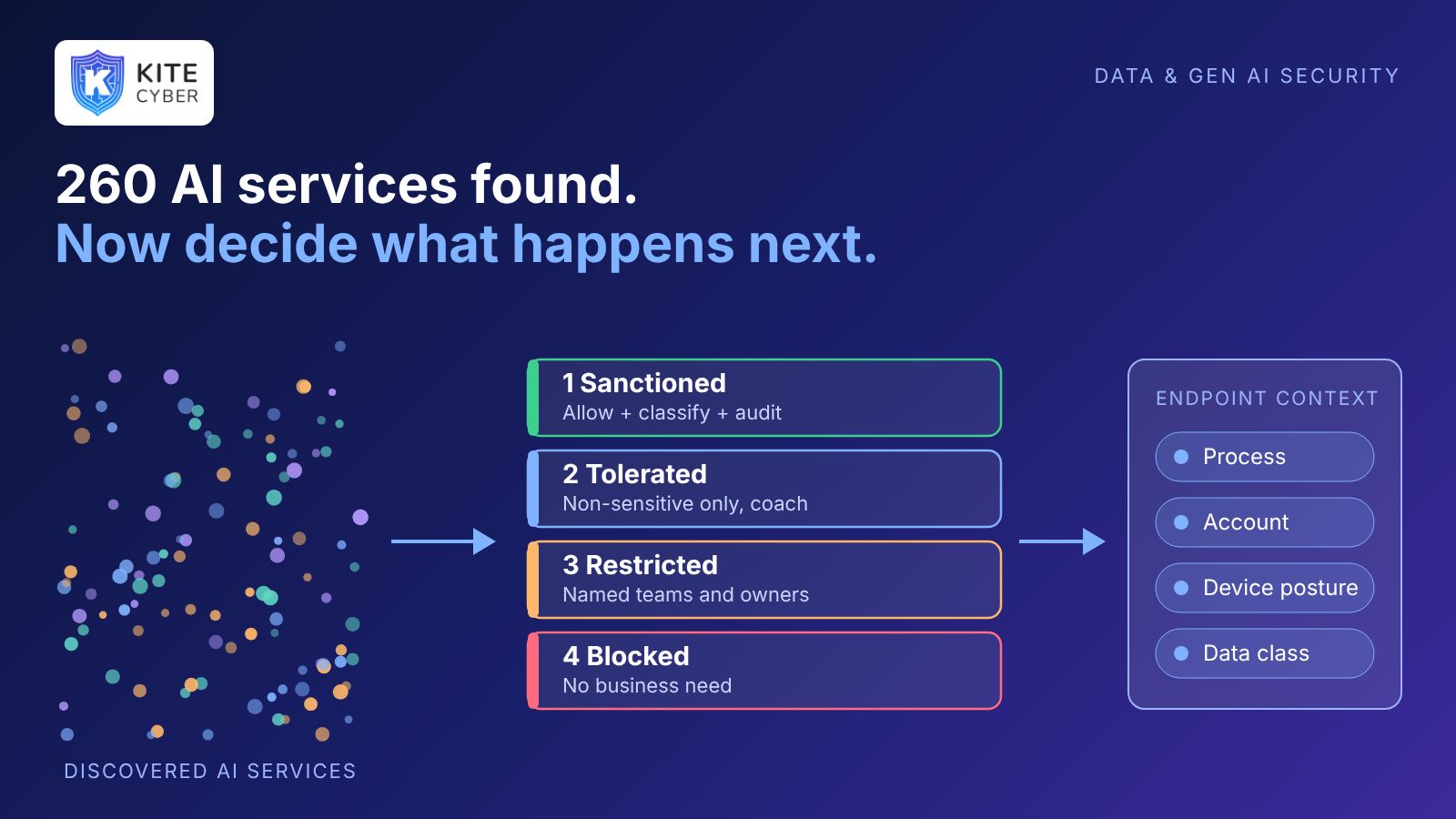
Those numbers will not surprise most security teams. The harder question is the one after discovery: with 260 services on the list, what do you do on Monday?
Discovery is the start of the work
A list of AI services is not a policy. Teams that stop at the inventory tend to end up in one of two places: a blanket block that employees route around with personal devices and accounts, or a long allow-list that nobody maintains. Neither reflects how people actually use AI, which depends on who they are, what they are working on and what data is involved.
Tier the list by decision, not by vendor
A workable approach is to sort what you find into a small number of tiers, each with a clear action:
The tiers only work if the decision can be made at the moment of use. That is where endpoint context matters.
What the endpoint adds to the decision
The same service can be fine in one situation and a problem in another. Four pieces of context do most of the work:
Because these signals sit on the device, they can be evaluated together, locally, before content leaves.
A practical first 30 days
Keep it proportionate
Discovery data about how individuals use AI is sensitive in itself. Collect what the policy needs, restrict who can view user-level records and tell employees what is monitored and why. Coaching messages that explain the rule and offer an approved alternative reduce workarounds better than silent blocks.
Where Kitecyber fits
Kitecyber runs Gen AI and data security on the endpoint, so the service, process, account, device posture and data classification (80+ categories) are available in one place at the moment of use. Policies can allow, coach or block by content, destination, account and posture, with an audit trail. The agent uses under 2% CPU, and deployment typically takes around a day with pre-built compliance policies, which makes the “observe first, then enforce” approach above realistic for a small team.
Book a Kitecyber walkthrough at kitecyber.com to see what your own AI inventory looks like.