Right now, someone on your team is probably pasting a customer contract, a chunk of source code, or a spreadsheet full of financial figures into a free AI chatbot. You do not know it is happening. Your security team does not either.
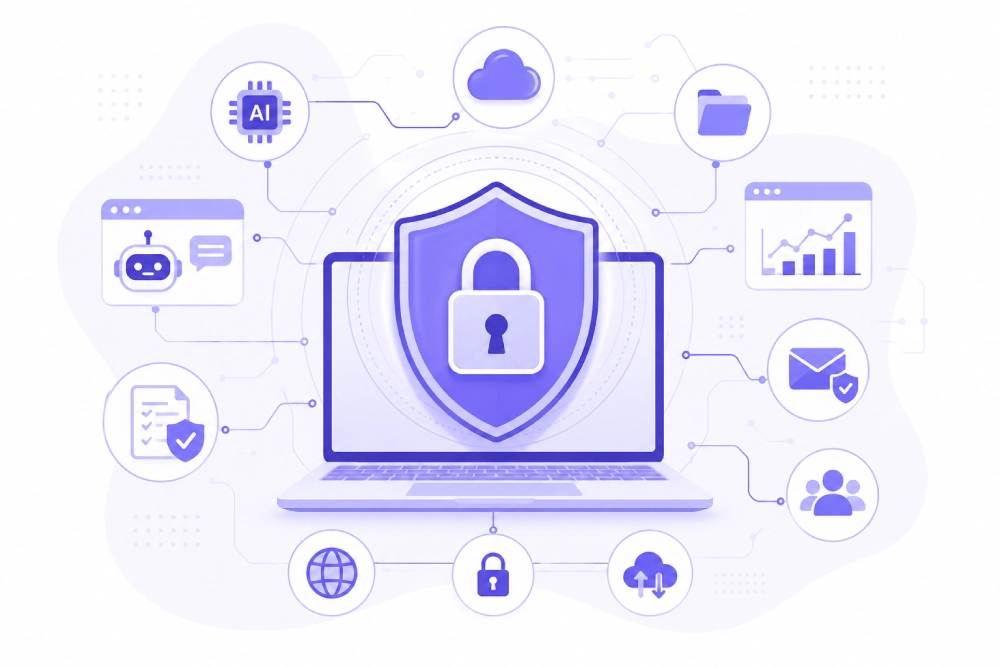
AI Security Posture Management exists to close that gap. It gives you a live view of every AI tool your people touch, and it stops sensitive data from walking out the door through a chat window instead of your firewall.
The numbers back up how urgent this has become. One 2026 industry report found that 78% of employees bring their own unauthorized AI tools to work, and 27% have already typed confidential company data into a public AI tool without approval from anyone on the security side. Data volume shared with AI tools grew by roughly 485% year over year, according to the same research.
If you manage security, IT, or compliance at a growing company, you already feel this problem. This guide breaks down what AI Security Posture Management actually does, why your current tools miss most of this activity, and the exact steps you can take this month to bring AI usage under control.
What Is AI Security Posture Management
AI Security Posture Management is a category of security practice built specifically for the risks that generative AI and AI agents introduce. It borrows ideas from older posture management disciplines like cloud security, but it points those ideas at a new target: the models, prompts, and AI-connected apps your business now runs on.
At its core, AISPM answers three questions on an ongoing basis. Which AI tools and agents are actually in use across your company? What data flows into and out of them? And where are the misconfigurations, unsafe permissions, or unapproved tools that put you at risk?
Security researchers describe this as the missing piece that older tools were never built to catch. One industry analysis notes that shadow AI in 2026 goes far beyond employees chatting with a bot. It now includes AI agents with persistent memory and the ability to take actions inside your systems, often invisible to the security team until something breaks.
You will also see this discipline called AI Posture Management or simply AISPM in vendor materials and analyst reports. The terms describe the same idea: manage your AI posture the same way you manage your cloud posture, except the asset you are protecting is a model, a prompt, or an autonomous agent instead of a server.
Why AISPM Matters Right Now
Three years ago, most companies had a handful of approved software tools and a security stack built to watch network traffic between them. That model breaks down completely once generative AI enters the picture, because the riskiest moment in AI usage happens inside a browser tab, not on the network.
Those figures come from Airia’s 2026 shadow AI research, which draws on Cyberhaven and Salesforce data. A separate Gartner-based study found that 68% of employees use AI tools without IT approval, and the average cost of ignoring shadow AI runs into the hundreds of thousands of dollars per year once you factor in incident response, according to Second Talent’s 2026 breakdown.
Regulation adds another layer of pressure. The EU AI Act now carries active enforcement milestones, and it creates direct liability for organizations that cannot account for the AI systems running inside their business, based on reporting from Airia’s CISO briefing. If you cannot show a regulator or an auditor which AI tools touch which data, you carry that risk personally as the person accountable for security.
None of this means you should ban AI outright. Employees will use it whether you approve it or not, and blocking it completely tends to push usage further underground. The practical answer is to see what is happening and govern it, which is exactly what AI Security Posture Management is built to do.
What Security Teams Say About Managing AI Risk
Search through security forums, G2 reviews, and practitioner write-ups, and a pattern shows up again and again. Teams describe feeling behind on AI visibility, frustrated by tools that only catch a fraction of real usage, and worried about the gap between what they can see and what is actually happening on employee devices.
A common complaint centers on cloud-based security tools. Security leads report that traditional gateways only catch shadow AI indirectly, through single sign-on logs or email scanning, which misses AI tools accessed through personal accounts or free tiers that never touch company identity systems. That blind spot matters because most shadow AI activity happens outside approved channels in the first place.
Another recurring theme involves the moment data actually leaves. Teams say their existing data loss prevention tools were built to watch files move across a network, not to catch a paste action inside a browser tab pointed at an AI chatbot. By the time a policy engine notices, the sensitive text already sits inside someone else’s model.
A third pattern shows up around AI agents connected through OAuth. Security practitioners increasingly flag AI agents and third-party integrations as a supply chain risk, since a single over-permissioned grant can hand an AI tool far more access to company systems than anyone intended. This concern shows up consistently in analyst coverage of the AISPM category, including Obsidian Security’s writeup on agentic AI risk.
The takeaway across these conversations is consistent. Security teams do not need another dashboard telling them AI is risky. They need a way to see the specific prompt, paste, or upload as it happens, and a way to act on it before the data leaves the device.
The real gap: Most security stacks were designed to watch network traffic. AI risk lives inside the browser tab, at the moment someone types or pastes into a prompt box. Closing that gap requires visibility at the endpoint, not just the network.
The Core Components of AI Posture Management
A mature approach to AI Posture Management usually includes six moving parts working together. Skip any one of them and you end up with partial visibility, which in practice means you are still flying blind on most of your actual AI usage.
1. Continuous AI discovery
You need a live inventory of every AI tool, browser extension, and agent in use across your company, updated automatically rather than through periodic surveys or manual audits.
2. Data flow visibility
Once you know which tools are in use, you need to see what kind of data moves into them. That means classifying prompts and uploads by category, such as customer records, source code, or financial data.
3. Risk classification
Not every AI tool carries the same risk. AISPM sorts tools into sanctioned, coached, and unsanctioned tiers, so you can allow safe usage and restrict risky usage without a blanket ban.
4. Policy enforcement
Visibility alone does not stop a leak. You need the ability to block, warn, or allow specific actions in real time, based on the user, the device, the tool, and the data involved.
5. OAuth and agent governance
AI agents connect to your SaaS stack through OAuth grants that often carry more permission than anyone reviewed. Mapping and revoking those connections closes a growing
attack surface.
6. Compliance reporting
You need audit-ready evidence of how AI is governed across your company, mapped to frameworks like SOC 2, ISO 27001, HIPAA, and GDPR, so you can answer a regulator or a customer’s security questionnaire without scrambling.
AISPM vs DSPM vs CSPM vs SSPM
Security teams often ask how AISPM fits alongside the posture management tools they already run. Each discipline protects a different layer, and the differences matter when you decide where to invest first.
Category | What It Protects | What It Misses |
AISPM | AI models, prompts, agents, and how they touch company data | Broader cloud infrastructure outside the AI layer |
DSPM | Where sensitive data lives and who can access it | What happens to data once it enters a prompt |
CSPM | Cloud infrastructure configuration and misconfigurations | AI-specific behavior, model risk, and prompt content |
SSPM | SaaS app configuration and identity risk | In-browser prompt activity and copy or paste actions |
These categories complement each other rather than compete. A company with strong CSPM and DSPM can still lose data through an AI prompt, because neither tool was built to watch that specific moment. AISPM fills that space, and the strongest security programs run it alongside their existing posture tools rather than instead of them.
7 Steps to Manage AI Posture at Your Company
You do not need a six-month project to start managing AI posture. Here is the sequence that works for most companies, whether you run a five-person IT team or a full security department.
Step 1: Run a discovery scan before you write a single policy
You cannot govern what you cannot see. Start by deploying a discovery tool that maps every AI app, browser extension, and agent already running across your fleet. Most teams find far more tools in use than they expected.
Step 2: Classify data types that matter most to your business
Define the categories you care about most, such as customer PII, source code, financial data, or legal documents. This becomes the basis for every policy you write later.
Step 3: Sort AI tools into sanctioned, coached, and unsanctioned
Approve tools your company trusts, allow risky tools with a real-time warning, and block tools that carry no acceptable use case. This keeps productivity intact while you close the highest-risk gaps first.
Step 4: Put controls at the endpoint, not just the network
Since the risky moment happens inside a browser tab, your controls need to sit where the user actually interacts with AI. A network-only approach will always miss copy, paste, and upload activity happening inside the app itself.
Step 5: Review OAuth grants tied to AI agents every month
AI agents accumulate permissions quickly, often without anyone reviewing what they can actually access. A monthly audit catches over-permissioned grants before they become an incident.
Step 6: Train employees on the why, not just the rule
People will find a workaround for any policy they do not understand. Explain the actual risk in plain terms, such as customer data ending up in a model your company does not control, and adoption improves.
Step 7: Report on AI posture the same way you report on any other risk
Bring AI usage into your existing security and compliance reporting cycle. Leadership and auditors should see AI governance as a normal part of your posture, not a separate side project.
Common Mistakes That Undo Good AI Governance
How Kitecyber Delivers AI Security Posture Management
Most AISPM tools on the market today work from the cloud, which means they inherit the same blind spot as older cloud gateways. They can tell you an AI app exists, but they cannot see the actual paste, prompt, or upload happening inside a browser tab. Kitecyber built its platform around solving that specific gap.
Kitecyber runs a lightweight agent directly on the endpoint, right where employees actually interact with AI tools. That gives you full shadow AI discovery across standalone tools like ChatGPT, Gemini, Claude, and Perplexity, plus AI features embedded inside SaaS apps and AI agents connected through OAuth. Because the agent sits on the device itself, it sees copy and paste actions and file uploads in real time, before the data ever leaves. Cloud-based gateways simply cannot see that moment.
The platform lets you classify every AI tool as sanctioned, coached, or unsanctioned, so approved tools like an enterprise ChatGPT plan run at full speed while free-tier or unapproved tools get blocked before a single prompt goes out. Kitecyber also maps AI agents and third-party integrations connected through OAuth, so you can spot and revoke over-permissioned grants before they become a supply chain risk.
Because inspection happens on the device instead of a distant cloud gateway, there is no backhaul and no added latency, so employees do not feel a performance hit while your security team gains full visibility. Every action gets logged into audit-ready reports mapped to SOC 2, ISO 27001, HIPAA, GDPR, and other frameworks, giving you defensible evidence the next time a customer or a regulator asks how you govern AI.
If you are comparing AI Security Posture Management options, the endpoint-based approach is worth weighing seriously against cloud-only tools, since the endpoint is where the actual risk happens.
Here’s a quick overview of Kitecyber AI Security Posture Management in this video:
https://www.youtube.com/watch?v=7yTYhks5AC0
See Your Shadow AI Usage in Minutes
Deploy a lightweight agent and get a live map of every AI and SaaS app running across your company, with the controls to govern them from day one.
Frequently Asked Questions