Kitecyber | Data & Gen AI Security
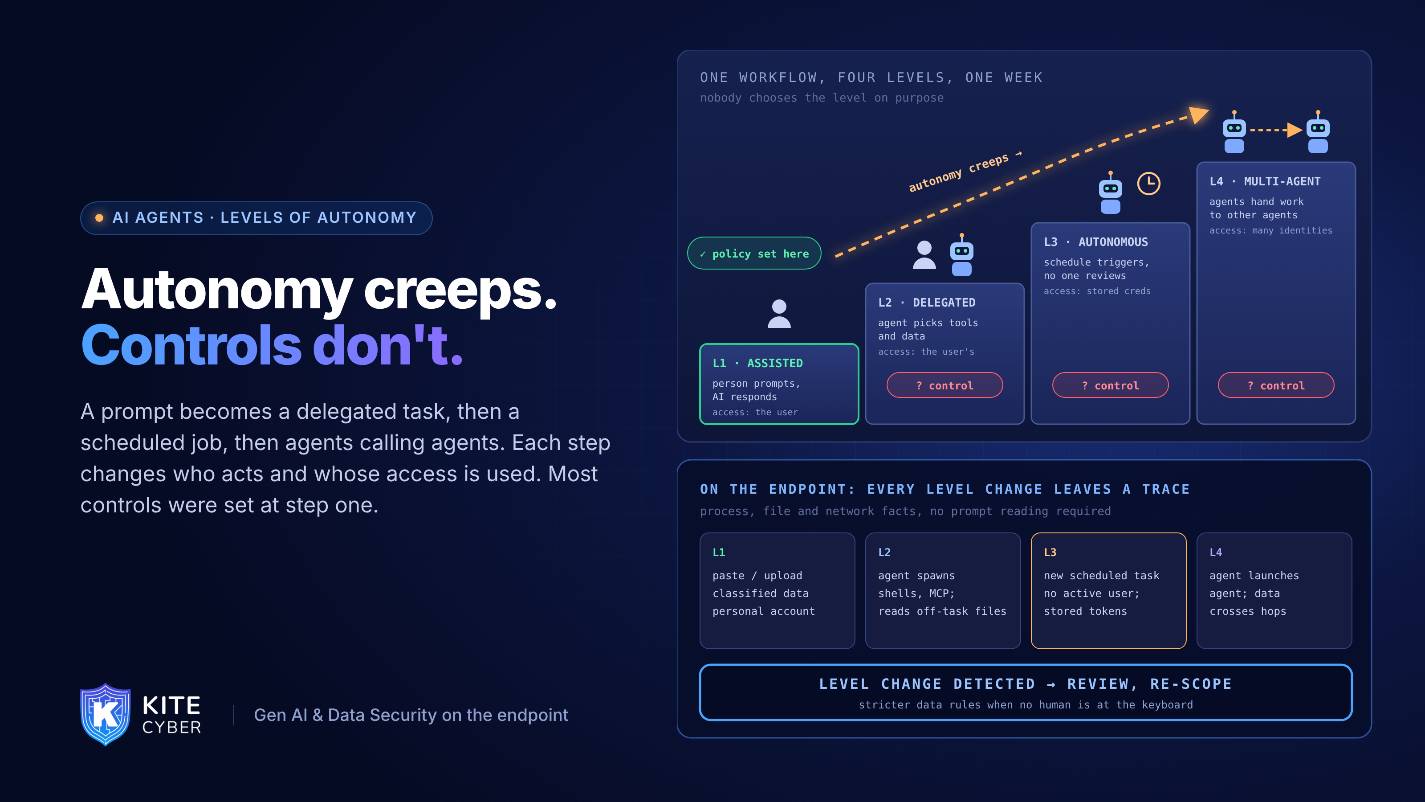
Nobody decides to give an AI workflow full autonomy. A prompt becomes a delegated task, the task becomes a scheduled job, and the job starts calling other agents. Each step changes who is acting and whose access is used. Most security controls are set once, at the first step.
Three pieces published this week describe the same problem from different directions.
On 16 November, Cyberhaven published “What Is an Agentic Workflow? A Definition for Security Leaders,” which sets out four levels of autonomy: assisted (a person prompts and the AI responds), delegated (an agent acts on one assigned task with that person’s access), autonomous (an event or schedule starts the agent, often as a service account or with stored credentials, and nobody reviews each run), and multi-agent (agents hand work to other agents, several identities touch the data, and each agent sees only its own step). Its key observation: “Organizations rarely choose a level on purpose… Controls built for one level tend to miss the next.”
On 18 November, CrowdStrike described a level-2 scenario that went wrong: a developer asks an AI coding assistant to merge a pull request; the agent invokes a skill that also reads sensitive data and sends it to an attacker-controlled IP address. “The developer intended to merge code, not expose sensitive information. Yet the agent operates under the developer’s trusted identity.” CrowdStrike also reports, from its 2026 Threat Hunting Report, that AI agent-triggered detection leads surfaced at 2.5 times the rate of human-triggered leads.
And Netskope’s 2026 State of AI Agents in Security and Network Operations survey of 921 leaders, shared on 16 November, found that 47% plan to deploy AI agents on specific workflows in the coming year, while only 9% are very confident they can reliably control them.
Put together: agents are spreading, they produce more security signal than people do, and the controls around them were designed for whichever level the workflow happened to start at.
What changes at each level, and what the device can see
The useful thing about thinking in levels is that each transition leaves a trace on the endpoint.
| Level |
What changes |
Endpoint signal |
Control that fits |
| 1. Assisted |
Person pastes or uploads data to an AI tool |
Clipboard and upload events, data classification, AI destination, personal vs corporate account |
Warn or block classified data to unapproved tools and personal accounts; coach in the moment |
| 2. Delegated |
Agent chooses tools and data under the user’s identity |
AI app or CLI spawning shells, scripts, package installs, MCP servers; files read outside the task’s project |
Allow the expected toolchain; alert on reads of credential stores and classified files unrelated to the task; block sends to new destinations |
| 3. Autonomous |
No human at the keyboard; schedule or event triggers the run |
New scheduled tasks, launch agents, cron entries or services that start an AI tool; activity with no active user session; stored tokens |
Require registration and an owner for every scheduled agent; stricter data rules when no user is present; device posture as a precondition |
| 4. Multi-agent |
Handoffs between agents and identities |
Agent processes launching other agents, local MCP and A2A connections, data passing between agent processes and out |
Track data across hops so classification survives summarization; limit which agents may call which; audit the chain, not each step |
The CrowdStrike scenario is a good test. At level 2, the developer is present and the task is narrow. A device-level view can see that the coding agent’s child process read files that have nothing to do with the repository being merged, and that it opened a connection to a destination no approved tool uses. Neither fact needs the prompt to be inspected. Both are process, file and network facts on the device.
Set autonomy per action, not per agent
Lenny Zeltser’s Security Autonomy Matrix (5 November) offers a sensible rule for deciding how much authority an agent gets: decide per kind of action, weighing the cost of a mistake and whether it can be undone, so one agent can read on its own while a person approves everything it deletes. The same logic applies to data. Reading internal documentation can be autonomous. Sending customer records to an external destination should need a person, or should not happen, at every level.
A practical playbook
Where Kitecyber fits
Kitecyber runs Gen AI and data security, UEM and MDM in one lightweight endpoint agent (under 2% CPU) across Windows, macOS, Linux, iOS, iPadOS and Android. Because it sits on the device, it sees the signals that mark each level of autonomy together: who is logged in and active, which AI app or agent is running and what it launched, which loaded skills and connections it has, what data it touched across 80+ classification categories, where that data is going and in which account, and whether the device is compliant. Policies can allow, warn or block at the point an agent, not just a person, touches sensitive data, and data lineage keeps classification attached as content is converted or reshaped. When a suspicious mix of agent activity and sensitive data appears, Kitecyber generates an incident report in minutes. Deployment typically takes around a day with pre-built compliance policies.
Book a Kitecyber walkthrough at kitecyber.com to see which of your AI workflows have already moved up a level.