

Refusals Are Telemetry: What AI Guardrail Signals Mean for Endpoint Monitoring

Quick Answer: AI Security Posture Management (AISPM), also called AI Posture Management, is the continuous process of discovering, monitoring, and controlling how AI tools, models, and agents interact with your company's data and systems. It covers everything from spotting an unapproved AI app on someone's laptop to blocking a customer record from being pasted into a public chatbot. Most teams that manage AI posture well pair a discovery layer with policy enforcement at the point where employees actually use AI, which is the endpoint.

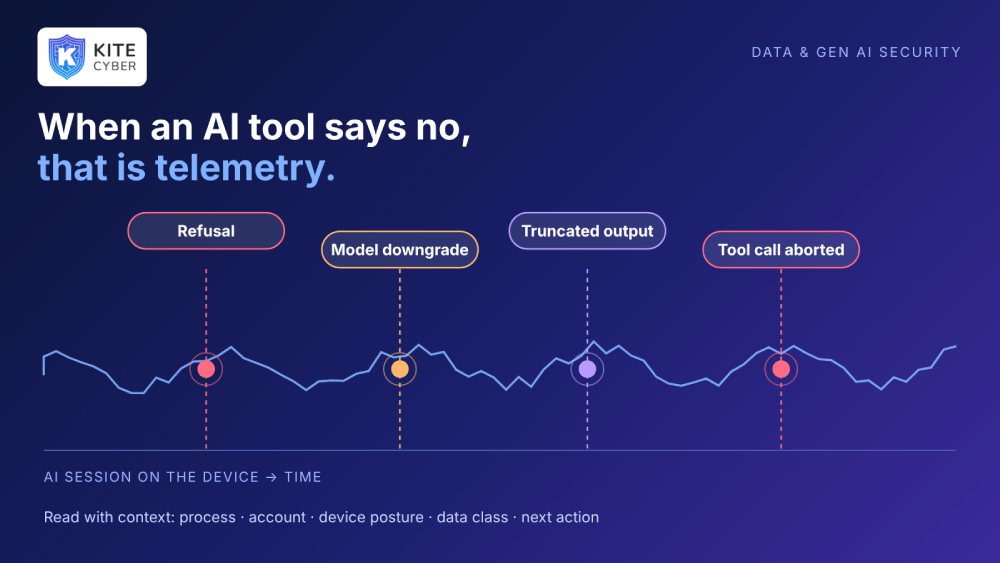
When an AI tool says no, stops mid-task or quietly gets worse, that is information.

On 28 October, CrowdStrike published research titled “When AI Guardrails Expose Vulnerabilities.” The researchers noticed that when a model declined to explain a piece of code, the refusal itself pointed to a flaw. A single changed token had introduced an out-of-bounds write, and the model never said so. It just would not engage. They call the approach Guardrail-based Vulnerability Discovery and report it was correct in 73 of 86 controlled test scenarios.

The offensive and defensive details of that work are for vulnerability researchers. The broader lesson is useful for anyone monitoring AI use inside a company: guardrails leave measurable traces, and most organizations throw those traces away.

The signals guardrails leave behind

The CrowdStrike post lists several forms a guardrail can take, and notes that most of them leak:
The common thread is that the guardrail changes something measurable, even when nobody reads the content.

Why this matters on employee devices

Your employees and their coding agents hit these same guardrails every day. Consider what each event can mean in a workplace:
None of these prove misuse. Each is a low-cost signal that can prioritize which events deserve a human look, or trigger a coaching message.

What the endpoint can see

Provider-side logs show refusals only to the provider. The device sees the surrounding context that makes them interpretable: which application and process sent the request, which account was used, what data class the content matched, what the device posture was, and what the user or agent did next. A refusal followed by the same content being pasted into a different service is a much more meaningful sequence than either event alone.

Using the signal responsibly

Three cautions apply:

Where Kitecyber fits

Kitecyber’s Gen AI and data security runs on the endpoint, where application, process, account, device posture and data classification (80+ categories) are available together. That context lets policy respond to what happens around an AI interaction, not only to the content of a single prompt, with an audit trail for review. A lightweight agent (under 2% CPU) and typical deployment in around a day keep the barrier low.
Book a Kitecyber walkthrough at kitecyber.com to see how endpoint context turns AI activity into usable signals.
With over a decade of experience steering cybersecurity initiatives, my core competencies lie in network architecture and security, essential in today's digital landscape. At Kitecyber, our mission resonates with my quest to tackle first-order cybersecurity challenges. My commitment to innovation and excellence, coupled with a strategic mindset, empowers our team to safeguard our industry's future against emerging threats. Since co-founding Kitecyber, my focus has been on assembling a team of adept security researchers to address critical vulnerabilities and enhance our network and user security measures. Utilizing my expertise in the Internet Protocol Suite (TCP/IP) and Cybersecurity, we've championed the development of robust solutions to strengthen cyber defenses and operations.
Posts: 102
Scroll to Top