Data loss prevention pricing for mid-market teams rarely comes down to the sticker price on a
quote. Trellix DLP, like most legacy suites, prices around a core license and then adds cost
through ePolicy Orchestrator management, network appliance clusters, and the ongoing
administrator time needed to tune policies. Endpoint-native DLP collapses much of that
architecture into a single lightweight agent, which changes the total cost of ownership math
even when the headline license fee looks similar. This matters most for mid-market security
teams, who rarely have a dedicated
DLP analyst and need a platform that a generalist IT or
security hire can run.
TL;DR
About the Author: This article is written by the Kitecyber team, whose endpoint-native DLP
platform is used by mid-market fintech, healthcare, and GenAI-native companies including
DuploCloud, Sarvam, and Scrut Automation to replace legacy point DLP tools without adding
headcount.
What Actually Drives Total Cost of Ownership in a DLP Deployment?
Total cost of ownership in DLP is the sum of licensing, infrastructure, and the labor required to keep policies accurate over time, not just the number on the vendor's quote. Most mid-market teams underestimate the third component. A DLP tool that generates high false positives or requires manual tuning consumes analyst hours every week, and those hours are the real cost driver once a platform is live for more than a quarter.
For a legacy suite like Trellix, the components stack up in a specific way:
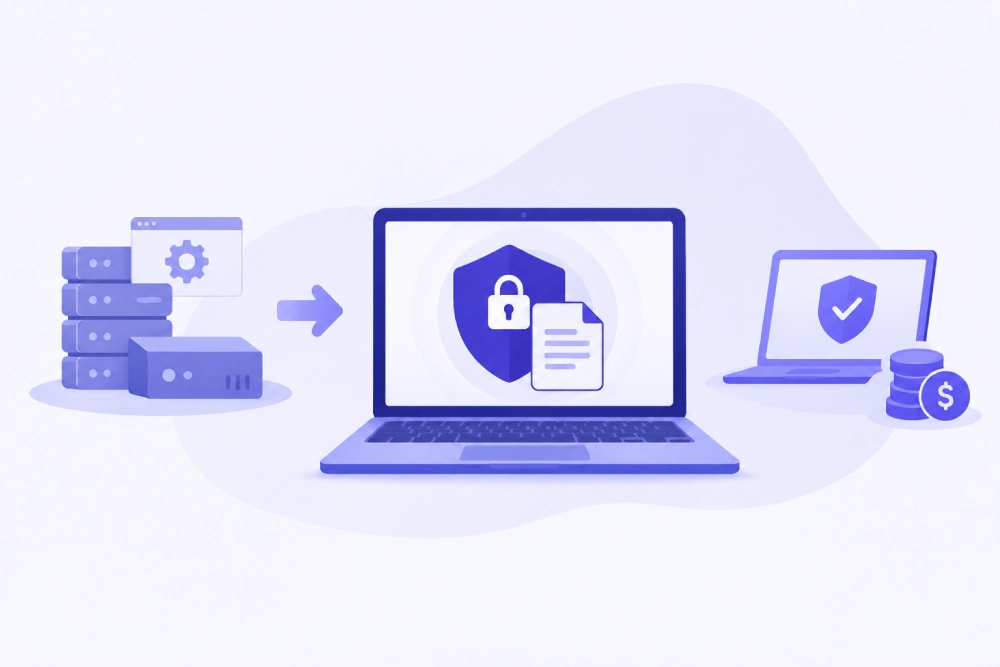
Endpoint-native DLP removes the appliance layer entirely. The classification and enforcement
engine runs on the device itself, so there is no separate network monitoring cluster to size,
patch, or scale as headcount grows. That single architectural difference removes an entire cost
category, not just a line item.
How Does Trellix DLP Price and Deploy Compared to an
Endpoint-Native Agent?
Trellix DLP is a legacy endpoint and network suite built around McAfee Enterprise’s original
architecture, and its total cost of ownership reflects that heritage. Trellix does not publish 2026 pricing and instead uses a custom quote-based model that mixes subscription and perpetual licensing. That flexibility can suit large enterprises with dedicated procurement teams, but it makes budgeting harder for a mid-market team trying to forecast a multi-year cost.
Architecturally, Trellix DLP protects endpoint, network, email, web browsers, and cloud storage, all managed centrally through ePolicy Orchestrator. It supports device control and browser-level content inspection for web apps, and extends endpoint DLP policy to cloud storage through its device-to-cloud model. However, its GenAI coverage is based on browser and endpoint monitoring rather than native, GenAI-aware data controls purpose-built for AI copilots. For a team whose employees now route customer data through ChatGPT-style copilots as part of daily work, that gap means the tool is largely inspecting the browser activity around the AI interaction rather than classifying the sensitive data being pasted or uploaded into it.
Endpoint-native DLP takes a different technical approach. It operates directly at the operating system level, consuming local device resources in exchange for immediate detection of offline activity like USB transfers and clipboard actions, with no network latency. Centralized network or gateway DLP, by contrast, requires no local agent but introduces inline scanning latency and
struggles with detection accuracy on encrypted traffic or devices that are off the corporate network. A remote employee working from a coffee shop, copying a customer list to a personal drive, is invisible to a network appliance that only sees traffic crossing the corporate perimeter. An endpoint agent sees the clipboard action the instant it happens, regardless of which network the laptop is on.
|
Cost Factor
|
Trellix DLP
|
Endpoint-Native DLP
|
|
Licensing model
|
Custom quote, subscription/perpetual mix
|
Per-endpoint, transparent tiers
|
|
Management console
|
Separate ePO management server
|
Included in single agent
|
|
Network appliances
|
Required for full network monitoring
|
Not required
|
|
SaaS/GenAI visibility
|
Device-to-cloud + browser-level monitoring
|
Native API coverage + context-aware classification of pasted/uploaded data
|
|
Offline device coverage
|
Depends on agent deployment
|
Native, OS-level enforcement
|
|
Admin overhead
|
Policy tuning across multiple components
|
Single console, context-aware classification
|
Why Does the Number of Components Matter More Than the License Price?
Every additional component in a DLP architecture is another thing that can misconfigure, another skill an administrator needs, and another renewal date to track. This is the part of total cost of ownership that rarely shows up in a vendor’s pricing page but shows up clearly in a mid-market team’s headcount plan. A team of two or three security generalists can reasonably run one agent with one policy console. Running an endpoint agent, a separate management server, and a cluster of network appliances is a different staffing problem entirely, closer to what a dedicated DLP engineer role was built for.
Think of it like the difference between a single thermostat that controls heating and cooling in a house versus separate systems for each: one unit that senses the temperature and acts immediately, versus a furnace, an AC unit, and a control panel that all need to agree with each other before anything happens. The single system reacts faster and has fewer places for something to break. That is functionally what happens when DLP enforcement moves from a network appliance stack to the endpoint itself: the sensor and the enforcement point are the same device, so there is no coordination lag and no separate infrastructure to keep in sync.
This is also where Kitecyber’s design differs from a typical point DLP product. Because the same lightweight agent that handles DLP also covers secure web gateway, SaaS app protection, zero trust network access, and basic device management, a mid-market team can cover more compliance requirements without deploying additional tools. That matters directly for SOC 2, ISO 27001,HIPAA, and FINRA audits, where evidence often needs to span device posture, access control, and data movement, not just DLP alerts in isolation.
What Compliance Pressure Is Actually Shaping DLP Budgets in 2026?
Compliance requirements, not just breach risk, are now the primary reason mid-market teams add or replace DLP tooling in 2026. The EU’s NIS2 Directive has expanded its scope to classify many mid-sized companies as important entities, and DORA and the EU AI Act add further obligations for financial and AI-adjacent firms. On top of direct regulation, mid-market companies face growing supply-chain pressure: larger enterprise customers now require proof of GDPR, HIPAA, and ISO 27001 controls before signing a contract, turning compliance from an internal checklist into a sales requirement.
This is a meaningful shift from a few years ago, when DLP budgets were justified primarily by insider risk or breach prevention. Now, a mid-market fintech or healthcare SaaS company may need to produce DLP evidence during a customer’s vendor security review within days, not months. A platform that generates lineage and incident reports automatically, rather than requiring manual log correlation across multiple consoles, shortens that review cycle considerably.
Does Endpoint-Native DLP Cost More or Less Over a Multi-Year Contract?
The honest answer is that it depends on deployment scope, but the structural cost advantages favor endpoint-native architectures for mid-market environments specifically. The broader DLP market has been shifting away from appliance-heavy deployments and toward lighter, faster-to-deploy models, driven by regulatory mandates and cloud-first architectures — exactly the segment endpoint-native DLP is built for.
For a Trellix-style deployment, a multi-year cost projection has to account for appliance refresh cycles, ePO licensing renewals, and the administrator time spent tuning a network-plus-endpoint policy set. An endpoint-native agent removes the appliance refresh line entirely and typically reduces tuning overhead because context-aware classification looks at document content and behavior rather than static regex patterns alone, cutting the false-positive volume that consumes analyst time.
How Should a Mid-Market Team Evaluate DLP Pricing Before Signing a Contract?
A DLP pricing evaluation should compare total operational cost over three years, not the first-year license fee, because the labor and infrastructure costs compound while the license line stays roughly flat. A practical checklist:
About Kitecyber
Kitecyber is a data loss prevention company built for the GenAI era, protecting sensitive data at the endpoint, where work actually happens. Its single lightweight agent covers Windows, macOS, and native Linux endpoints, plus SaaS apps, browsers, clipboard, email, and removable media, giving mid-market security teams real-time visibility without the appliance sprawl of legacy DLP suites. The agent’s integrated coverage of DLP, secure web gateway, SaaS app protection, zero trust network access, and device management helps mid-market teams address more SOC 2, ISO 27001, HIPAA, and FINRA controls than a point DLP product alone could.
See verified customer reviews of Kitecyber on G2 and SourceForge.
References
Frequently Asked Questions