Table Of Content
Related Posts


Mapping the OWASP LLM Top 10 to Endpoint AI Agent Security Controls
-
July 10, 2026
-
Quick summary :
Autonomous AI agents are quietly becoming one of the most significant data security blind spots in enterprise environments today. Unlike a human employee who clicks, pauses, and considers, an AI agent reads files, summarizes documents, calls APIs, and uploads outputs at machine speed – all within the same trusted session your security tools already approved. In 2026, the question is no longer whether your organization uses AI agents. The question is whether your security controls were actually built to handle them.
AI agents running on endpoints are not just a productivity story. They are a data security story. When an autonomous agent can read a file, summarize a document, paste credentials into a prompt, and upload results to an external service in under three seconds, the endpoint becomes the last defensible point where a security control can actually intercept that action. The OWASP LLM Top 10 provides the clearest authoritative map of where these risks concentrate [aembit.io]. This article translates each relevant risk into a concrete endpoint control, so security teams can stop asking “what could go wrong?” and start asking “where exactly do we enforce?”
TL;DR
- The OWASP LLM Top 10 (2025/2026) identifies risks like prompt injection, sensitive data disclosure, and excessive agency that directly affect endpoint AI agents [aembit.io][elevateconsult.com].
- Legacy tools, which were built for malware or static policy enforcement, cannot observe or interrupt AI agent actions at machine speed.
- Every OWASP LLM risk maps to a specific enforcement point at the endpoint: data classification, process monitoring, clipboard control, network filtering, or policy enforcement.
- Agentic AI security risks require real-time decisioning, not post-incident forensics.
- Consolidation onto one endpoint-native agent removes the blind spots that appear when DLP, SWG, and access controls run as separate, uncoordinated tools.
About the Author: Kitecyber is a Bay Area cybersecurity company specializing in endpoint-native data security for AI-era threats, with direct experience securing agentic workflows, shadow GenAI apps, and sensitive data movement across SaaS, browsers, and autonomous AI systems.
What Is the OWASP LLM Top 10, and Why Does It Matter for Endpoint Security?
The OWASP LLM Top 10 is a community-maintained framework that ranks the ten most critical security risks in large language model applications [owasp.org][aembit.io]. Originally scoped to LLM APIs and web-facing applications, it now extends explicitly into agentic AI deployments, where models plan, act, and call tools with minimal human oversight [docs.modulos.ai]. This shift matters enormously for endpoint security teams.
AI agents run on employee devices, inside browsers, within IDE plugins, and through SaaS integrations that have direct access to local files, clipboard content, and authenticated sessions. The endpoint is where agent actions touch real, sensitive data. That makes the OWASP LLM Top 10 a practical threat model for endpoint controls, not just an API developer checklist.
How Do the Top Agentic AI Security Risks Map to Endpoint Controls?
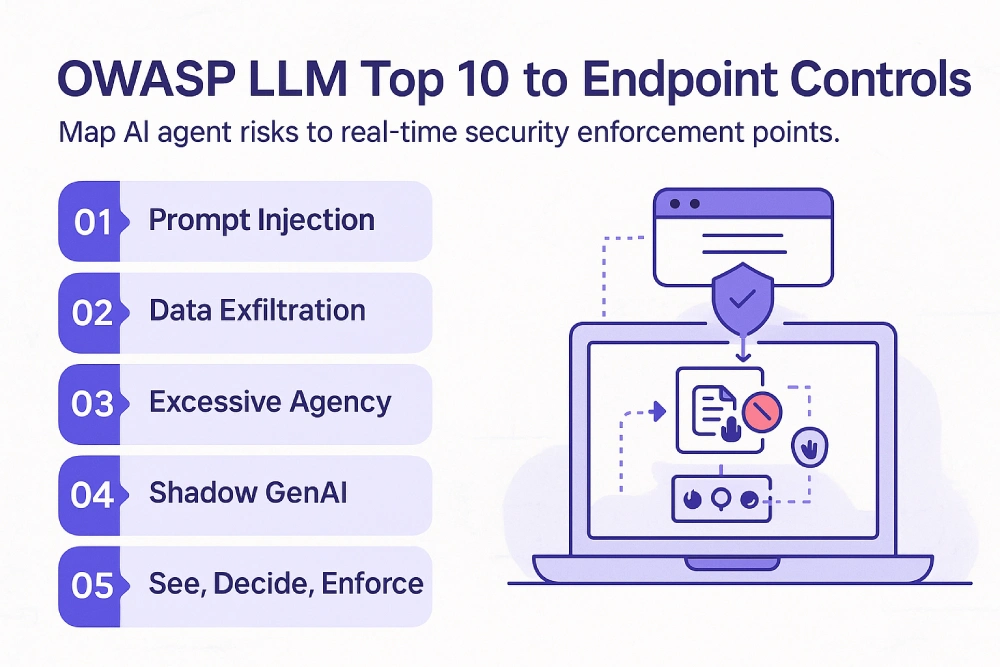
Building on the framework above, the harder question is not what the risks are but where on the endpoint each risk becomes detectable and stoppable. The table below maps the most operationally relevant OWASP LLM risks to specific endpoint controls [aembit.io][docs.modulos.ai][elevateconsult.com].
OWASP LLM Risk | What Happens at the Endpoint | Endpoint Control Required |
|---|---|---|
LLM01: Prompt Injection | Malicious content in a file or webpage hijacks agent instructions | Process and clipboard monitoring; inspect data entering AI prompts |
LLM02: Sensitive Information Disclosure | Agent reads and exfiltrates PII, credentials, or IP via prompt | Data classification; outbound DLP on GenAI channels |
LLM06: Excessive Agency | Agent takes actions beyond its intended scope | Least-privilege process controls; behavioral anomaly detection |
LLM08: Vector and Embedding Weaknesses | Poisoned context manipulates agent reasoning | Data lineage tracking; source verification controls |
LLM09: Misinformation | Agent outputs untrusted data that gets stored or shared | GenAI output monitoring and SaaS controls |
LLM10: Unbounded Consumption | Agent makes uncontrolled external API calls | Network filtering and egress controls on AI service endpoints |
Each of these risks becomes real at the moment an agent touches data on a device. That is the moment a control must fire.
What Makes Prompt Injection Particularly Dangerous in Agentic Workflows?
Prompt injection is ranked first in the OWASP LLM Top 10 for good reason [aembit.io]. In agentic workflows, a compromised prompt does not just return a bad answer. It can redirect the agent to read additional files, exfiltrate content to an attacker-controlled endpoint, or escalate its own permissions [idanhabler.medium.com]. This is not a theoretical risk. Any agent with access to user documents, browser history, or clipboard content can be manipulated by content embedded in those sources.
The endpoint control required here is not signature-based detection. It is behavioral. A security agent needs to observe what process is reading what data, what that data is being combined with, and where the resulting output is going. This is precisely the “See, Decide, Enforce” model: observe the agent’s behavior continuously, evaluate the context of each action, and enforce a block or alert before data leaves the device.
Why Do Legacy Tools Fail Against Agentic AI Security Risks?
Stepping back from the technical detail, a separate concern is why existing tools leave organizations exposed. Legacy endpoint tools were designed to detect malicious executables. Network inspection tools were designed to catch known bad traffic. Static DLP rules were designed around human-speed data movement and predictable transfer patterns. None of these architectures were designed to handle an AI agent that legitimately has access to sensitive data and can move it through a sanctioned channel like a browser upload or a GenAI API call [elevateconsult.com].
Vendors like Cyberhaven bring strong data lineage tracking. Nightfall focuses on SaaS and cloud API-level detection. Netskope and Zscaler inspect traffic at the network layer through their SSE platforms. These are genuine capabilities, but they each operate at a distance from the endpoint action itself. By the time a network tool sees the traffic, or a SaaS API scanner sees the upload, the data has already left the device.
What LLM Security Best Practices Should Endpoint Teams Apply Right Now?
Applying LLM security best practices at the endpoint does not require rebuilding the security stack. It requires repositioning the enforcement point. Practically, this means:
- Classify data before agents touch it. Context-aware classification that understands document type and content, not just file extension or regex patterns, is essential for catching sensitive data that agents process.
- Monitor AI process behavior, not just network traffic. Which processes are spawning AI agent sessions? What files are they reading? What is being placed on the clipboard?
Apply outbound controls to GenAI channels specifically. Browser-based GenAI tools like ChatGPT, Copilot, and Claude receive data through upload and prompt fields, not traditional file transfer paths. - Enforce least privilege on agentic workflows. An AI coding agent does not need access to customer records. Scope your controls to what each agent type legitimately needs [docs.modulos.ai].
- Track data lineage continuously. When sensitive data moves from a local file into a prompt and then into a SaaS platform, the full chain must be visible, not just the final destination.
- Treat shadow GenAI as an insider risk vector. Employees using unsanctioned AI tools represent one of the highest-probability exfiltration paths today.
About Kitecyber
Kitecyber is a next-generation cybersecurity company that puts data security at the endpoint, where AI agents, users, and sensitive data actually interact. Its single lightweight agent unifies endpoint DLP, AI agent security controls, and network protections including Secure Web Gateway, zero-trust network access, and unified device management into one platform that operates on a continuous See, Decide, Enforce model. Rather than stitching together fragmented point solutions, Kitecyber gives security teams real-time enforcement at the exact point of risk, with full context of who is acting, on what data, and where it is going. For organizations navigating the OWASP LLM Top 10 and building secure agentic workflows, Kitecyber provides the controls to innovate with confidence.
Ready to map your AI agent risk exposure to real endpoint controls? Visit kitecyber.com to explore how Kitecyber enforces data security at the point where AI agents and sensitive data meet.
References
- OWASP Top 10 for Large Language Model Applications | OWASP Foundation (owasp.org)
- OWASP Top 10 for LLM Applications (2025) (aembit.io)
- Demystifying the OWASP Top 10 for Agentic Applications | by Idan Habler | Medium (idanhabler.medium.com)
- OWASP Top 10 for Agentic Applications (2026) – Modulos Governance Guide | Modulos Docs (docs.modulos.ai)
- OWASP LLM Top 10: AI Security Risks to Know in 2026 (elevateconsult.com)
Frequently Asked Questions
It is a framework maintained by OWASP that lists the ten most critical security vulnerabilities in LLM-based applications, covering risks from prompt injection to model theft [owasp.org][aembit.io].
Prompt injection, excessive agency, and sensitive information disclosure are consistently ranked as the highest-priority risks for autonomous AI agents operating with tool access [docs.modulos.ai][elevateconsult.com].
Legacy DLP tools enforce static policies and were not designed to observe AI agent behavior in real time. They miss exfiltration that occurs through sanctioned GenAI channels and browser-based uploads.
It refers to an AI agent taking actions beyond its intended scope, such as reading files it should not access or making external API calls without authorization [docs.modulos.ai].
The endpoint is the right enforcement point because that is where agent actions touch real data. Network-level controls see data only after it has left the device.
Shadow GenAI refers to employees using unsanctioned AI tools outside IT visibility. Sensitive data entered into these tools bypasses all organizational data controls.
Data lineage tracking records the full path of data from its source through every transformation and transfer. This allows security teams to reconstruct exactly how sensitive data reached an AI model or external destination.

Ajay Gulati
Ajay Gulati is a passionate entrepreneur focused on bringing innovative products to market that solve real-world problems with high impact. He is highly skilled in building and leading effective software development teams, driving success through strong leadership and technical expertise. With deep knowledge across multiple domains, including virtualization, networking, storage, cloud environments, and on-premises systems, he excels in product development and troubleshooting. His experience spans global development environments, working across multiple geographies. As the co-founder of Kitecyber, he is dedicated to advancing AI-driven security solutions.