Table Of Content
Related Posts
6 Best DLP Platforms for Telehealth Companies Protecting Patient Video, Chat, and PHI Data in 2026
-
September 15, 2026
-
Quick Answer:
AI Security Posture Management (AISPM), also called AI Posture Management, is the continuous process of discovering, monitoring, and controlling how AI tools, models, and agents interact with your company's data and systems. It covers everything from spotting an unapproved AI app on someone's laptop to blocking a customer record from being pasted into a public chatbot. Most teams that manage AI posture well pair a discovery layer with policy enforcement at the point where employees actually use AI, which is the endpoint.
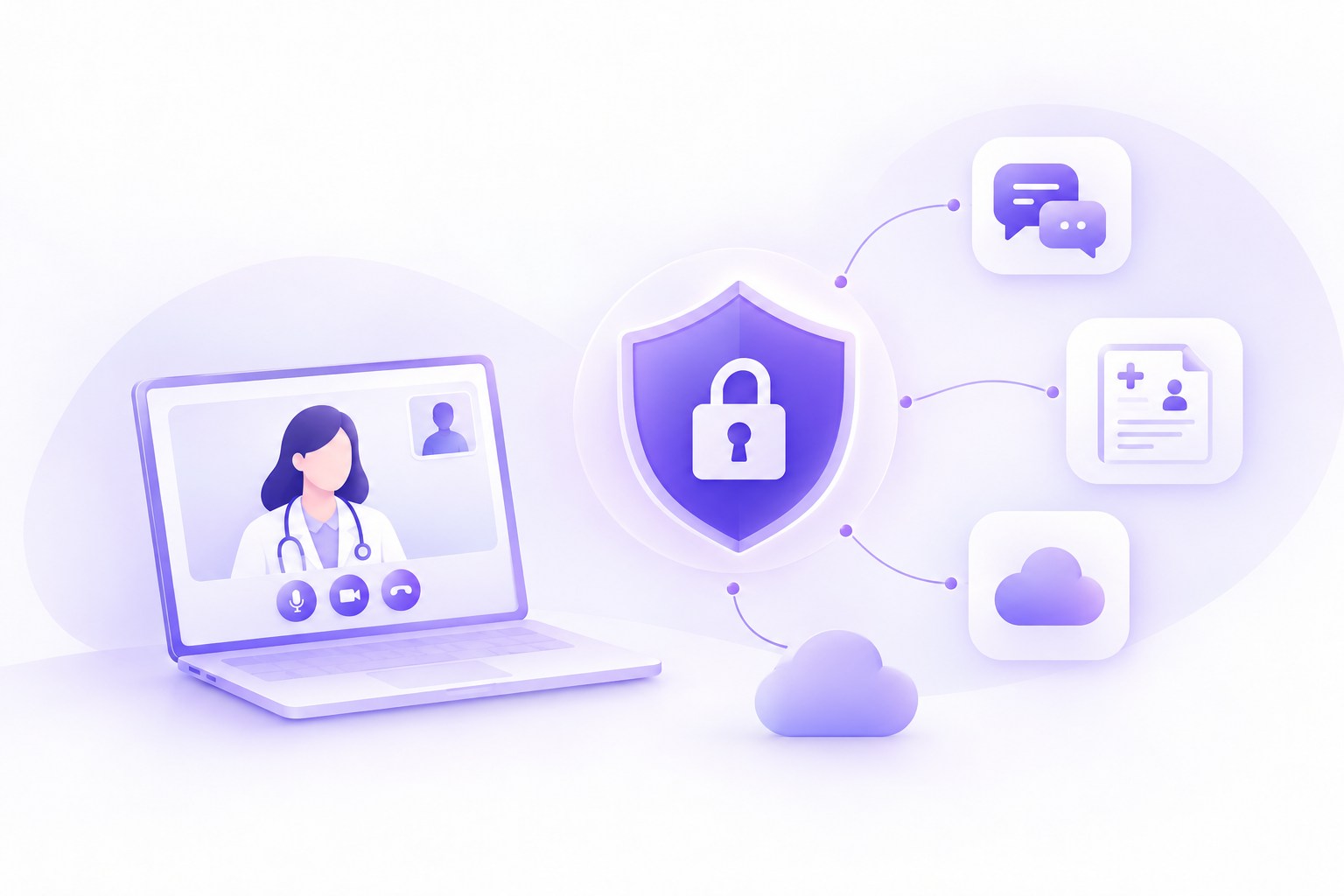
Telehealth companies need data loss prevention (DLP) platforms that protect PHI as it moves through video visits, chat messages, EHR integrations, and increasingly, AI scribes and copilots that sit inside clinical workflows. The best options in 2026 are Kitecyber, Microsoft Purview, Forcepoint, Nightfall, Cyberhaven, and Strac, each with different architectures and tradeoffs for how they capture data at the endpoint versus in the cloud. This guide breaks down what each platform actually does, where it fits, and why endpoint-native enforcement has become the deciding factor for telehealth security teams as AI tools reach directly into patient records.
TL;DR
- Telehealth PHI now moves through video platforms, chat, EHR fields, and AI scribes, expanding the attack surface well past the video call itself.
- HIPAA and HITECH require encryption at rest and in transit, strict access controls, audit logging, and clear business associate liability for any vendor touching PHI.
- Endpoint-native DLP catches data movement that network or API-only tools miss, because clinicians increasingly copy, paste, and upload patient data into apps that never touch a cloud API.
- Kitecyber, Microsoft Purview, Forcepoint, Nightfall, Cyberhaven, and Strac represent the main architectural approaches, from endpoint agents to cloud consoles to API-first redaction.
- The right choice depends on whether your biggest risk is EHR data leaving the endpoint, shadow AI tools, SaaS sprawl, or Microsoft 365 sensitivity labeling.
About the Author: Kitecyber builds endpoint-native DLP for regulated industries, including telehealth and healthcare companies protecting PHI across video, chat, and EHR workflows, and has published detailed comparisons against legacy and cloud DLP vendors used to secure clinical environments.
What Makes DLP Different for Telehealth Companies?
DLP for telehealth is data loss prevention applied to a workflow where the sensitive data isn’t just sitting in a database, it is actively streaming through video, voice, and chat sessions in real time. A traditional DLP deployment protects files and email. A telehealth deployment has to also account for a chat message with a patient’s diagnosis pasted into a support ticket, or an AI scribe summarizing a session and pushing that summary into a third-party tool.
This matters because the regulatory bar is specific. Under the HIPAA Security Rule and HITECH Act, telehealth companies must implement encryption for PHI both at rest and in transit, enforce strict access controls and multi-factor authentication, maintain audit logs, and ensure business associates are directly liable for compliance and breach notifications. A DLP platform that only watches network traffic or only integrates with a handful of SaaS APIs will miss the moment a clinician downloads a patient record to a laptop and uploads it somewhere unapproved. That gap is exactly why the endpoint, not the network perimeter, has become the place telehealth companies need real-time visibility.
Why Has the Endpoint Become the Real Decision Point for PHI Protection?
The endpoint is the device where clinical staff actually work, and it is now the place where PHI moves fastest and least visibly. A few years ago, the biggest PHI leak risk was an unencrypted email or a misconfigured cloud bucket. Today, a clinician’s laptop might have an AI copilot summarizing patient notes, a browser tab open to a consumer chatbot, and a clipboard that just carried a diagnosis from the EHR into a third-party scheduling tool, all within the same five minutes.
This is the mechanism behind the “AI has changed the endpoint threat model” argument that security teams are increasingly making. Network appliances only inspect traffic they can physically see, so encrypted or local operations pass through invisibly. Static-pattern DLP suites catch known formats like a properly structured SSN but miss context, like a paragraph of narrative clinical notes that reads as sensitive to a human but not to a regex rule. API-based tools protect the specific SaaS apps they’re wired into but go dark the moment data leaves through a channel they weren’t built to watch, such as clipboard or a screen share.
Kitecyber’s operating model, “See, Decide, Enforce, continuously,” treats the endpoint as the choke point for all of these paths at once: files, clipboard, browser uploads, email, SaaS and cloud apps, GenAI paste and upload activity, and removable media, through one lightweight agent. For a telehealth company, that means the same policy engine that blocks a PHI file from being copied to an unencrypted USB drive can also stop a clinician from pasting patient notes into an unapproved AI chatbot, because both actions are visible at the point where the data actually moves.
Which DLP Platforms Should Telehealth Companies Actually Evaluate?
Telehealth security teams generally end up comparing six platforms, each representing a distinct architecture rather than a feature checklist. Here’s how they differ in practice.
| Platform | Architecture | Best fit for telehealth |
|---|---|---|
| Kitecyber | Endpoint-native agent covering files, clipboard, browser, email, SaaS, GenAI paste/upload, and removable media. | Companies needing real-time enforcement across clinical devices plus GenAI/shadow AI control, without deploying separate tools. |
| Microsoft Purview | Cloud-native, integrated into Microsoft 365 and Azure. | Telehealth companies already standardized on M365 for clinical documentation and messaging. |
| Forcepoint | Hybrid: cloud or on-premises, with optional network appliances for web/email inspection. | Larger telehealth organizations wanting risk-adaptive protection with the option of on-prem control. |
| Nightfall | Cloud-native, API integrations plus an endpoint agent. | Teams whose PHI risk is concentrated in SaaS and telehealth-specific cloud workflows. |
| Cyberhaven | Cloud console with endpoint agents and browser extensions, tracing data lineage. | Organizations that need to trace exactly how a piece of PHI moved and where it went, not just block it. |
| Strac | Agentless, API-first, cloud-native with inline redaction. | Companies wanting fast SaaS and email coverage without deploying endpoint software. |
Beyond the table, it’s worth being specific about where each of the other five genuinely fits, because the right platform depends far more on your architecture than on a feature count.
Microsoft Purview is the natural starting point for a telehealth company already deep in Microsoft 365, where clinical documentation, email, and Teams messaging all live. Its sensitivity labeling and native integration across Exchange, SharePoint, OneDrive, and Teams are genuinely strong inside that ecosystem. The tradeoff is scope: Purview is not a network DLP tool, and by Microsoft’s own framing its coverage stops at the edge of Microsoft 365, so PHI moving through non-Microsoft SaaS, consumer AI tools, or the clipboard falls outside its native reach. Endpoint and Gen AI coverage also sit behind higher licensing tiers.
Forcepoint suits larger telehealth organizations that want risk-adaptive protection and the option of on-premises control, spanning network, endpoint, and cloud. Its classification library is deep and its behavioral (UEBA) indicators are mature. The cost is operational: Forcepoint’s endpoint and network DLP are distinct products, and its setup and tuning are widely described as complex, often requiring dedicated specialists to run well.
Nightfall is a good fit when your PHI risk is concentrated in SaaS and cloud workflows rather than on the device itself. Its AI-native detection and inline controls are built for SaaS and telehealth-specific cloud apps, with an endpoint agent to extend coverage. Teams whose clinicians live mostly in a handful of cloud tools will get value quickly; teams worried about local clipboard, screen-share, and offline paths will want to confirm how far the agent reaches.
Cyberhaven is the platform to look at when your core requirement is knowing exactly how a piece of PHI moved and where it went, not just blocking it. Its data detection and response model traces data lineage across endpoints and cloud environments, which is powerful for investigations and for distinguishing a routine clinical workflow from an actual leak. Full lineage depends on deploying its agents and browser extensions across the devices and browsers involved.
Strac fits companies that want fast SaaS and email coverage without deploying endpoint software at all. Its agentless, API-first model with OCR and inline redaction can stand up quickly and is attractive to smaller or cloud-first telehealth teams. The flip side of agentless is that anything happening off the API path, on the local device, is outside its view.
How Does Kitecyber Compare on PHI-Specific Workflows?
Kitecyber’s advantage for telehealth specifically comes from combining endpoint coverage with context-aware classification, meaning it reads document context rather than relying on pattern matching alone. That distinction matters for clinical data, where a chat message discussing “the patient’s A1C trending up” doesn’t look like a Social Security number or credit card pattern, but is clearly PHI to a system that understands clinical context.
Kitecyber also maintains real-time data lineage, tracking where a piece of sensitive data originated and everywhere it has traveled since. Cyberhaven’s data detection and response model traces data lineage across endpoints and cloud environments to prevent exfiltration, which is a similar underlying concept: knowing the history of a piece of data is what lets a security team distinguish a routine clinical workflow from an actual leak. The difference is where enforcement happens. Kitecyber enforces at the endpoint agent across files, clipboard, browser, and GenAI paste and upload activity in one deployment, while Cyberhaven’s full lineage capture depends on agent or extension deployment across the devices and browsers involved.
For telehealth companies specifically weighing GenAI risk, this matters because clinical staff experimenting with AI scribes or drafting tools are a growing source of shadow AI exposure. Kitecyber discovers shadow GenAI usage across the organization and tracks sensitive data as it is pasted or uploaded into GenAI tools, so it can block PHI before it leaves the device, rather than only logging that it happened after the fact. Rather than reading or logging the full text of a prompt, it classifies the actual data in the paste or upload payload and enforces policy at that moment.
What About Compliance Frameworks Beyond HIPAA?
HIPAA is the floor, not the ceiling, for most telehealth companies operating in 2026. Beyond HIPAA, telehealth companies must often comply with the HITRUST Common Security Framework (CSF) for certifiable security controls, state privacy laws like the CCPA/CPRA, and other standards such as SOC 2 Type II, GDPR, NIST CSF 2.0, and 42 CFR Part 2. Each of these adds its own audit trail, consent, and access control requirements on top of PHI-specific rules.
This is where the architecture choice compounds. A telehealth company juggling HIPAA, SOC 2, and HITRUST simultaneously benefits from a platform whose scope naturally overlaps multiple frameworks. Kitecyber’s single agent delivers DLP alongside secure web gateway, SaaS app protection, zero trust network access, and device management capabilities, which helps address a broader set of SOC 2 and HIPAA technical safeguard controls through one deployment rather than combining multiple point products. As with any tool, the platform supports these controls; compliance itself still depends on how an organization configures, operates, and documents its program.
What Should a Telehealth Company Look for in EHR and Video Data Protection?
Electronic health record security is the anchor requirement, since almost every telehealth workflow eventually writes back to or pulls from the EHR. Look for a DLP platform that can classify data leaving the EHR by context (not just format), enforce policy at the moment a clinician tries to copy, download, or share that data, and log the full chain of custody for audit purposes. Video and chat protection follow the same principle: encryption in transit is table stakes, but the harder problem is stopping a clinician from screen-sharing a patient chart into an unapproved tool or pasting session notes into a consumer chatbot after the call ends.
A useful mental model here: think of PHI like a patient walking through a hospital. The building’s front door (network perimeter) matters, but a security team that only watches the front door has no idea what happens once the patient is inside, moving between rooms, being handed between staff. Endpoint-native DLP is the equivalent of tracking the patient’s chart at every handoff, not just checking IDs at the entrance.
About Kitecyber
Kitecyber is a data loss prevention company built for the GenAI era, giving security and IT teams real-time visibility and control over sensitive data at the endpoint, where clinical work actually happens. Its single lightweight agent covers files, clipboard, browser uploads, email, SaaS and cloud apps, GenAI paste and upload activity, and removable media across Windows, macOS, and native Linux. For telehealth companies, that means one deployment can help address PHI protection, shadow AI discovery, and a broader set of HIPAA and SOC 2 technical controls without stacking multiple point products. Kitecyber offers a free trial and self-serve signup for teams that want to evaluate endpoint-native DLP for their clinical workflows.
See verified customer reviews of Kitecyber on G2 and SourceForge.
References
Frequently Asked Questions
Zoom for Healthcare is commonly listed among approved telehealth video platforms, alongside Doxy.me, Teladoc, and Amwell, distinct from consumer Zoom, FaceTime, or Google Meet, which are not approved for PHI. A signed business associate agreement and correct configuration are still required regardless of platform.
Yes. Video platform compliance covers the call itself, encryption and access controls for that specific tool, but PHI moves well beyond the video session, into chat, EHR fields, clipboard, and AI tools that a video vendor's compliance posture doesn't touch.
Encryption protects data at rest and in transit so it can't be read if intercepted. DLP decides whether that data should move at all, and to where, which is a separate and necessary control under HIPAA and HITECH.
Yes, if clinical staff paste patient data into AI tools without organizational visibility or control, which is the shadow GenAI risk that endpoint-native DLP is built to detect and stop.
Not necessarily. Several platforms, including Nightfall, Strac, and Cyberhaven, operate without on-premises network appliances, relying instead on cloud consoles, endpoint agents, or API integrations.
HITRUST CSF, SOC 2 Type II, state privacy laws like CCPA/CPRA, GDPR for international patients, NIST CSF 2.0, and 42 CFR Part 2 for substance use disorder records are all common additional requirements.

Ajay Gulati
Ajay Gulati is a passionate entrepreneur focused on bringing innovative products to market that solve real-world problems with high impact. He is highly skilled in building and leading effective software development teams, driving success through strong leadership and technical expertise. With deep knowledge across multiple domains, including virtualization, networking, storage, cloud environments, and on-premises systems, he excels in product development and troubleshooting. His experience spans global development environments, working across multiple geographies. As the co-founder of Kitecyber, he is dedicated to advancing AI-driven security solutions.