Table Of Content
Related Posts


Fractional CISO vs. Endpoint-Native Platform: Two Paths to SMB Security Maturity Compared
-
August 18, 2026
-
Quick Answer:
AI Security Posture Management (AISPM), also called AI Posture Management, is the continuous process of discovering, monitoring, and controlling how AI tools, models, and agents interact with your company's data and systems. It covers everything from spotting an unapproved AI app on someone's laptop to blocking a customer record from being pasted into a public chatbot. Most teams that manage AI posture well pair a discovery layer with policy enforcement at the point where employees actually use AI, which is the endpoint.
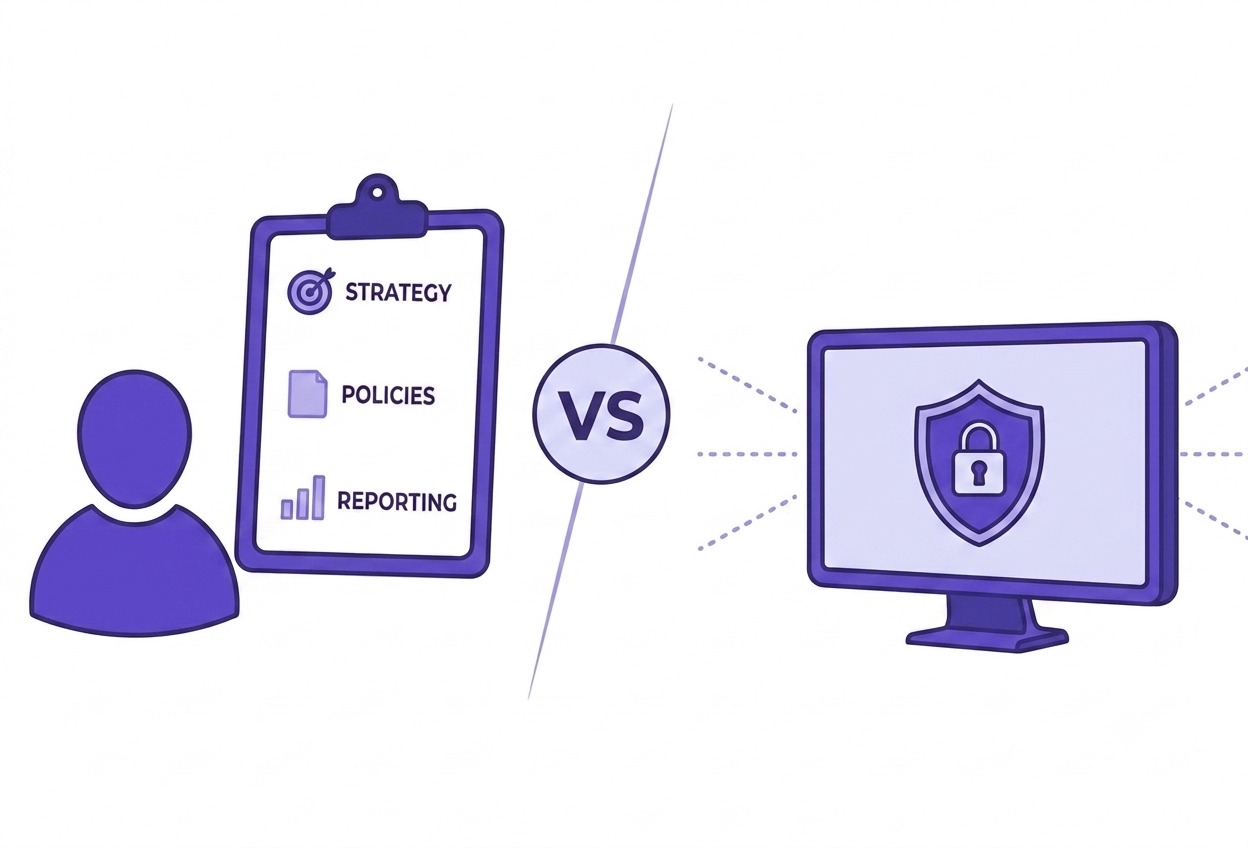
Small and mid-sized businesses generally have two ways to build security maturity fast: hire a fractional CISO to set strategy and governance, or deploy an endpoint-native platform to enforce protection directly on devices as data moves. A fractional CISO costs roughly $3,000 to $20,000 per month and can be engaged within days, giving you leadership and a risk-prioritized roadmap without a full-time executive salary [tysonmartin.com][discovercybersolutions.com]. An endpoint-native platform takes weeks to deploy depending on organization size, giving you continuous, automated enforcement across devices, browsers, and SaaS apps. Most SMBs that reach real maturity end up using both, but understanding what each one actually does, and does not do, determines whether you spend the next year fixing gaps or closing them.
TL;DR
- A fractional CISO provides part-time executive leadership: risk prioritization, policy, audit readiness, and board reporting. It does not enforce controls on a device.
- An endpoint-native platform provides continuous, automated enforcement of data security controls at the point where employees and AI tools touch sensitive data.
- AI copilots and agents changed the math: data exfiltration that once took weeks can now happen in minutes, which shifts the priority toward real-time enforcement over quarterly reviews.
- The strongest maturity path pairs governance (fractional CISO) with enforcement (endpoint-native platform) rather than treating them as competing options.
About the Author: Kitecyber is an endpoint-native data security company built for the AI agent era, helping SMBs and technology companies including DuploCloud, Vanta, Scrut Automation, and Sarvam consolidate endpoint DLP, GenAI security, and compliance automation into a single lightweight agent. This piece draws on Kitecyber’s work helping resource-constrained security teams cover the gap between strategic planning and real-time enforcement.
What Is a Fractional CISO and What Problem Does It Solve?
A fractional CISO is a part-time, contracted security executive who sets direction, prioritizes risk, and builds a security operating model for organizations that cannot justify a full-time Chief Information Security Officer [tysonmartin.com]. The role is advisory and structural: writing policy, running risk assessments, mapping controls to frameworks like SOC 2 or HIPAA, preparing for audits, and reporting risk posture to the board or investors [tysonmartin.com][discovercybersolutions.com].
This matters most in the earliest stage of security maturity, when a company has no formal program at all. Cyber Defense Magazine notes that a fractional CISO helps ensure platforms stay current and that onsite and offshore teams operate securely, filling a leadership gap rather than a technical one [cyberdefensemagazine.com]. Zip Security’s tactical guidance for small and mid-sized organizations frames this as the first step in a three-step maturity path: get executive direction before you invest in tooling [zipsec.com].
What a fractional CISO typically does not do is sit on your endpoints enforcing policy in real time. They set the rules of the game. Someone or something else has to referee it every second employees are working.
What Is an Endpoint-Native Platform and How Does It Differ?
An endpoint-native platform is software that observes, evaluates, and controls data movement and user activity directly on the device, rather than inspecting traffic at a network perimeter or relying on periodic audits. This is the architectural pivot that matters for AI-era security: the endpoint is the decision point where sensitive data changes hands, whether that’s a file copied to clipboard, a prompt pasted into an LLM, or an autonomous agent pulling records from a SaaS app on a user’s behalf.
Traditional network DLP relies on static rules inspecting data in transit at the perimeter, but it misses encrypted or off-network traffic entirely [blog.cyberadvisors.com]. Endpoint DLP instead monitors local device actions like copy and paste directly, and AI-native approaches add machine learning for context-aware classification and dynamic data lineage tracking across SaaS environments [blog.cyberadvisors.com]. Leading endpoint DLP platforms use lightweight agents and browser extensions to catch sensitive data pasted into tools like ChatGPT or Claude, track data lineage in real time, monitor SaaS activity via API, and automatically block unauthorized uploads [blog.cyberadvisors.com].
Kitecyber operates on this model directly: See, Decide, Enforce, continuously. One lightweight agent observes endpoint posture, browser behavior, data movement, SaaS access, AI interactions, and private app sessions. It evaluates each action in context (who is acting, what device, what data, where it’s headed), then enforces the right response, whether that’s allow, block, warn, coach, log, or isolate, at the exact moment risk appears.
Why Has AI Changed Which Path Matters More?
AI has made real-time enforcement critical to security maturity. AI agents operate at machine speed, and documented cases show dwell time for data exfiltration compressed from weeks to minutes, with autonomous agents scanning endpoints, stealing credentials, exfiltrating data, and even drafting ransom notes without human involvement [blog.cyberadvisors.com].
Think of it like the difference between a building’s fire code and its sprinkler system. A fractional CISO writes the fire code: what materials are allowed, where exits must be, how often drills happen. That code doesn’t stop a fire once it starts. You need something physically present, at the point of ignition, that reacts in the same second the fire begins. That’s what an endpoint-native platform does for data: it’s the sprinkler system sitting at the point of risk, not the policy document describing what should happen.
This is precisely the gap legacy tools weren’t built to close. Endpoint tools historically hunted malware. Network tools inspected traffic. Static DLP enforced fixed rules. VPNs trusted the network, not the action. None of them were designed for a world where a copilot can summarize and forward a customer database before a human ever reviews the request.
How Do the Two Paths Compare in Practice?
Building on the mechanism above, the practical comparison comes down to what each path can and cannot do on its own.
| Dimension | Fractional CISO | Endpoint-Native Platform |
|---|---|---|
| Primary function | Strategy, governance, risk prioritization | Real-time enforcement at the point of risk |
| Typical cost | $3,000-$20,000/month [tysonmartin.com] | Varies by organization size and deployment scope [tysonmartin.com] |
| Deployment speed | Days [tysonmartin.com] | Weeks depending on organization size [tysonmartin.com] |
| Coverage | Policy, audit prep, board reporting | Files, clipboard, browser, GenAI prompts, SaaS uploads, removable media |
| Best for | Building a security program from zero | Stopping data leakage as it happens |
| Blind spot | Cannot watch every device action live | Cannot set organizational risk tolerance or negotiate with auditors |
Neither column replaces the other. A fractional CISO without enforcement tooling produces excellent policy documents that nobody’s endpoint actually respects. An endpoint-native platform without governance produces excellent logs that nobody has prioritized into a coherent risk program. Security frameworks guidance for SMB teams describes exactly this: core functions (identify, protect, detect, respond, recover) require both leadership and tooling working together, not one substituting for the other [blog.cisosafe.com].
Where Does Shadow GenAI and Insider Risk Fit Into This Decision?
A related but distinct question is what specifically breaks down without endpoint enforcement, because governance alone leaves this exposed by design. Shadow GenAI, employees using unsanctioned AI tools outside any policy, and insider risk, whether malicious or accidental, both require observation at the point of action to catch. A CISO’s policy can say “no unsanctioned AI tools.” It cannot see the moment an employee pastes a client contract into a personal ChatGPT account.
Kitecyber’s endpoint and network DLP is built to catch exactly this: it discovers and classifies sensitive data using document context in addition to pattern matching, then prevents leakage from clipboard, browser, GenAI prompts, SaaS apps, and removable media, all from the same lightweight agent that also handles zero trust network access, secure web gateway functions, and SaaS app control. That consolidation matters operationally: instead of stitching together separate DLP, ZTNA, and SaaS security posture management tools from vendors like Netskope, Zscaler, Forcepoint, Safetica, or Cyberhaven, teams run one agent with a shared trust engine and no blind spots between products.
How Should an SMB Actually Choose Between the Two?
Stepping back from the comparison, the real decision isn’t binary for most companies past their first year of operation. If you have zero security program, start with a fractional CISO to establish direction, especially if you’re pursuing HIPAA compliance software requirements, SOC 2, or CMMC and need someone to own the audit relationship. Fractional CISO services are widely recommended as the first rung on the maturity ladder for exactly this reason [tysonmartin.com][discovercybersolutions.com][zipsec.com].
Once you have direction, the next investment should go toward enforcement, not more policy. That’s where an endpoint security platform earns its cost: unified endpoint management, real-time data classification software, and compliance automation software running continuously rather than being audited quarterly. Many insurers now also factor real-time enforcement into small business cyber insurance premiums, since demonstrable, continuous controls reduce claim likelihood.
About Kitecyber
Kitecyber is a data security company headquartered in the Bay Area that puts protection at the endpoint, where sensitive data actually moves: files, clipboard, browser uploads, GenAI prompts, SaaS apps, and autonomous AI agents acting on a user’s behalf. Its single lightweight agent runs on the See, Decide, Enforce model, continuously observing activity, evaluating context, and enforcing the right action at the point of risk. Around that data-security core, Kitecyber unifies zero trust network access, secure web gateway protection, SaaS app control, and unified endpoint management, replacing fragmented point solutions with one platform. Technology companies including DuploCloud, Vanta, Sarvam, and Scrut Automation use Kitecyber to adopt AI with confidence while meeting compliance frameworks like HIPAA, SOC 2, and CMMC.
If you’re weighing governance against enforcement, or trying to figure out where your current stack leaves gaps at the endpoint, visit Kitecyber to see how a single agent can close that gap.
References
- Fractional CISO Services for SMBs: A Practical Buyer’s Guide | Tyson Martin (tysonmartin.com)
- Fractional CISO Services for SMBs | Cyber Solutions (discovercybersolutions.com)
- How and When to Know You Need a Fractional CISO – Cyber Defense Magazine (cyberdefensemagazine.com)
- The 3-Step Path to Security Maturity | Zip Security (zipsec.com)
- Security Frameworks for SMB Firms: A Practical Guide (blog.cisosafe.com)
- Cybersecurity Trends Every SMB Must Prepare For in 2026 (blog.cyberadvisors.com)
Frequently Asked Questions
No. A fractional CISO sets strategy and governance; they don't run continuous, device-level enforcement themselves [tysonmartin.com].
It supports compliance (HIPAA, PCI DSS, SOC 2, GDPR) by enforcing controls and generating audit evidence, but organizations still need someone accountable for interpreting requirements and managing the audit relationship [blog.cisosafe.com].
A fractional CISO can typically start within days. Endpoint platform deployment varies depending on organization size and complexity [tysonmartin.com].
Network DLP inspects traffic in transit at the perimeter using static rules and misses encrypted or off-network activity. Endpoint DLP monitors actions directly on the device, including clipboard and browser activity [blog.cyberadvisors.com].
Because prompts, uploads, and agent actions happen locally before any network request is even made, a control that only watches network traffic never sees the exposure occur [blog.cyberadvisors.com].
Consolidating DLP, ZTNA, secure web gateway, and SaaS control into a single agent removes the coordination gaps that appear when separate tools don't share context, which is the specific advantage of endpoint-native architecture over stitched-together stacks.

Ajay Gulati
Ajay Gulati is a passionate entrepreneur focused on bringing innovative products to market that solve real-world problems with high impact. He is highly skilled in building and leading effective software development teams, driving success through strong leadership and technical expertise. With deep knowledge across multiple domains, including virtualization, networking, storage, cloud environments, and on-premises systems, he excels in product development and troubleshooting. His experience spans global development environments, working across multiple geographies. As the co-founder of Kitecyber, he is dedicated to advancing AI-driven security solutions.