Table Of Content
Related Posts


The Prompt Injection Blind Spot: Why Endpoint Visibility Matters When AI Agents Act on Malicious Instructions
-
August 7, 2026
-
Quick Answer:
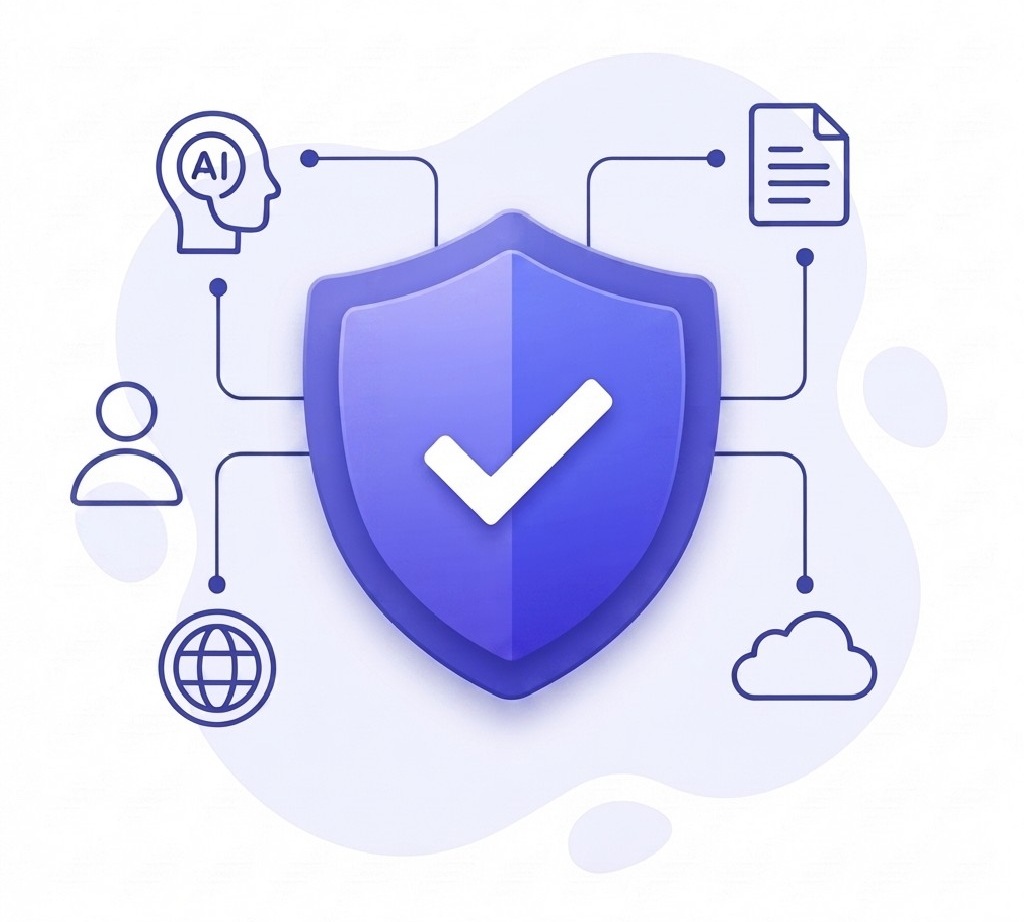
AI Security Posture Management (AISPM), also called AI Posture Management, is the continuous process of discovering, monitoring, and controlling how AI tools, models, and agents interact with your company's data and systems. It covers everything from spotting an unapproved AI app on someone's laptop to blocking a customer record from being pasted into a public chatbot. Most teams that manage AI posture well pair a discovery layer with policy enforcement at the point where employees actually use AI, which is the endpoint.
Prompt injection is an attack where malicious input, hidden in a document, email, web page, or chat message, changes how an AI agent behaves without the user or the agent’s operator ever writing that instruction. OWASP splits this into two categories: direct injections that override system instructions outright, and indirect injections buried inside external content the agent reads, like a PDF, a support ticket, or a webpage the agent visits on your behalf [crowdstrike.com]. Once an agent absorbs a hostile instruction, it can act on it with the same permissions it already holds, and it can do so in milliseconds, long before a security team notices. The only place that action becomes visible before damage is done is the endpoint, because that’s where the agent reads files, touches the clipboard, and pushes data to a browser tab or SaaS upload. Network tools see traffic. Endpoint DLP software sees the data itself.
TL;DR
- Prompt injection attacks manipulate AI agents into leaking data or taking unauthorized actions, using instructions hidden in documents, web pages, or other content the agent processes[crowdstrike.com] [atlan.com].
- Agents can exfiltrate sensitive data and fire off thousands of API calls before a human analyst ever sees an alert, which makes speed, not just detection, the core security problem.
- GDPR, HIPAA, SOC 2, and the EU AI Act were not written with multi-agent systems in mind, leaving a real compliance gap for anyone deploying autonomous agents today.
- Endpoint DLP and AI agent security close the visibility gap that network inspection, static DLP, and identity checks alone cannot cover, because they observe the action at the moment it happens.
- Kitecyber's "See, Decide, Enforce" model gives security teams real-time enforcement at the point of risk, using one lightweight agent instead of a stack of disconnected tools.
About the Author: This article is written from Kitecyber’s engineering and threat-research perspective as an endpoint-native data security vendor built specifically for the AI agent era, working with AI-native companies such as DuploCloud, Lily AI, Sarvam, and Vanta on securing agentic workflows and shadow GenAI use at the endpoint.
What Is Prompt Injection and Why Does It Bypass Traditional Security?
Prompt injection is a manipulation technique that exploits the fact that large language models cannot reliably distinguish between developer instructions and untrusted input they process at runtime [crowdstrike.com]. NIST’s adversarial machine learning taxonomy classifies it under three categories of harm: availability violations, integrity violations,and misuse violations[crowdstrike.com]. In practice, an attacker doesn’t need to breach your network or steal a credential. They just need to plant text somewhere an AI agent will read it: a calendar invite, a customer support message, a shared document, a webpage the agent is asked to summarize.This is exactly why network-centric tools miss it. A firewall inspects packets. A SIEM correlates logs. Neither one is positioned to notice that an AI agent, acting with legitimate credentials on a legitimate device, just read a poisoned instruction and decided to forward a customer database to an external address. The traffic looks normal because, technically, it is. The agent is authorized. The account is authorized. The only thing wrong is the intent behind the action, and intent only becomes visible at the point where the agent touches data.
Why Do AI Agents Create Blind Spots That EDR and SIEM Tools Miss?
Endpoint detection and response tools are built to catch malware signatures, anomalous process behavior, and known attack patterns, not to interpret whether an AI agent’s data access request is legitimate or the product of a manipulated prompt. Security teams researching this problem have identified seven distinct blind spots where EDR, SIEM, XDR, DLP, and identity platforms struggle to account for autonomous AI behavior [securityinfowatch.com]. The common thread across all seven is that these tools were designed to answer “is this process malicious” or “is this login anomalous,” not “is this AI agent about to move sensitive data somewhere it shouldn’t.”
A related but distinct problem is memory. Prompt security controls, the filters that inspect what goes into and out of a model, do not provide visibility into how an AI agent uses memory across a session or a workflow [zenity.io]. An agent might be manipulated early in a multi-step task, then execute the malicious instruction several steps later, after the injection point has scrolled out of any single log entry a security tool would flag. Runtime observability researchers draw a useful distinction here: an AI bill of materials tells you what an agent has access to, while behavioral visibility tells you what it’s actually doing with that access [armosec.io].Access mapping is necessary. It’s not sufficient. You need to watch the action itself.
How Fast Can a Manipulated AI Agent Actually Cause Damage?
Speed is the variable that breaks the human-in-the-loop assumption most security programs still rely on. AI agents can exfiltrate data in milliseconds and execute thousands of API calls before a human analyst even receives an alert, which means machine-speed execution routinely outpaces human detection capabilities built around review-and-respond workflows.
Think of it like the difference between a leaky faucet and a burst pipe. A slow insider threat, someone quietly copying files over weeks, gives a security team time to notice the pattern and intervene. A manipulated agent is the burst pipe: the damage is done in the time it takes to notice water on the floor. Detection that arrives after the fact is not protection, it’s documentation. That’s why the security model has to shift from reactive alerting toward real-time enforcement at the point of risk, meaning the control has to sit at the endpoint, evaluate the action as it happens, and block or allow it before the data leaves.
What Attack Vectors Should Security Teams Actually Prepare For?
Direct injection and indirect injection are the two documented categories, but they manifest differently depending on what the agent is authorized to touch [crowdstrike.com]. A well-documented example involves attackers crafting prompts that instruct an agent to expose server ports to the internet or leak access tokens to external destinations [atlan.com]. Other researched blind spots include agents with excessive standing permissions, agents that chain tool calls in ways no single log captures, and agents operating across SaaS boundaries where no single tool has full visibility [appsecengineer.com][securityinfowatch.com].
| Attack Surface | Mechanism | Where Visibility Needs to Exist |
|---|---|---|
| Document/Webpage Content |
Indirect injection hidden in external data the agent reads
crowdstrike.com |
Endpoint, when the agent opens the file or page |
| Multi-Step Agent Memory |
Malicious instruction executed across multiple steps
zenity.io |
Continuous session monitoring, not single-event logging |
| Tool/API Chaining |
Agent calls external services based on manipulated instructions
atlan.com |
Endpoint DLP tracking data lineage across the chain |
| SaaS & Browser Uploads | Agent copies data into an unsanctioned app or clipboard | Endpoint, at the moment of upload or copy |
Why Is Endpoint Visibility the Right Layer to Close This Gap?
Building on the attack surfaces above, the practical question is where enforcement should live, and the answer is the endpoint, because that’s the one layer that sits between every agent action and the data itself. The endpoint is where the file gets opened, where the clipboard gets used, where the browser tab receives an upload, and where the GenAI prompt gets typed or generated. Network inspection sees traffic after the decision has already been made. Static DLP enforces fixed policies that don’t understand context like which agent is acting or what document lineage looks like. Legacy VPNs trust the network, not the action.
This is the specific gap Kitecyber’s architecture is built to close. Its data security core, endpoint and network DLP, tracks data lineage in real time across files, clipboard, browser activity, GenAI prompts, SaaS apps, and removable media, classifying data by document context rather than pattern matching alone. Enforcement follows a continuous loop: See, Decide, Enforce. The endpoint-native agent observes activity, evaluates it in context, who is acting, what device, what data, where it’s headed, and enforces the appropriate response, whether that’s allow, block, warn, coach, log, or isolate, at the exact moment the action occurs. That model is a direct answer to the speed problem: enforcement that happens after the fact doesn’t help when the exfiltration completes in milliseconds.
What Does the Compliance Gap Mean for Regulated Organizations?
A separate but related concern is regulatory exposure. Major frameworks including GDPR, HIPAA, SOC 2, and the EU AI Act do not explicitly address the data handling requirements or prompt injection risks specific to multi-agent systems, which leaves organizations deploying autonomous agents with a genuine compliance gap rather than a checklist they can simply follow. Organizations under HIPAA DLP, GDPR compliance software requirements, FINRA, CMMC, or PCI DSS obligations can’t wait for regulators to catch up; they need data classification software and insider risk management practices that hold up under audit today, regardless of whether a specific clause mentions AI agents by name.
How Widespread Is This Problem Right Now?
Scale matters here too. Enterprise adoption of endpoint AI agents grew by more than 500 percent year-over-year, with roughly 80 percent of Fortune 500 organizations now deploying them. Despite that pace of adoption, 94 percent of organizations report gaps in visibility into AI activity on their own endpoints. That gap between adoption speed and visibility is precisely where shadow GenAI use and unmonitored agentic workflows accumulate, quietly, until an incident forces the issue.
How Should Security Teams Build Endpoint Visibility Into Their AI Agent Strategy?
Practical steps worth prioritizing:
- Inventory every agent with data access. You can't protect what you haven't mapped, including copilots embedded in SaaS tools your team adopted without a formal review.
- Classify sensitive data by context,not just pattern. Regex-based DLP misses documents that don't match a known pattern but are still sensitive in context.
- Move enforcement to the point of action. Real-time enforcement at the endpoint catches the exfiltration attempt before it leaves the device, not after.
- Implement identity-driven zero trust network access. Evaluate identity, device posture, and least privilege for every session, rather than trusting anything already inside the network perimeter.
- Adopt a unified endpoint agent instead of multiple point tools. Fragmented solutions across DLP, SWG, and UEM create the seams where blind spots hide; consolidation with one endpoint agent removes those seams.
About Kitecyber
Kitecyber is a data security company built around the idea that the endpoint, not the network perimeter, is the real decision point for protecting sensitive data in the AI agent era. Its endpoint-native platform combines endpoint DLP software, AI agent security, secure web gateway, SaaS app protection, zero trust network access, and unified endpoint management into one lightweight agent, replacing the fragmented stacks that leave blind spots between tools. Operating on a continuous See, Decide, Enforce model, Kitecyber gives security and IT teams real-time enforcement at the point of risk across files, clipboard, browser activity, GenAI prompts, and autonomous agent actions. Companies including DuploCloud, Lily AI, Sarvam, and Vanta use Kitecyber to adopt AI with confidence rather than restrict it out of caution.
If prompt injection and agentic workflows are on your risk register this year, contact Kitecyber to learn how endpoint-native data security closes the visibility gap.
References
- Prompt Security Limits in Modern AI Agent Risk (zenity.io)
- 7 Blind Spots AI Agents Create for Security Teams | Security Info Watch (securityinfowatch.com)
- 5 Reasons AI Agents Are a Blind Spot in Your Security Strategy (appsecengineer.com)
- Runtime Observability for AI Agents: See What Your AI … (armosec.io)
- How Prompt Injection Attacks Compromise AI Agents in 2026 (atlan.com)
- What is Prompt Injection? | CrowdStrike (crowdstrike.com)
Frequently Asked Questions
It's a way of hiding instructions inside content an AI agent reads, so the agent follows the attacker's commands instead of, or in addition to, its intended task [crowdstrike.com].
Not on its own. EDR is tuned to detect malware and anomalous processes, not to judge whether an authorized AI agent's action reflects a manipulated instruction [securityinfowatch.com].
Static, pattern-based DLP struggles with agent-driven exfiltration because it wasn't built to track data lineage across GenAI prompts and agentic workflows in real time.
Not explicitly. Neither framework, nor SOC 2 or the EU AI Act, addresses multi-agent data handling risk directly, leaving organizations to build their own controls ahead of regulatory clarity.
Direct injection overrides system instructions outright; indirect injection is embedded in external content like a document or webpage that the agent processes as part of its task [crowdstrike.com].
Because the action, reading the file, copying the clipboard, uploading to a SaaS app, happens at the endpoint. Network monitoring only sees the traffic after the decision is already made.
A manipulated agent acting on a legitimate user's credentials looks similar to insider risk from a monitoring standpoint: authorized access misused. The same real-time behavioral visibility that catches insider risk also catches agent manipulation.

With over a decade of experience steering cybersecurity initiatives, my core competencies lie in network architecture and security, essential in today's digital landscape. At Kitecyber, our mission resonates with my quest to tackle first-order cybersecurity challenges. My commitment to innovation and excellence, coupled with a strategic mindset, empowers our team to safeguard our industry's future against emerging threats.
Since co-founding Kitecyber, my focus has been on assembling a team of adept security researchers to address critical vulnerabilities and enhance our network and user security measures. Utilizing my expertise in the Internet Protocol Suite (TCP/IP) and Cybersecurity, we've championed the development of robust solutions to strengthen cyber defenses and operations.
Posts: 101
With over a decade of experience steering cybersecurity initiatives, my core competencies lie in network architecture and security, essential in today's digital landscape. At Kitecyber, our mission resonates with my quest to tackle first-order cybersecurity challenges. My commitment to innovation and excellence, coupled with a strategic mindset, empowers our team to safeguard our industry's future against emerging threats.
Since co-founding Kitecyber, my focus has been on assembling a team of adept security researchers to address critical vulnerabilities and enhance our network and user security measures. Utilizing my expertise in the Internet Protocol Suite (TCP/IP) and Cybersecurity, we've championed the development of robust solutions to strengthen cyber defenses and operations.
Posts: 101