Are You Stuck in NinjaOne’s Limitations?
NinjaOne is a widely used
Endpoint Management Platform. But is it still enough?
Many IT and security teams feel they’re constantly juggling tools for patching, compliance, and endpoint control, even with NinjaOne in place. And with rising costs, limited built-in security, and scattered visibility, it’s no surprise that companies are searching for a more hyperconverged and unified approach.
Here’s the truth: businesses now want one solution that manages devices, protects data, and scales affordably.
In this list, we’ll dive deep into overview, features, pricing, & G2 reviews so that you can make the best-informed decision when it comes to choosing between NinjaOne alternatives.
Let’s explore.
TL;DR: Hate reading that much? Click on links to navigate faster!
What is NinjaOne?
However, it lacks advanced compliance, user behavior tracking, and modern zero-trust capabilities.
Set up Device Management and Compliance with this NinjaOne Alternative
Businesses of all types and sizes use Kitecyber Device Shield to secure device and achieve compliance.
Why choose Kitecyber?
Why Do Businesses Look for a NinjaOne Alternative?
Businesses are increasingly seeking NinjaOne alternatives due to evolving IT needs, hybrid work, and the shift to BYOD and zero-trust architectures. NinjaOne excels in endpoint monitoring, automated patching, and remote access for MSPs and IT teams. However, its 50-device minimum, limited Linux remote support, steep learning curve, and complex integrations 268 drive many to seek alternatives. The table below summarizes key challenges businesses face with NinjaOne along with key reasons for them to switch to a better NinjaOne Replacement based on recent discussions and reviews on reddit and several other forums like Quora and hackernews.
| Reason for Switching |
NinjaOne Limitation |
Business Impact |
| Integrated Security |
No built-in DLP, ZTNA, or SWG |
Increased risk; extra tools needed |
| Pricing Model (As of 2025) |
Per-endpoint pricing and 50-device minimums strain SMB budgets |
High costs for large or Remote/ BYOD fleets |
| SaaS & User Control |
Limited SaaS app/user behavior controls |
Incomplete risk management |
| AI Risk Insights |
No native AI for risk-based decisions |
Slower threat detection; manual work |
| Compliance Control |
Patch/asset visibility ≠ full compliance |
Gaps in regulatory coverage |
| User Experience |
Lacks PSA, automation, unified workflows |
More manual processes; less efficiency |
| Customer Support |
Mixed reviews on support expertise |
Delays in issue resolution |
| Scalability |
Pricing and features don’t scale well |
Costs rise as business grows |
Top 10 NinjaOne Alternatives for Businesses in 2025
A majority of NinjaOne alternatives shine where it falters: simpler pricing, Linux/macOS configuration feasibility, and minimum operational overhead. While open-source RMMs offer cost freedom, commercial tools like Kitecyber Device Shield deliver faster ROI through automation and support. Before selecting a NinjaOne alternative, consider the benefits of these competitors, which address cross-platform device management through diverse approaches like unified
endpoint management and scalable automation.
1. Kitecyber Device Shield
The most complete replacement for NinjaOne
Overview:
Kitecyber Device Shield unifies
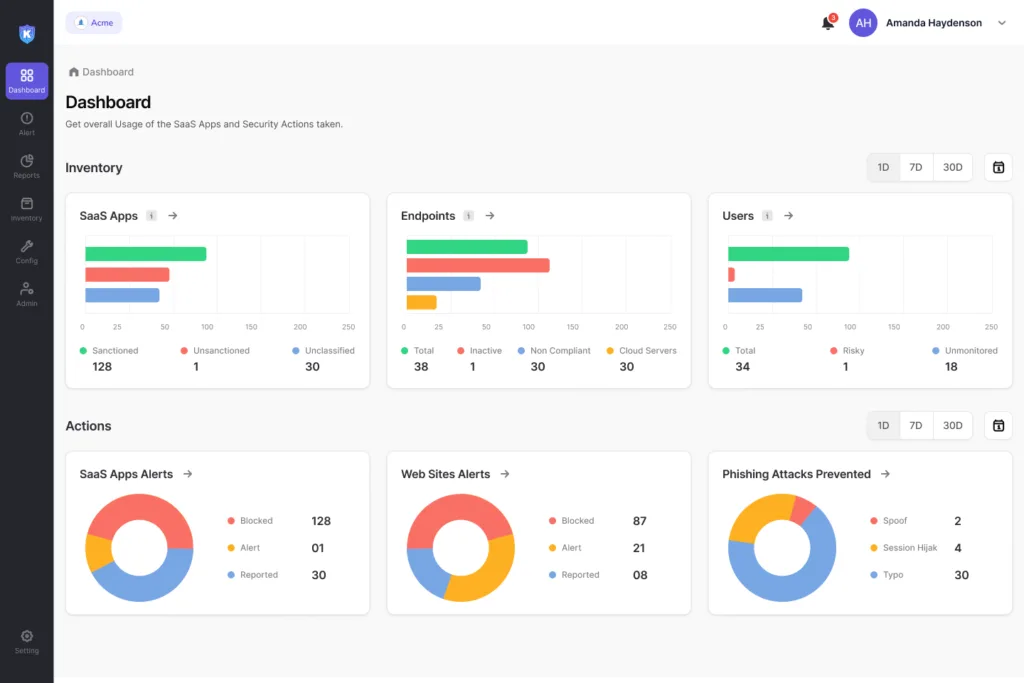
endpoint management, AI-powered risk monitoring, and security in a single console. With user-based pricing, it provides full visibility into device health, compliance status, and user activity. It supports Windows, macOS, and Linux equally and offers fast deployment with minimal setup. Businesses benefit from reduced operational costs, fewer security gaps, and robust compliance readiness.
Key Features:
Pricing:
G2 Rating:
⭐ 4.8/5 — “Unified dashboard, fast support, deep compliance visibility.”
Kitecyber vs NinjaOne - Why Customers Choose Kitecyber?
Customers choose Kitecyber over NinjaOne when they need a unified
endpoint management (UEM) platform that combines enterprise-grade security, automation, and flexibility—far beyond traditional RMM tools. Kitecyber Device Shield brings together device management, ZTNA, SaaS security, and data protection into one powerful solution. It’s purpose-built for organizations that require:
Here’s what Drew Danner, Managing Director at BD Emerson says about our solution:
"Kitecyber has been amazing for our SMB customers, who can now enjoy enterprise grade security with a simple and cost effective solution."
"Instead of dealing with multiple complex solutions, with Kitecyber they can get advanced security with ease using a single copilot”
– Drew Danner
Managing Director at BD Emerson
In summary, Organizations choose Kitecyber Device Shield over NinjaOne when they need more than basic RMM. Kitecyber delivers a unified
endpoint management and security platform with built-in Zero Trust controls, passwordless access, compliance automation, and flexible deployment options. While NinjaOne is well-suited for IT teams looking for remote monitoring and patching tools, it lacks native security controls, forcing customers to rely on third-party integrations for data protection, VPN, and compliance.
| Feature / Aspect |
Kitecyber Device Shield |
NinjaOne |
| Best for |
Unified endpoint management & security with Remote Monitoring & Management, Patch Management, Remote Lock, Reset, & Wipe |
Remote monitoring, patching, and remote access for SMBs and IT teams. |
| Pricing |
Pay-per-user model. Modular pricing based on additional security features like ZTNA, DLP, or SSPM. |
Per-endpoint pricing with a 50-device minimum. Additional costs for integrations (e.g., VPN, MDM). |
| Deployment |
SaaS or self-hosted with a single console. Agent-based Zero Touch |
Cloud-only, managed by NinjaOne. No on-premises deployment. |
| Zero Trust & Security |
Built-in passwordless authentication, device trust scoring, microsegmentation, and AI-driven threat prevention. |
Depends on third-party tools like Microsoft Defender or VPNs for security. Lacks native ZTNA or data protection capabilities. |
| Onboarding & Management |
Zero-touch onboarding in <1 hour, seamless upgrades, and granular device and user policy enforcement. |
Requires agent deployment. Onboarding and policy configuration can be time-consuming at scale. |
| Device Posture Checks |
Yes. Real-time posture assessments, compliance enforcement, and automated remediation workflows. |
Not natively supported. Must integrate with external tools for advanced posture assessments. |
| Integration |
Native integration with SSO, SaaS apps, internet, and private cloud environments. Combines endpoint and network-level visibility. |
Limited SaaS governance. Focused on endpoint-level operations. Relies on APIs and external add-ons for deeper integration. |
| Performance & Scaling |
No device minimums. Designed to scale seamlessly from startups to global enterprises. High-performance edge computing without traffic hairpinning. |
50-device minimum. Scaling beyond SMBs can increase complexity and overhead. |
| Unique Features |
Passwordless security, automated compliance reports (HIPAA, FINRA), ZTNA for all app types, and real-time ransomware blocking. |
Strong patch automation. Offers backup and monitoring, but lacks deep security or compliance capabilities. |
| Support |
Dedicated onboarding, enterprise-grade support, and compliance guidance for SMBs, MSPs, and large enterprises. |
Standard support included. Priority support available on higher-tier plans. |
|
|
|
2. Atera
Best for: All-in-one platform, scalability
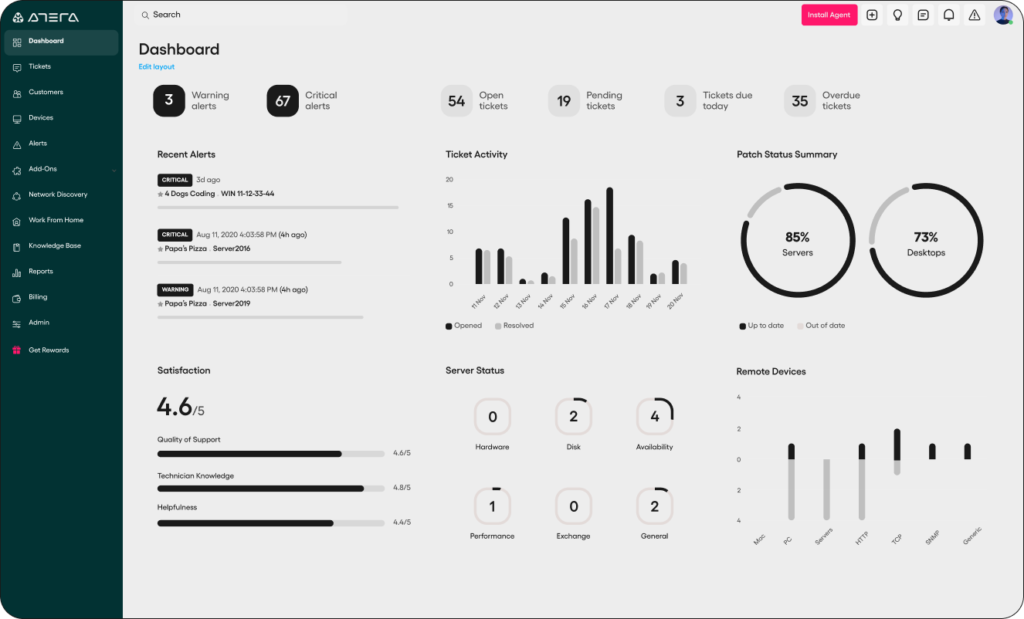
Overview: Atera is one such NinjaOne alternative that offers an all-in-one remote monitoring and management (RMM) and professional services automation (PSA) platform designed for managed service providers (MSPs). It allows unlimited devices per technician, which makes it highly scalable for small IT teams. Atera includes features like patch management, remote access, billing, and helpdesk ticketing. Its cloud-native architecture enables rapid deployment and remote operations. It’s particularly praised for its clean interface and flat-rate pricing model.
Features:
Pricing:
G2 Rating:
⭐ 4.6/5
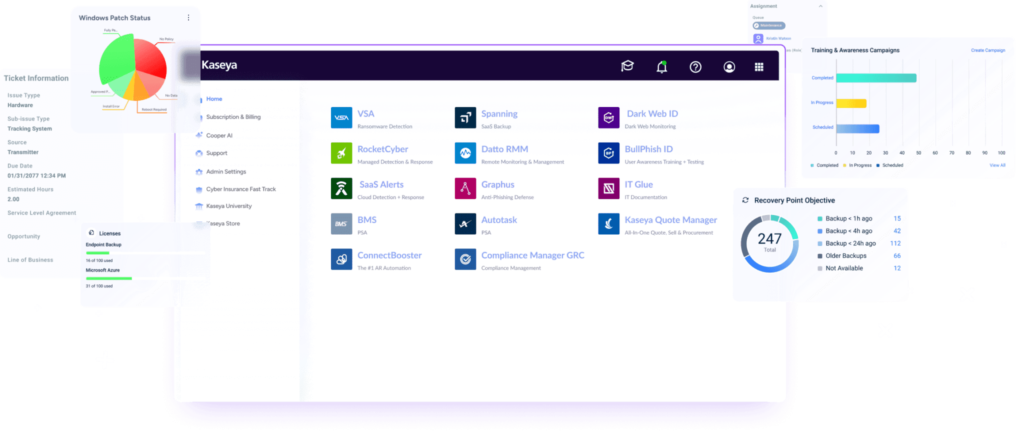
3. Kaseya VSA
Best for: Large teams needing enterprise automation
Overview: Kaseya VSA is a robust RMM and IT automation tool tailored for enterprises with complex IT operations. It enables deep automation,
patch management, remote scripting, and device monitoring at scale. Kaseya’s platform integrates with its broader IT Complete suite, giving users access to security, backup, and service desk tools. However, the tool has a steeper learning curve and may require more onboarding time. It’s best suited for mature IT teams needing granular control.
Features:
Pricing:
G2 Rating:
⭐ 4.0/5
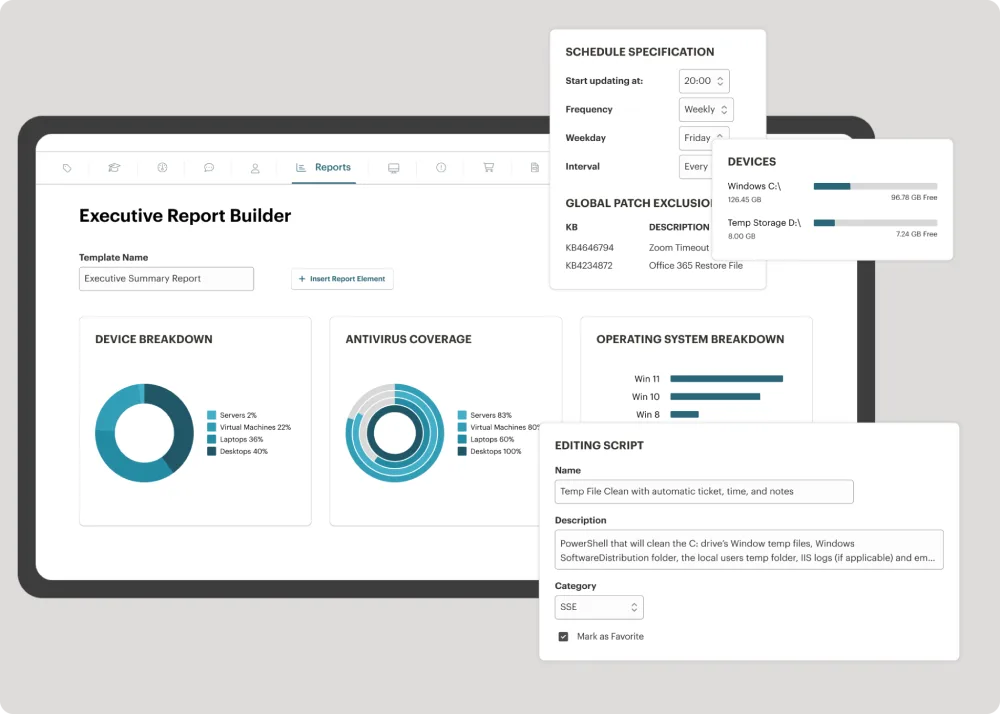
4. ManageEngine Endpoint Central
Best for: SMBs needing flexible patching and automation
Overview: Endpoint Central (formerly Desktop Central) is a comprehensive UEM solution that supports patching, configuration management, software deployment, and remote troubleshooting. It works across Windows, macOS, and Linux, and includes mobile device management as well. Its strengths lie in deep policy enforcement and IT asset control, making it ideal for enterprise settings. Though the UI is dated and support response times can vary, it remains one of the most feature-rich tools at a competitive price point.
Key Capabilities:
Pricing:
G2 Rating:
⭐ 4.4/5 — “Excellent features. UI and support can improve.”
5. Syncro
Best for: SMBs and MSPs needing RMM + business tools
Overview: Syncro is a dual RMM and PSA platform optimized for MSPs and IT departments servicing SMBs. It combines endpoint monitoring, ticketing, invoicing, and customer management in a single interface. Syncro integrates with third-party platforms like QuickBooks, Zapier, and Xero, offering strong business automation capabilities. It’s designed for smaller teams looking to simplify workflows and manage operations efficiently. While not as security-focused as others, it’s highly effective for service-driven teams.
Features:
Pricing:
6. Trio MDM
Best for: SMBs needing multi-OS device management and compliance automation.
Overview: Trio MDM is a cloud-first solution supporting mobile, desktop, and IoT devices. It enforces unified policies across platforms and automates compliance. Real-time monitoring and remote troubleshooting are included. The platform is easy to integrate and quick to onboard. It’s ideal for businesses with diverse device needs.
Features:
Pricing:
G2 Rating:
⭐4.7/5
7. Action1
Best for: SMBs and IT teams seeking free or low-cost patch management and RMM.
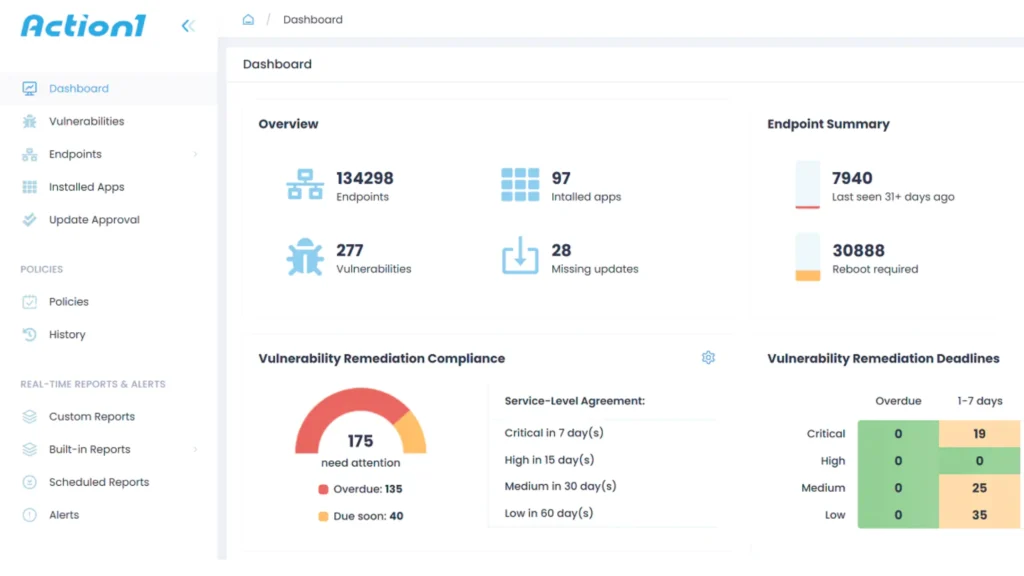
Overview: Action1 is a cloud-based
endpoint security and
patch management platform. It’s free for up to 100 endpoints, making it ideal for small businesses. The solution automates software deployment and updates. Real-time monitoring and compliance are built in. It scales easily as your business grows.
Features:
Pricing:
G2 Rating:
⭐ 4.8/5
8. Domotz
Best for: IT teams and MSPs needing network and IoT device monitoring.
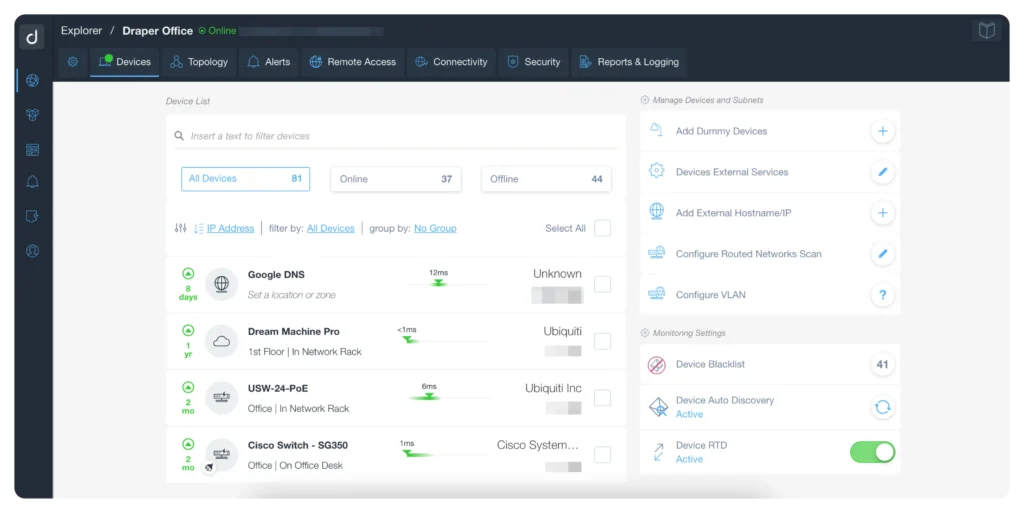
Overview: Domotz is a network monitoring and management platform. It provides real-time alerts and customizable notifications. Deployment is easy and the dashboard is intuitive. It supports SNMP, NetFlow, and remote access. The customer support is highly rated.
Features:
Pricing:
G2 Rating:
⭐ 4.7/5
9. GoTo Resolve
Best for: SMBs needing easy, affordable remote support and IT management.
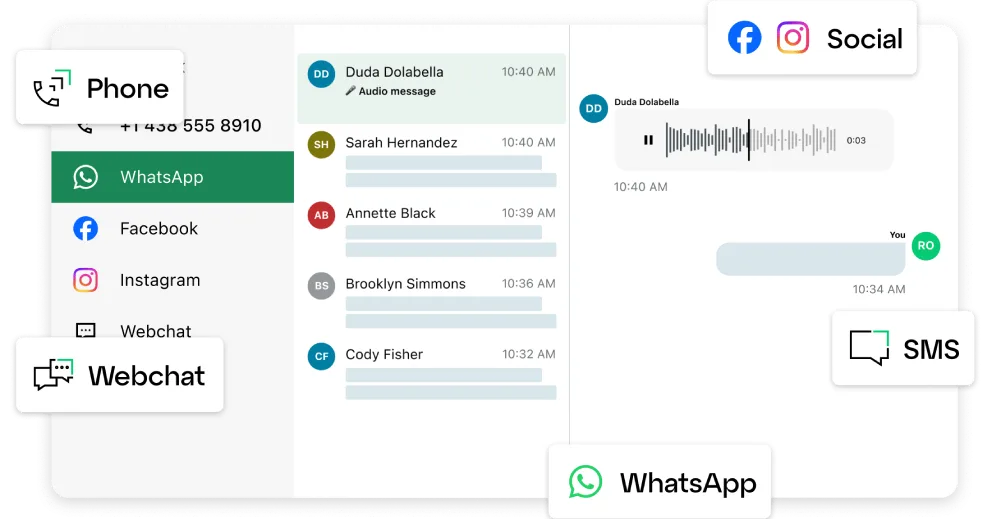
Overview: GoTo Resolve is a cloud-based IT support and RMM platform. It offers a free plan for small teams and a simple, intuitive setup. Remote support, ticketing, and automation are included. The platform is scalable for growing needs. It’s ideal for businesses wanting quick deployment.
Features:
Pricing:
G2 Rating:
⭐ 4.4/5
10. Hexnode UEM
Best for: SMBs seeking affordable, multi-OS unified endpoint management.
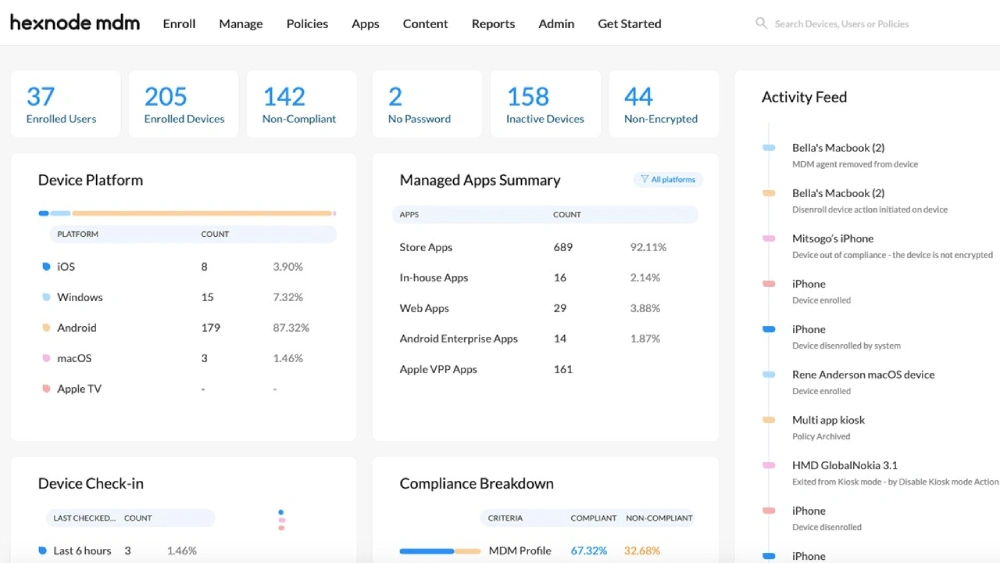
Overview: Hexnode UEM supports multiple platforms for mobile and desktop management. It offers kiosk mode, remote control, and policy enforcement. Deployment is simple and the interface is user-friendly. Compliance and reporting features are strong. The platform is scalable for growing businesses.
Features:
Pricing:
G2 Rating:
⭐ 4.6/5
Key Takeaways
NinjaOne has been a popular choice for unified
endpoint management and IT automation, offering robust device monitoring, patching, and remote support. However, as organizations shift to hybrid work, BYOD, and zero-trust security models, several limitations have become apparent.
Modern businesses now seek alternatives that deliver:
Kitecyber Device Shield is one of the top NinjaOne alternatives that empower organizations to reduce costs, improve security, and maintain agility as their IT environments evolve. You can
start a free trial of Kitecyber Device Shield now and decide for yourself.